
3D Art
Metal
What metal looks like depends largely on what it reflects. Polished copper, brushed steel, and satin aluminium are not different greys: reflected colour, micro-roughness, and curvature rewrite the environment together.
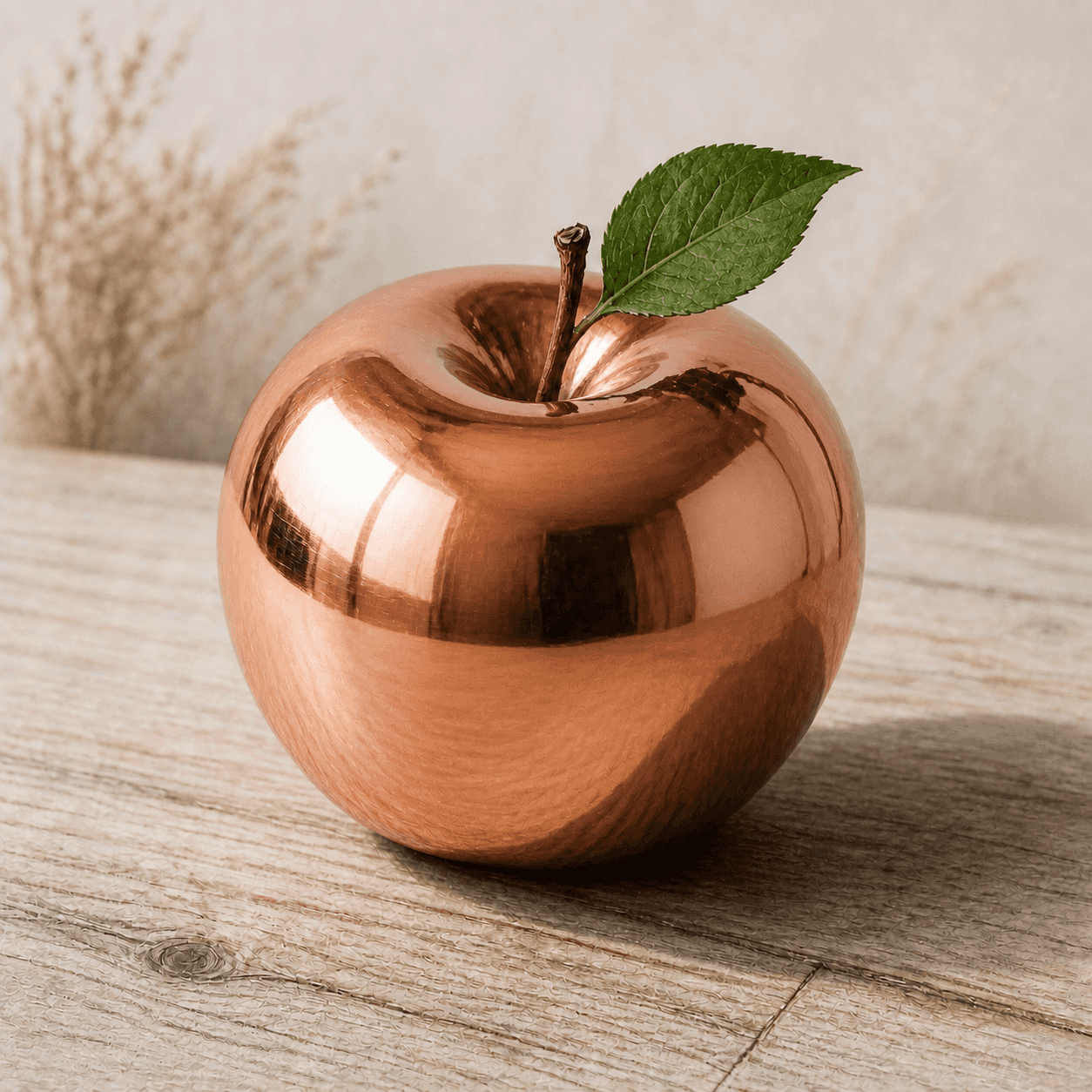
READ THE IMAGE
The apple's light and dark belong not to the fruit, but to the room bent across it
Broad bright bands reflect softboxes or sky; dark bands reflect darker surroundings. Curvature makes those reflections flow, while top and rim compress them into stronger highlights. Without an environment, metal loses its most useful visual information.
- 01
Let reflection describe a place
Bright and dark bands should correspond to imaginable lights, windows, ground, or backdrop—not arbitrary gradients.
- 02
Spread reflection with roughness
Polished metal preserves an image; satin metal broadens and breaks up the same environment.
- 03
Let curvature organise highlight
Hard edge, fillet, and dimple redirect reflection, so highlight draws the form.
- 04
Separate metal colour from coating
Copper and gold tint reflection; painted metal behaves more like a coated dielectric.
In one sentence
Shape form through environmental reflection rather than local surface colour—
and let roughness and curvature decide how sharply that reflection flows
In PBR, a metal usually has no ordinary diffuse component: it reflects incoming light specularly, often tinting that reflection. Roughness describes how dispersed micro-surface normals are: low values preserve a mirror image, high values make broad soft bands. Metallic is not a ‘brighter’ switch; without a reflectable environment, correct normals, and meaningful edges, no value will read as metal.
VISUAL LANGUAGE
Environmental-reflection DNA
Scene
Environment precedes material
Rough
Micro-surface spreads reflections
Roughness moves from sharp mirror to wide soft reflection bands.Form
Curvature moves highlight
Fillets, rounds, and dimples control highlight breaks and flow.Tint
Metal may colour reflection
Gold and copper tint reflected light; silver and chrome remain more neutral.Trace
Wear needs direction
Brushing, polish, oxidation, and fingerprints follow making or contact logic.Where it came from
From vessels and polished mirrors through industrial finishes to PBR workflow, metal keeps bringing surrounding space back onto an object's surface
Gold, copper, silver, and steel have long served structure, ornament, and mirror image. Product photography learned to use strip lights and gradient backdrops to describe them; digital rendering encodes that knowledge through metalness, roughness, normals, and environmental illumination.
Metal vessels and polished mirrors
Rarity, malleability, and reflection serve ceremony and daily objects.
Industrial finish becomes language
Aluminium, steel, chrome, and brushing communicate speed, precision, and modernity.
CG learns believable reflection
Environment maps, ray reflection, and BRDF research replace one generic highlight.
PBR creates shared parameter language
Metal/roughness workflows move assets more consistently between tools, games, and film.
ARTISTS & WORKS
Meet it through four cases
Polished silverware
Curved surface compresses room, people, and light into moving reflection.Chrome product design
Clear environmental reflection and hard edge highlight write speed and precision on a shell.Brushed aluminium casing
Directional micro-scratches turn mirror into a soft technical band.PBR game asset
Metalness, roughness, and scene lighting keep surfaces readable in real time.How to recognise it
Find environment reflection first, then test whether roughness, curvature, and colour obey one metallic reflection logic
- ✓Can bright and dark bands map to lights or environmental zones?
- ✓Does reflection clarity vary with roughness rather than adding a white highlight layer?
- ✓Do fillets and curved surfaces use highlight flow to explain shape?
- ✓Do brushing, oxidation, or scratches have manufacturing, gravity, or contact causes?
STYLE RELATIONS
Three surfaces defined by light
REFERENCES
Sources & image note
The apple is a metal-material teaching interpretation focused on environmental reflection, roughness, rim highlight, and curvature. It is not an exact sample of one alloy, coating, or oxidation process.