
3D Art
Glass
Glass is not an object with lower opacity. It refracts, reflects, and reveals thickness. Glass style makes edge, interior path, environmental reflection, and fragile physicality readable together.
READ THE IMAGE
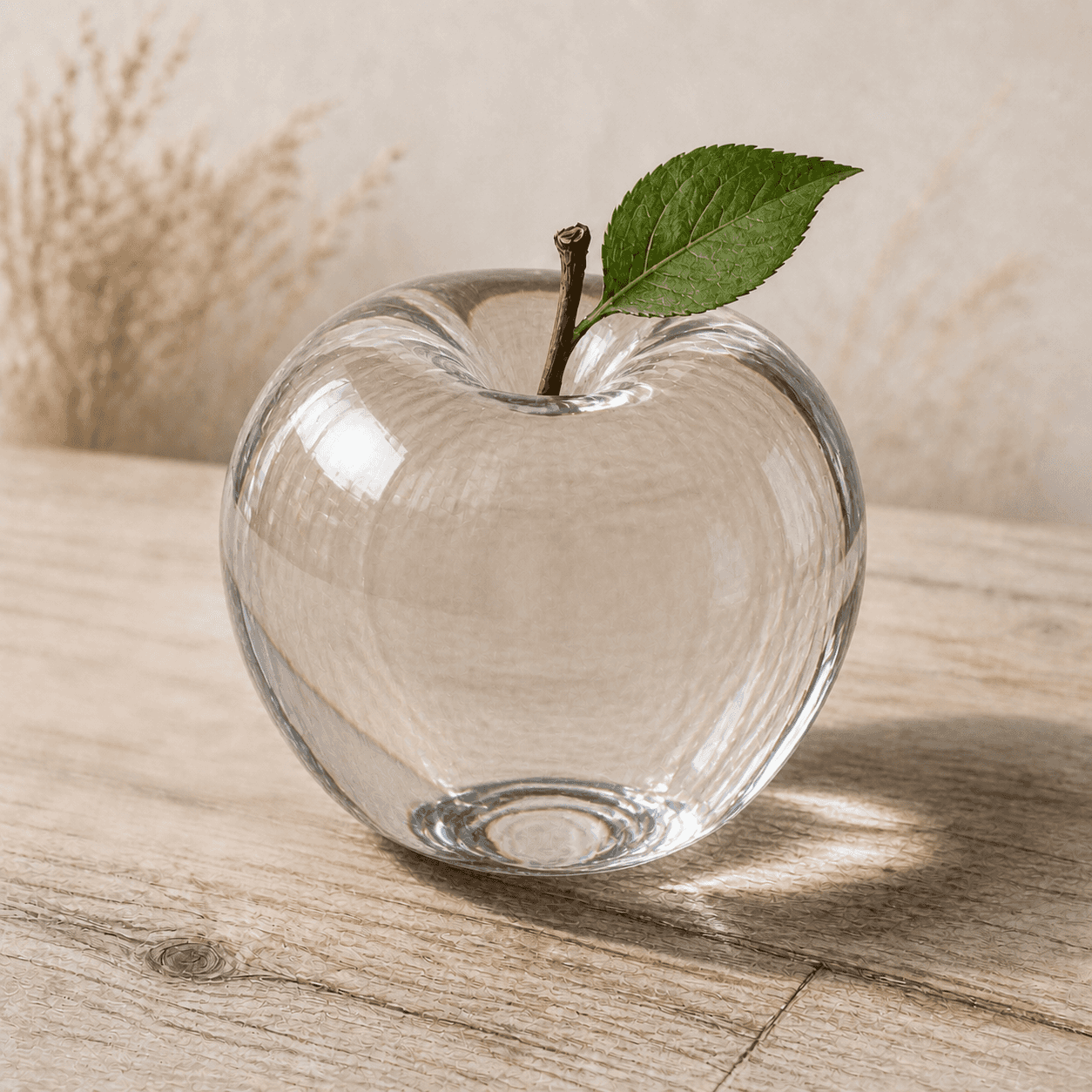
The clearest glass apple is often read at its edge and through its internal light path
The face seems transparent while grazing edges brighten with reflection; the thick belly shifts and tints the background. Highlight and reflection borrow their form from the environment, proving glass never appears alone.
- 01
Brighten grazing edges
Reflection rises at a grazing angle, so contour often defines glass more than face.
- 02
Let thickness move the background
Rays change direction on entry and exit; displacement and tint grow through thicker paths.
- 03
Borrow reflection from surroundings
Clear highlights and reflections need lights, windows, or scenery to mirror.
- 04
Use roughness to blur paths
Frosting spreads directions of both reflection and refraction; it is not merely lower opacity.
In one sentence
Use edge reflection, refractive displacement, volume thickness, and environmental reflection—
to give a transparent object a readable body
Glass combines transmission and reflection. Index of refraction controls ray turning at an interface; roughness controls whether that turning stays sharp; geometric thickness controls travel distance, background shift, and absorption colour. A single transparent plane rarely reads as solid glass because it has no clear entry and exit surface.
VISUAL LANGUAGE
Glass-optics DNA
Edge
Contour carries reflection
Thickness
Closed volume explains the path
Inner and outer surfaces give refraction entry and exit.Scene
Environment is material
Without lights, colour, or objects to reflect, glass becomes hard to see.Roughness
Frosting spreads the path
Higher roughness broadens and softens highlights, reflection, and background.Colour
Absorption accumulates with distance
Tint increases in thicker paths; surface opacity alone is insufficient.Where it came from
From architectural and vessel transparency to physical rendering and real-time approximation, glass always asks artists to design the object and the light around it
Glass serves containment, separation, and daylight while turning reflection and refraction into visible design. Digital rendering translates this into IOR, ray paths, and approximations; stylised glass still depends on thickness, edge, and environment.
Vessels and window glass develop
Transparent material combines function, colour, craft, and light.
Optics and industry advance
Material control broadens use of sheet glass, mirrors, and vessels.
CG pursues credible transparent solids
Ray tracing, refraction, and caustics become rendering and VFX challenges.
Physical and artistic controls coexist
Real-time pipelines approximate while offline rendering preserves multiple paths for the shot.
ARTISTS & WORKS
Meet it through four cases
Stained-glass window
Thickness, colour, and transmitted light turn architecture into image.Blown vessel
Wall thickness, bubble, and curved surface show transparent handwork.CG glass prop
Closed geometry, environment light, and refraction control make transparent objects visible on camera.Frosted glass UI
Simplifies optical glass into blur and translucency to maintain text hierarchy.How to recognise it
Confirm thickness and a reflectable environment, then test whether transmission, reflection, and refraction agree
- ✓Do rim and grazing angles carry more reflection and contrast than the face?
- ✓Does the background shift or tint plausibly through thickness?
- ✓Are clear light sources and environment shapes available for highlights and reflections?
- ✓Does frosting blur both reflection and view-through rather than add white fog alone?
STYLE RELATIONS
Three transmissive visual languages
REFERENCES
Sources & image note
The apple is a glass-material teaching interpretation, highlighting closed thickness, rim reflection, refractive shift, and environmental highlight. It is not a physical measurement of one glass recipe.