
Painting Media
Oil Painting
Oil painting is not one brushstroke style but a variable system of drying oil, pigment, ground, and time. It can grind colour into glazes thin as coloured glass or build highlights that retain a physical stroke; slow oxidation permits blending, removal, and layered revision.
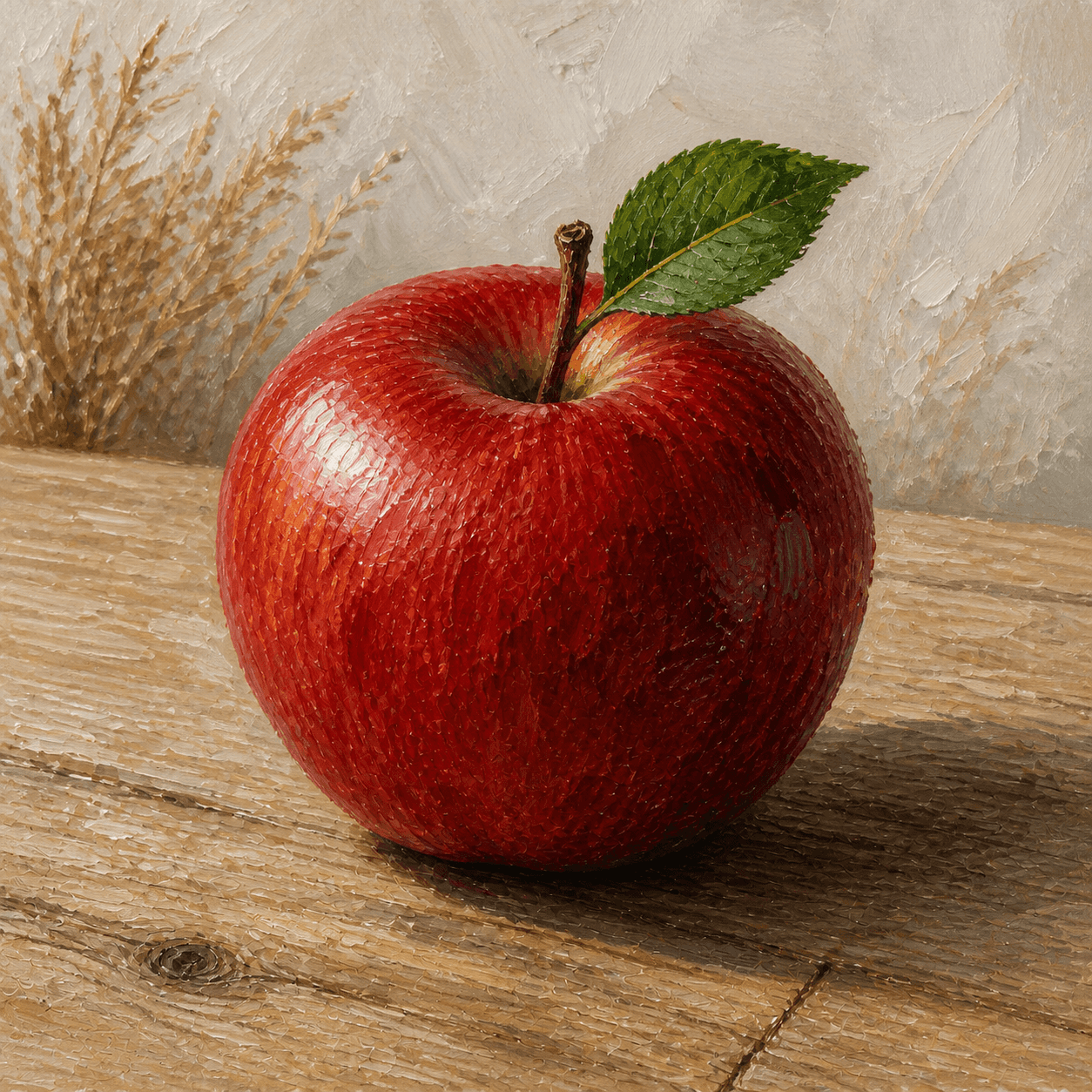
READ THE IMAGE
Within one apple, shadow gains transparent depth, turning form uses wet fusion, and highlight makes paint physically rise
Red is not one mixture. A warm brown preparation shows through translucent crimson; a cool thin film lowers the shadow, and opaque orange-white returns on top. Stroke direction separately describes fruit and tabletop.
- 01
See preparation through upper paint
Brown-red around the stem remains visible beneath translucent colour, making depth without dead black.
- 02
See wet colour turn softly
Red, orange, and cool violet push into one another before drying, creating volume rather than a digital gradient.
- 03
See the body of an opaque highlight
A final pale stroke covers the lower layer and preserves a ridge and brush tip.
- 04
See stroke follow form
Curved short marks wrap the apple while lateral drags and cast-shadow direction distinguish the table.
In one sentence
Suspend pigment in an oil that cures by oxidation—
and model light through transparency, coverage, and thickness
Oil paint disperses colour particles in a drying oil, most often linseed, with walnut and poppy oils among alternatives. The film slowly absorbs oxygen and polymerises, giving a long open time for mixing, wiping, and wet-in-wet work; complete curing continues long after touch-dry. Pigment, oil content, support, medium, and layer thickness together govern transparency, gloss, wrinkling, and ageing, so an ‘oil effect’ cannot be reduced to one filter or coarse stroke.
VISUAL LANGUAGE
Oil, layer, and time DNA
Ground
Support is isolated and unified
Thin
Glaze gives colour depth
Sparse pigment in an appropriate medium lets light cross colour and return from a pale ground.Wet
Slow drying negotiates edge
Adjacent hues can fuse, push, and wipe on the surface, though too much working destroys purity.Thick
Opaque pigment becomes terrain
Highlights and focus can rise in impasto, making brush and knife cast real micro-shadows.Time
Touch-dry, cure, and age differ
Oil-rich thickness, dark pigment, and environment alter drying; layer order must avoid a hard skin over moving paint.Where it came from
Oil was not suddenly invented in the fifteenth century; Netherlandish painters systematised an existing material before canvas, tubes, and modernism repeatedly rewrote it
Oil-based painting is recorded in northern Europe by the twelfth century. In the fifteenth, Jan van Eyck and peers developed precise underlayers, glazes, and blending that joined brilliant colour to reflective matter and convincing space; by the sixteenth century oil dominated European painting. Venetian canvas and freer handling, nineteenth-century tubes, and modern material emphasis kept expanding its speed and scale.
Oil binders are already recorded
Oil serves polychromy and decoration and mixes with tempera rather than appearing as one sudden invention.
Netherlandish technique spreads
Van Eyck, Campin, and Memling demonstrate the compound power of glaze, detail, and soft transition.
Canvas, direct stroke, and layered colour coexist
Titian, Velázquez, and Rembrandt extend scumble, wet handling, and visible impasto beyond glaze.
Manufacture and tubes change location
The collapsible tube around 1841 aids outdoor work; modern art foregrounds oil film, stroke, and ageing themselves.
ARTISTS & WORKS
Meet it through four artists
Jan van Eyck
Unifies distinct reflection in skin, textile, metal, and jewel through precise preparation and repeated transparent layers.Titian
Alternates glaze, scumble, and broad bodily marks over a compound ground so contour emerges inside colour.Rembrandt
Opposes thin darkness to lead-white relief, letting paint carry the weight of flesh, cloth, and chain.Vincent van Gogh
Makes sky, plant, and land rhythmic through directional adjacent strokes, refusing to hide fabrication.How to recognise it
Judge relations among layers and the actual surface—not canvas texture, an oily filter, or a coarse brush alone
- ✓Does shadow arise through compound colour and transparency rather than simple black?
- ✓Do soft edges follow wet fusion and hard edges later coverage or scraping?
- ✓Do highlight thickness, sheen, and stroke agree with focus and form?
- ✓Are crack, yellowing, wrinkle, and metal-soap protrusion understood as material history rather than texture stickers?
STYLE RELATIONS
Three film-and-layer logics
Oil Painting
Drying oil oxidises and cross-links, with long open time from transparent glaze to bodily impasto.CURRENTAcrylic
Water evaporates and polymer particles form a film; it dries quickly and is usually water-resistant afterward.↗Tempera
Egg emulsion rapidly makes a lean, fine film, often built with short strokes and thin layers.↗REFERENCES
Sources & image note
The apple is a contemporary oil-painting teaching interpretation combining a compound preparation, transparent red glaze, wet turning, and opaque highlight. A screen cannot show true optical layer depth, surface relief, varied gloss, or changes through time.