
Painting Media
Acrylic
Acrylic disperses pigment in a synthetic polymer system: a water-borne emulsion can be diluted while wet, then its particles fuse as water leaves into a film that is usually water-resistant. Rapid film formation accelerates masking, coverage, and serial layers while making edges, joins, and timing highly visible.
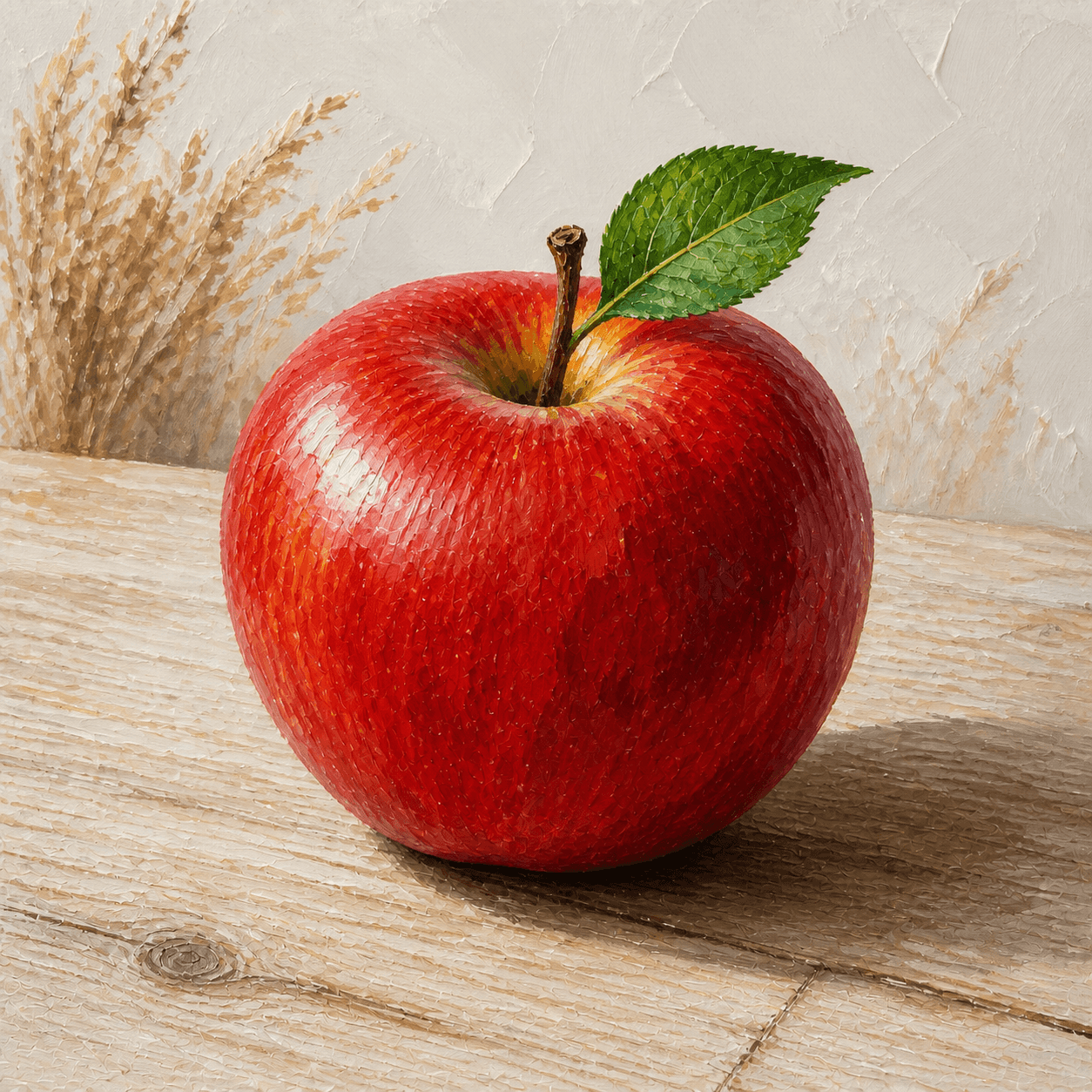
READ THE IMAGE
Watch the apple rise from quick-dry fields, then be rewritten by clear film, hard edge, and scraped body
Background brushing leaves clear joins; opaque red first establishes the silhouette, then transparent violet shadow and orange drybrush cross it. Highlight can rapidly cover once the lower film dries, without waiting days.
- 01
See dry edge and join
Fields stop with a defined boundary rather than remaining open for prolonged oil-like blending.
- 02
See vivid covering layers
Orange-red repaints a dry violet-red without normally re-dissolving the ground in water.
- 03
See clear and opaque coexist
A thin polymer film lowers shadow while heavy-body paint or gel holds a ridge in light.
- 04
See tools exceed the brush
Squeegee, sponge, masking tape, or a homemade comb can pull planes, grooves, and repeated rhythm.
In one sentence
Let water carry polymer particles and pigment—
then evaporate into a fast, water-resistant film that can be built upon
Artists' acrylic has histories in both solvent-borne resin and water-borne emulsion; the latter is now most familiar. In its wet state polymer particles are dispersed in water. As water evaporates, they approach, deform, and coalesce into a continuous film fixing pigment. Medium can change transparency, gloss, viscosity, and open time, whereas arbitrary excess water may weaken binding and adhesion. ‘Fast-drying’ also does not mean every physical change ends immediately.
VISUAL LANGUAGE
Polymer-film DNA
Film
Coalescence locks colour
Fast
Edges record time
A thin layer quickly loses openness; stay-wet palette, retarder, and small-area work extend fusion.Body
Medium changes structure, not just dilution
Fluid, gel, heavy body, and paste alter viscosity, transparency, and relief while maintaining binder.Grip
Many prepared surfaces are possible
Canvas, panel, paper, and some non-absorbent supports work, but gloss, grease, and flex mismatch can cause loss.Soft
Modern films are thermoplastic
Heat may increase tack and dirt pickup; abrasion and unsuitable cleaning can alter sensitive matte surfaces.Where it came from
Acrylic emerged from twentieth-century polymer industry and became a painting language between Mexican muralism, American commercial material, and postwar experiment
Synthetic acrylic resin entered coatings in the first half of the twentieth century. Solvent-borne artists' colours existed by the 1940s; water-borne emulsions followed and became widely commercial through the 1950s and 1960s. Speed, adhesion, and adjustable body linked mural, hard-edge abstraction, Pop, colour field, installation, and current mixed media.
Synthetic resin enters art and mural
Industrial chemistry offers weather-resistant binders; makers in Mexico and the United States test solvent acrylic.
Water-borne emulsion is commercialised
Solvent systems such as Magna coexist with water-borne brands such as Liquitex, offering rapid strong colour.
Flat fields, stain, and tools expand
Hard edge, Pop, and Jack Whitten turn masking, squeegee, pour, and one-pass pulling into method.
Gel, dry film, and cross-media construction
Products range from spray ink to heavy paste; acrylic can evoke tradition or cast, cut, and collage itself.
ARTISTS & WORKS
Meet it through four artists
David Alfaro Siqueiros
Brings industrial spray tools, synthetic resin, and collective experiment into mural workshops for a modern social material.Helen Frankenthaler
Soaks thin synthetic colour into unprimed canvas so a field stains the support instead of merely describing its surface.David Hockney
Uses quick flat paint, controlled hard edges, and patterned water to construct the artificial brightness of California space.Jack Whitten
Pulls a twelve-foot Developer across layered acrylic in one action, then cuts dry films into tesserae to build painting like a wall.How to recognise it
Do not label every bright smooth field acrylic; seek evidence of film, fast-dry joins, water-resistant layers, and medium body
- ✓Does an upper pass sit on a dry film without reactivating the ground as gouache would?
- ✓Do brush joins, masked hard edges, or pour rims follow rapid water loss?
- ✓Can clear film, heavy gel, and matte field still share a coherent polymer structure?
- ✓Do dirt pickup, dent, or cleaning change reveal conservation issues of a soft thermoplastic film?
STYLE RELATIONS
Three covering paint systems
Acrylic
A water-borne dispersion rapidly forms a polymer film, usually water-resistant when dry, with many bodies.CURRENTOil Painting
Drying oil slowly oxidises and cross-links, providing long open time, optical depth, and varied gloss.↗Gouache
A soluble binder makes an opaque matte layer that water can reactivate after drying.↗REFERENCES
Sources & image note
The apple is a contemporary acrylic teaching interpretation emphasising fast hard edges, covering layers, transparent film, and heavy-body scrape. A screen cannot reproduce temperature-sensitive polymer surface, subtle sheen, or true film thickness.