
Modern Art
Op Art
The surface is still, yet vision feels bulging, turning, and vibration: the work occurs between pattern and perception.
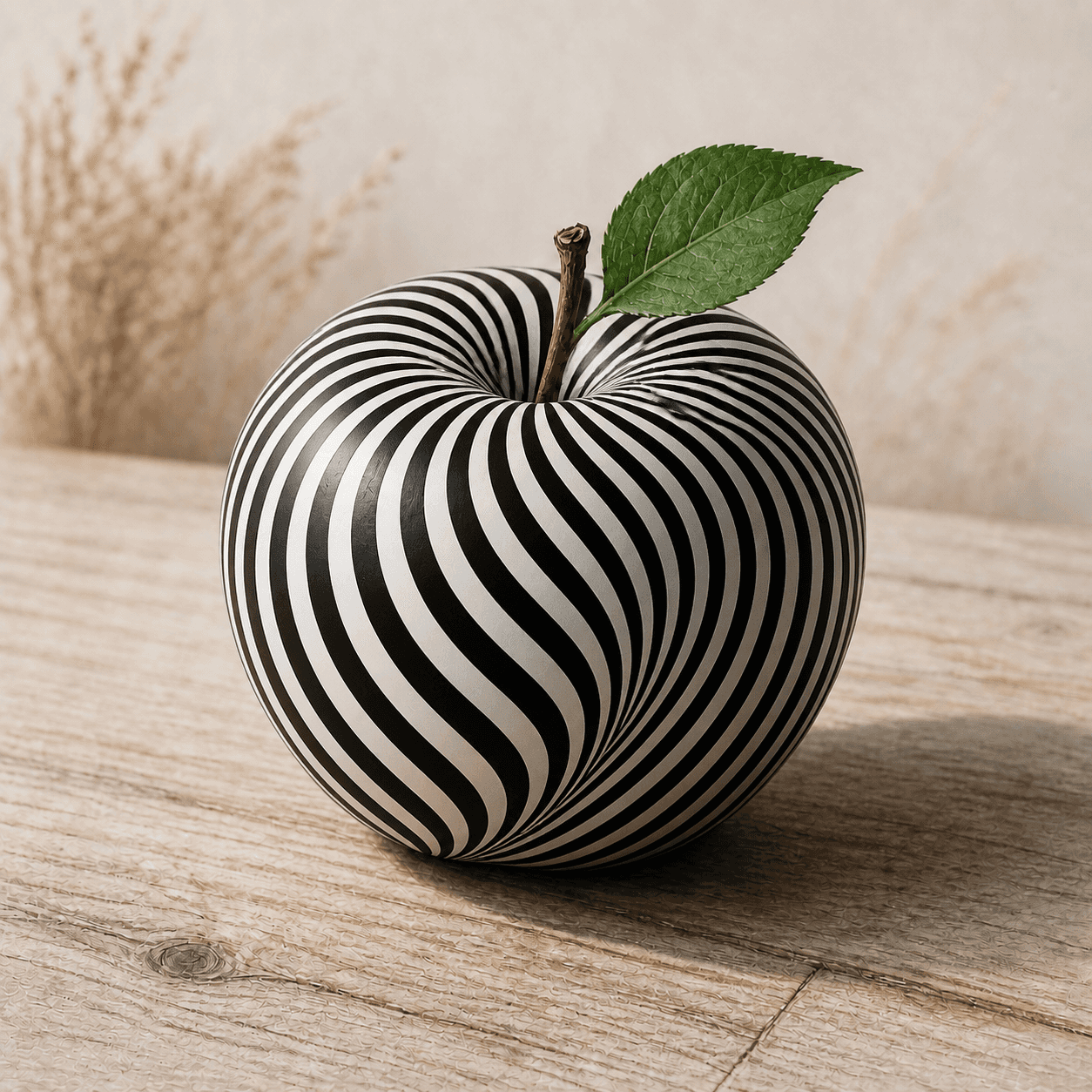
READ THE IMAGE
The apple does not move—so why do the stripes flow?
Black and white bands narrow, widen, and turn around a curved surface. The illusion comes from exact changes among repeated units and the eye's effort to stabilise high-contrast edges.
- 01
Compare band width
Intervals change from edge to centre, which vision interprets as bulging and recession.
- 02
Follow convergence
Curves gather near the stem, giving a still surface a sense of rotation and suction.
- 03
Feel high-contrast edges
Alternating black and white boundaries flicker, blur, and leave brief afterimages in vision.
- 04
Move eye or body
Vibration changes with fixation and distance; the viewer's visual activity is part of the work.
In one sentence
Not depicting movement—
but making vision itself produce movement
Op art is an abstract tendency named and popularised in the 1960s. Black-and-white or saturated lines, grids, and geometric units investigate perception. Exact control of interval, scale, direction, and colour contrast makes flat surfaces seem to vibrate, deepen, wave, or generate afterimages. It neighbours Kinetic art, but an Op work can remain entirely still.
VISUAL LANGUAGE
Visual DNA
Unit
Geometric, repeated
Variation
Gradual, exact
Width, angle, density, and colour change by controlled steps.Contrast
High
Black-white edges or complementary hues keep visual response active.Effect
Vibration, depth, afterimage
Static matter produces perceptual motion and unstable space.Viewer
Active, embodied
Distance, fixation, and movement change what appears.Where it came from
From colour theory and geometric abstraction to a responsive eye
Op drew on Bauhaus colour teaching, Constructivism, Concrete art, and Gestalt psychology while intertwining with Latin American and Paris-based Kinetic networks. Fashion rapidly appropriated its patterns, causing perceptual experiments to be mistaken for a decorative craze.
Vasarely makes Zebra
Curving black-white stripes form intertwined volumes without contour.
Le Mouvement
Galerie Denise René in Paris brings together Vasarely, Soto, and others around optical and actual motion.
‘Op Art’ enters mass media
Time magazine uses the short label, quickly linking the new visual category to fashion and design.
The Responsive Eye
MoMA's group exhibition makes Riley, Stanczak, and perceptual experiments famous while provoking debate about dazzle and commerce.
ARTISTS & WORKS
Meet it through four artists
Victor Vasarely
Built a scalable language from modules, gradients, and geometric deformation and became a key precursor.Bridget Riley
Released unstable energy from precise black-white curves and later sequences of coloured stripes.Jesús Rafael Soto
Layered line, wire, and transparent planes so real space vibrated as the viewer moved.Julian Stanczak
Used rigorous colour sequences and boundary contrast to make light appear to emanate from the surface.How to recognise it
Ask whether pattern systematically triggers perception
- ✓Is the image built from exact repetitions of stripes, grids, dots, or geometric units?
- ✓Do interval, scale, angle, or colour change progressively rather than decoratively?
- ✓Does a still surface produce vibration, swelling, depth, or afterimage?
- ✓Do viewing distance and eye movement clearly alter the effect?
STYLE RELATIONS
Different jobs for geometry
REFERENCES
Sources & image note
The apple is a contemporary perception exercise using changes of stripe width and direction for volume and rotation. Historical Op is usually nonrepresentational or spatially constructed.