
Modern Art
Pop Art
Bringing ads, comics, products, and celebrities into art—embracing mass images while exposing how reproduction manufactures desire.
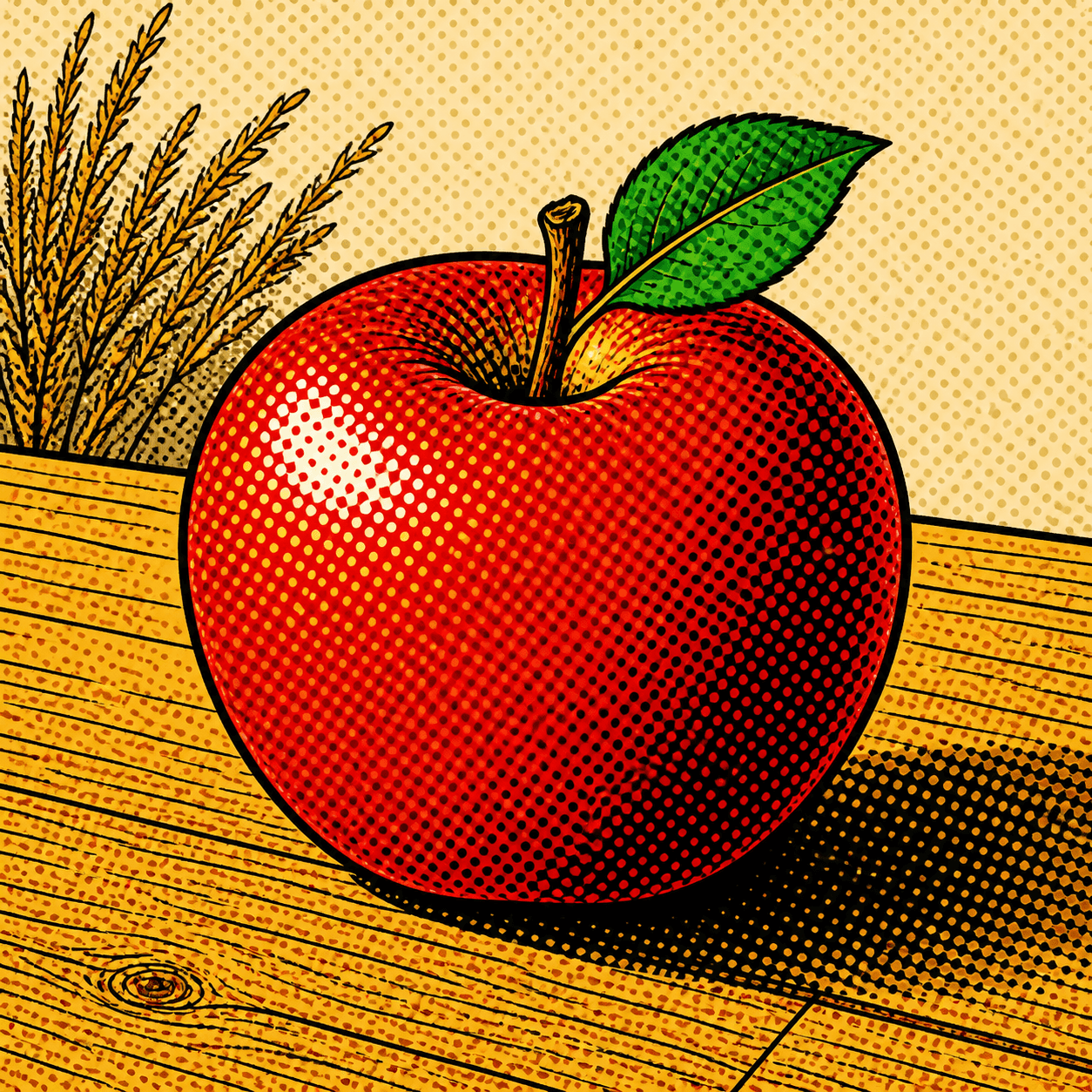
READ THE IMAGE
This is not simply a comic illustration—it enlarges print as a subject
Black outlines, limited primaries, and regular dots imitate commercial reproduction. Pop asks not only what an apple is, but how it becomes instantly legible, repeatable, and consumable as an image.
- 01
Read mechanical dots
Value is built through changing size and density of dot screens rather than smooth natural modelling.
- 02
Follow the heavy contour
An inky edge compresses complex volume into the speed of a printed sign.
- 03
Notice the limited saturated palette
Red, yellow, green, and black resemble advertising and packaging colours chosen for impact and reproducibility.
- 04
See the everyday enlarged
A common apple dominates like a product close-up; its ordinariness challenges what deserves artistic attention.
In one sentence
Not making art look fashionable—
but using popular culture to question art and society
Pop art emerged first in 1950s Britain through debate about American mass culture, then took distinct forms in the United States and beyond. Artists appropriated advertising, comics, press photographs, packaging, and celebrity while using screenprinting, repetition, and commercial fabrication. The boundary between high art and mass culture collapsed. Works could admire and criticise consumer society at once, often keeping their attitude deliberately ambiguous.
VISUAL LANGUAGE
Visual DNA
Source
Found mass imagery
Reproduction
Repeated, serial
One image recurs like shelf stock or a circulating press photograph.Surface
Flat, print-like
Dots, screenprint slippage, and hard contour suppress traditional painterly touch.Scale
Enlarged, cropped
Packaging, comic panels, and food become monumental.Attitude
Cool, witty, ambiguous
Celebration and criticism coexist without a simple verdict.Where it came from
When television, supermarkets, and magazines rewrote everyday vision
Postwar consumption, mass communication, and branding created an unprecedented image environment. British Pop often analysed the ‘American dream’ through collage and discussion; American artists worked directly with domestic commercial imagery in a cool response to Abstract Expressionist heroics.
The Independent Group meets
Artists, designers, and critics in London debate advertising, science fiction, technology, and American mass culture.
This Is Tomorrow
Richard Hamilton and others bring popular imagery, design, and environments into a cross-disciplinary exhibition.
American Pop converges
Lichtenstein uses comics, Warhol shows soup cans, and Oldenburg and Wesselmann turn to consumer life.
International impact is secured
Rauschenberg wins the Venice Biennale prize as media globalise American new art; local Pops develop distinct politics worldwide.
ARTISTS & WORKS
Meet it through four artists
Richard Hamilton
Used magazine collage to analyse how interiors, bodies, advertising, and technology manufacture postwar desire.Andy Warhol
Screenprinted soup, celebrity, and disaster so consumption, fame, and death shared a mechanical surface.Roy Lichtenstein
Hand-enlarged comic separations and Ben-Day dots to probe reproduction, drama, and authorship.Marisol
Combined carved wood, casts, paint, and found objects in sharp, funny groups of families and celebrities.How to recognise it
First trace where the image came from
- ✓Does it appropriate advertising, comics, packaging, news, or celebrity photography?
- ✓Do copying, repetition, dots, or screenprint function as content rather than decoration?
- ✓Is an everyday commodity enlarged, isolated, or moved into an art context?
- ✓Does consumer culture appear seductive and suspect at once?
STYLE RELATIONS
Different uses of mass imagery
REFERENCES
Sources & image note
The apple is a contemporary recognition exercise using Ben-Day-like dots, heavy contour, and a product close-up. Pop's British, American, and other international contexts differ politically and visually.