
Modern Art
Dada
When war made ‘rational order’ absurd, artists used chance, collage, readymades, and jokes to ask what art could be.
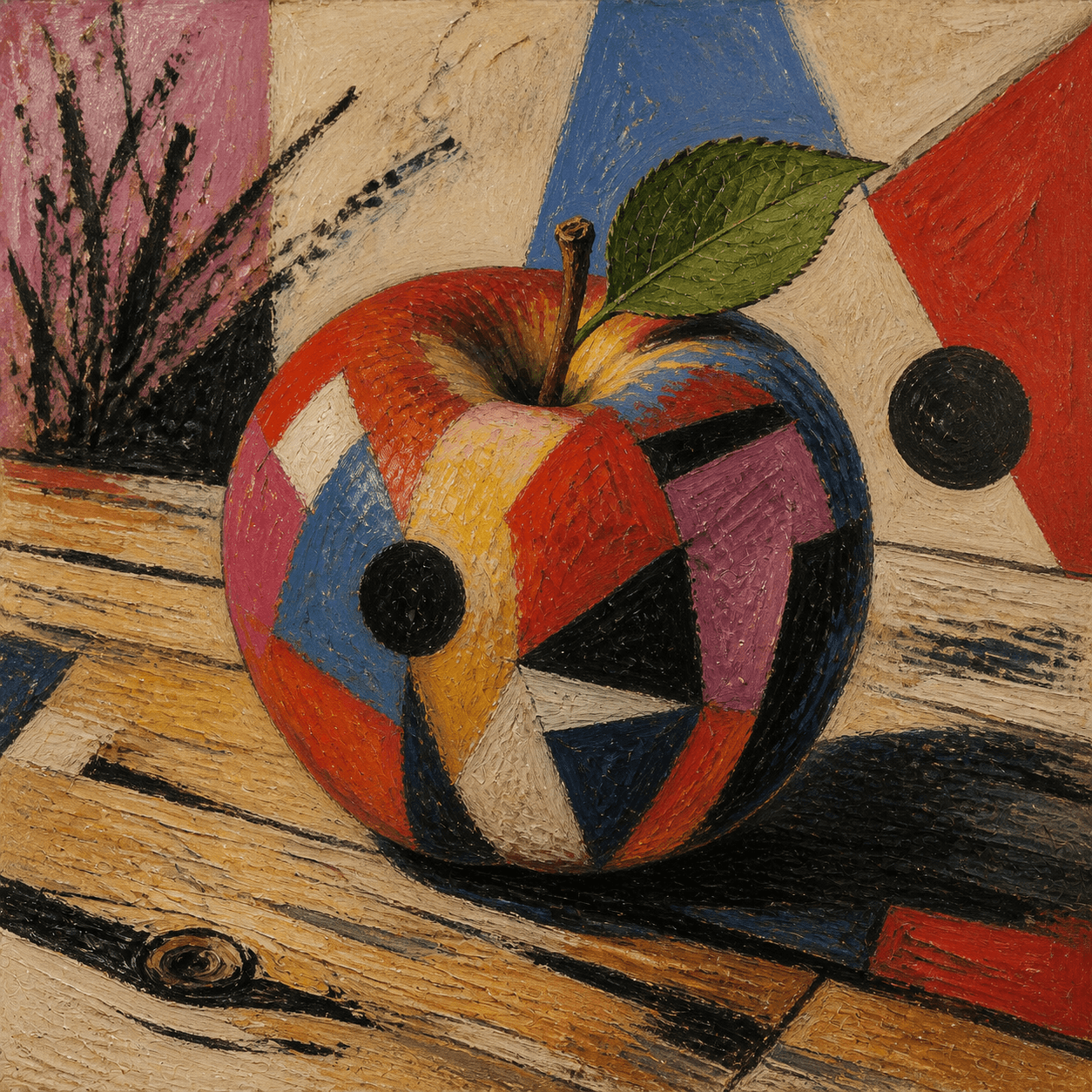
READ THE IMAGE
It looks disorderly because it disrupts how looking should work
This teaching image covers an apple with incompatible fragments and lets background shapes invade it. Dada matters less as a look than as a refusal of coherence, skill worship, and inherited rules.
- 01
Find incompatibility
Red, blue, pink, black, and cream collide without serving natural colour or harmony.
- 02
Read the collage logic
Shapes resemble clippings from unrelated printed matter, joined with deliberately abrupt edges.
- 03
Notice chance
Circles and triangles seem indifferent to realistic structure, suggesting games and improvisation.
- 04
See displacement
The apple remains legible but is occupied by a sign system alien to still-life painting.
In one sentence
Dada is not a painting style—
but a strategy for undoing art's rules
Dada formed in Zurich and New York during World War I and spread through an international network. Artists opposed nationalism, authority, and conformity while distrusting the reason and civilisation that had enabled mass violence. Collage, photomontage, readymades, performance, wordplay, and chance challenged assumptions that art must be beautiful, original, handmade, skilled, and serious.
VISUAL LANGUAGE
Visual DNA
Materials
Everyday, printed, discarded
Method
Collage, appropriation
Cutting and recombination turn mass media against itself.Control
Chance, improvisation
Random procedures weaken the artist's total command.Attitude
Ironic, provocative
Absurdity and humour attack cultural authority.Boundary
Idea before beauty
Art can be a choice, title, act, or question.Where it came from
A refusal beginning at Cabaret Voltaire
In 1916, exiles and antiwar artists staged sound poems, masks, and chaotic performances at Zurich's Cabaret Voltaire. Each city developed a distinct Dada: Berlin was overtly political, New York foregrounded readymades and ideas, and Hanover produced Schwitters's Merz collage.
Cabaret Voltaire opens
Hugo Ball, Emmy Hennings, Tristan Tzara, Hans Arp, and others organise performance and exhibition in Zurich.
The Fountain affair
Duchamp submits a urinal signed R. Mutt, testing whether an open exhibition truly has no jury.
Berlin Dada turns political
Höch, Hausmann, Heartfield, Grosz, and others weaponise photomontage against media and militarism.
The network transforms
Dada strategies move into Surrealism and later shape Conceptual art, performance, and institutional critique.
ARTISTS & WORKS
Meet it through four practitioners
Hannah Höch
Used photomontage to dissect gender, bodies, media, and political power.Marcel Duchamp
Shifted creation from fabrication toward selection, naming, and institutional judgement through readymades.Hans Arp
Dropped torn squares according to chance, seeking an order beyond total rational control.Kurt Schwitters
Built Merz collage from tickets, packaging, and urban refuse.How to recognise it
Look for a strategy, not one appearance
- ✓Does the work appropriate newspapers, photographs, industrial objects, or daily debris?
- ✓Do chance, play, or improvisation help determine it?
- ✓Does irony challenge beauty, originality, and artistic skill?
- ✓Is the question it poses more important than a stable formal style?
STYLE RELATIONS
Different directions of revolt
REFERENCES
Sources & image note
The apple is only a collage-based teaching cue. Dada has no single visual style; readymades, performances, and language cannot be represented by one painting.