
Modern Art
Futurism
Giving a still image speed: compressing duration, mechanical rhythm, and urban energy into one form.
READ THE IMAGE
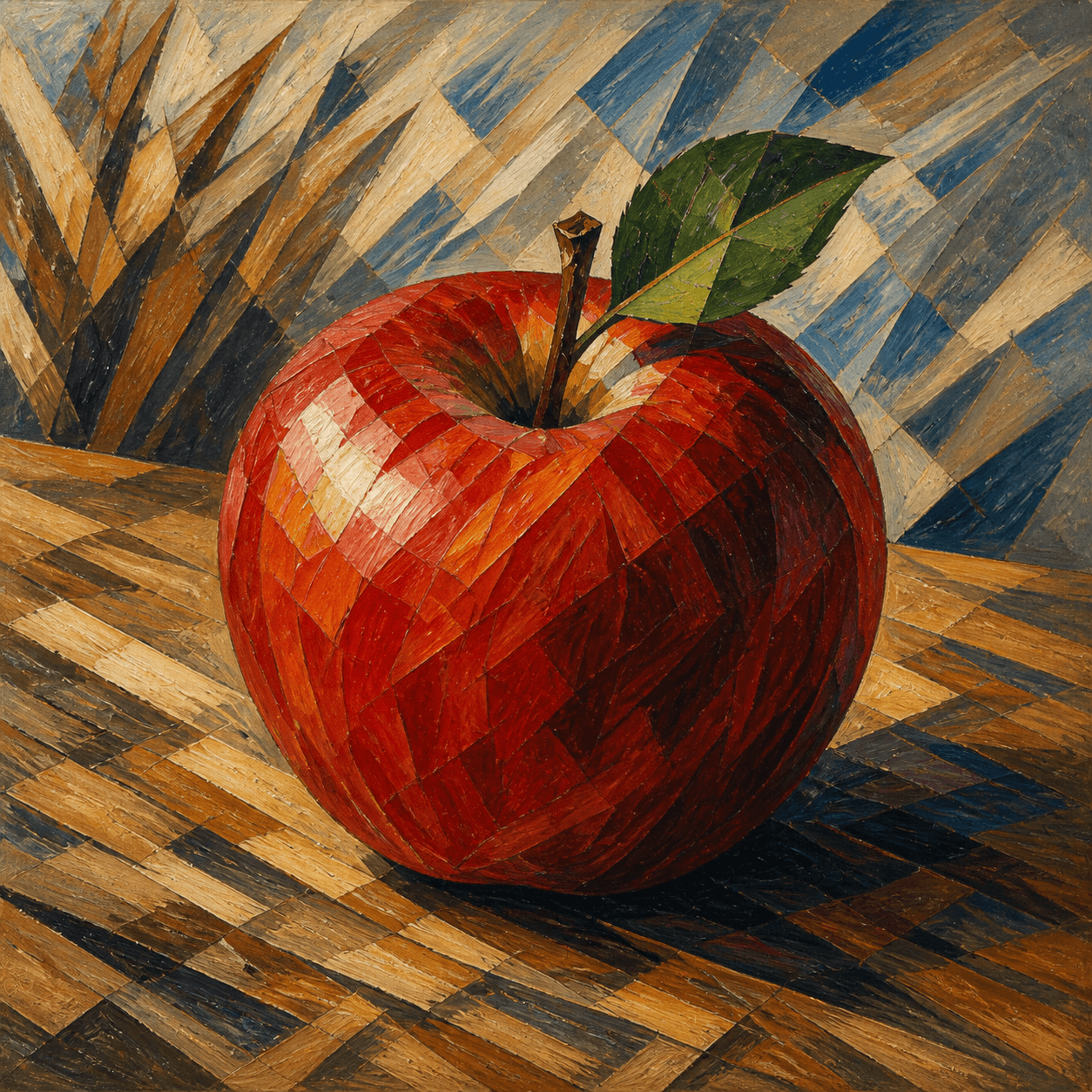
The apple is still—so why does the image accelerate?
This teaching image fractures apple, table, and background into diagonal passages, using motion lines, repetition, and interpenetration to suggest speed.
- 01
Follow the diagonals
A strong lower-left to upper-right direction replaces stable horizontals and verticals.
- 02
Read successive slices
Adjacent passages resemble a series of positions occupied across time.
- 03
See object and setting interpenetrate
Leaf, fruit, and background share triangles and radiating lines, weakening a sealed boundary.
- 04
Feel the rhythm
Repeating light and dark planes echo machinery, light trails, and chronophotographic motion studies.
In one sentence
Not making objects look futuristic—
but putting time into the image
Futurism was catalysed by Italian poet Filippo Tommaso Marinetti's 1909 manifesto. Artists celebrated speed, machines, cities, and technology through fragmented forms, repeated contours, and force lines. Its formal innovations were influential, but its early advocacy of violence, war, nationalism, and misogyny remains inseparable from its history.
VISUAL LANGUAGE
Visual DNA
Direction
Diagonal, radial
Time
Successive, superimposed
Several stages of an action coexist in one image.Form
Fragmented, interpenetrating
Subject and setting share shards as boundaries dissolve in motion.Rhythm
Repeated, accelerating
Contours, planes, and paths recur like a mechanical or urban pulse.Subjects
Machine-age modernity
Cars, trains, aircraft, crowds, and cities become heroic motifs.Where it came from
A manifesto declares speed a new beauty
Futurism began in literature before painters and sculptors translated its program into visual experiment. They learned from Cubist fragmentation and from sequential photography and studies of movement.
The founding manifesto appears
Marinetti publishes in Le Figaro, using provocation to demand a rupture with the past.
Painters issue their manifestos
Boccioni, Carrà, Balla, Severini, and others publish painting and technical manifestos.
A language of dynamism matures
Paris exhibitions, Boccioni's sculpture, and Balla's motion sequences extend dynamism across media.
War creates a rupture
Support for war and the deaths of artists change the movement; a politically complicated Second Futurism follows.
ARTISTS & WORKS
Meet it through four artists
Umberto Boccioni
Fused moving bodies with surrounding space and gave Futurist sculpture its defining image.Giacomo Balla
Studied speed through repeated contours, paths, and light—from running dogs to cars and swifts.Gino Severini
Turned dance, trains, and warfare into fragmented, rhythmic images of modern life.Carlo Carrà
Used rotating composition and colliding force lines for crowds and politics before turning to Metaphysical painting.How to recognise it
Remember: speed, succession, interpenetration
- ✓Do diagonals, radiating lines, or force lines propel the composition?
- ✓Does repetition or segmentation show several moments of one object?
- ✓Do subject and environment share fragments and pass through one another?
- ✓Does the work centre machines, cities, crowds, or modern speed—not geometry alone?
STYLE RELATIONS
Different reasons to fragment form
Cubism
Combines multiple viewpoints to rethink object and space; speed is not its primary aim.↗Futurism
Uses fragmentation, repetition, and force lines for continuous motion and modern energy.CURRENTConstructivism
Redirects geometry, material, and communication toward social production after the Russian Revolution.↗REFERENCES
Sources & image note
The apple is a contemporary teaching interpretation highlighting diagonal force and succession. The page keeps Futurism's formal contribution in tension with its advocacy of violence, war, and nationalism.