
Modern Art
Cubism
Freeing an object from a single viewpoint: breaking it into planes, turning it in the mind, and compressing several observations onto one surface.
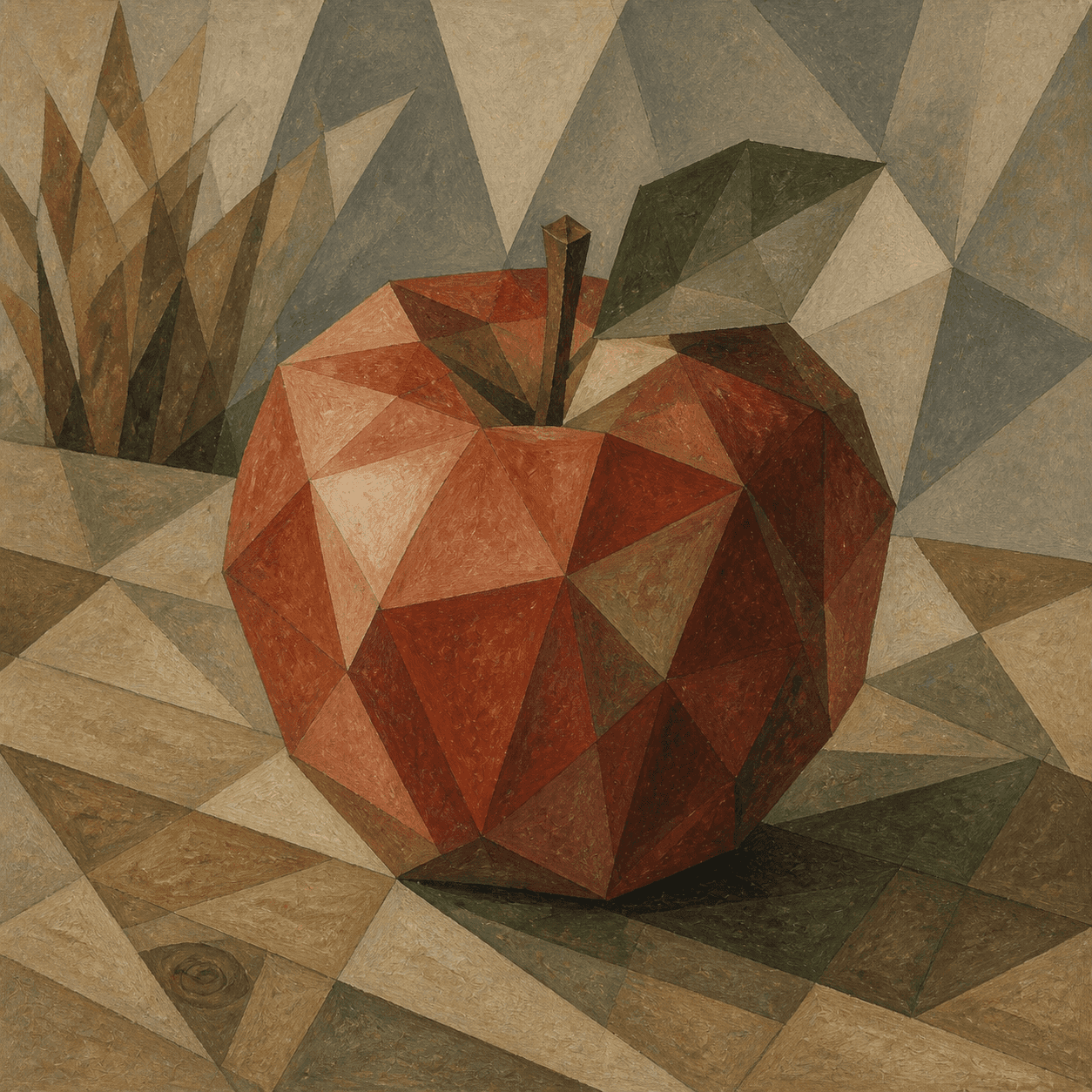
READ THE IMAGE
Why does this apple look dismantled and rebuilt?
This is a contemporary teaching interpretation of Cubist visual language, not a historic work. It helps us examine faceting, shifting viewpoints, and compressed space.
- 01
Look at the facets
The apple's volume is built from interlocking triangles and polygons rather than one continuous rounded contour.
- 02
Look at the viewpoints
Stem, leaf, and body seem to come from slightly different angles; the image refuses one fixed camera position.
- 03
Look at the space
Subject, tabletop, and background share the same geometric language, flattening depth and making object and setting interpenetrate.
- 04
Look at the colour
Ochres, grey-greens, and earth reds distinguish planes. Colour serves structure rather than imitating natural light.
In one sentence
Not turning things into cubes—
but dismantling one-point vision
Cubism challenged the single, stable viewpoint that had long organised Western painting. Picasso, Braque, and others broke subjects into planes and geometric components, often placing several angles in one composition. The result was not a photographic copy of appearance but a structure that joined seeing, memory, and reasoning.
VISUAL LANGUAGE
Visual DNA
Form
Faceted, fragmented
Viewpoint
Multiple, simultaneous
A single object may suggest front, side, above, or internal structure at the same time.Space
Compressed, interlocking
Foreground and background lose hierarchy, so objects and surrounding space behave as one construction.Colour
Restrained, structural
Analytic Cubism often used browns, greys, and ochres to focus attention on formal relationships.Material
Collaged, everyday
Synthetic Cubism introduced newspapers, wallpaper, and other materials, complicating the boundary between image and thing.Where it came from
Two painters turned the picture into a shared laboratory
From roughly 1907 to 1914, Pablo Picasso and Georges Braque worked in close dialogue in Paris. They drew on Cézanne's experiments with form and shifting viewpoints and on African and Oceanic sculpture—an influence that must also be understood within colonial collecting and cultural appropriation.
Experiments accelerate
Picasso paints Les Demoiselles d'Avignon. It is often treated as a turning point toward Cubism, which emerged through the artists' subsequent collaboration.
“Cubes” suggest a name
Critic Louis Vauxcelles describes Braque's L'Estaque landscapes in terms of cubes; the initially mocking language develops into the movement's name.
Analytic Cubism
Objects dissolve into dense facets, space becomes shallow, and restrained brown-grey palettes keep attention on structure.
Synthetic Cubism
Collage and papier collé enter the work; shapes simplify, colours brighten, and newspapers or wallpaper become part of the image.
ARTISTS & WORKS
Meet it through four artists
Pablo Picasso
Worked with Braque to develop Cubism while moving between painting, collage, and sculpture.Georges Braque
Used still life and musical instruments to test plane, material, and space, and pioneered papier collé.Juan Gris
Developed Synthetic Cubism through clearer geometry and carefully balanced colour-structure relationships.Albert Gleizes
Helped bring Cubism to a broader public through Salon exhibitions and theoretical writing.How to recognise it
Remember: facets, viewpoints, compressed space
- ✓Is the subject broken into interlocking geometric planes?
- ✓Does one form appear to be seen from several directions at once?
- ✓Do subject and background share a structure that compresses depth?
- ✓Does the work use lettering, newspaper texture, or actual materials to test the boundary between image and reality?
STYLE RELATIONS
Keep the neighbouring languages distinct
Post-Impressionism
Cézanne's simplified forms and shifting viewpoints helped open a path toward Cubism, while objects and space remained more continuous.↗Cubism
Reconstructs objects through facets, multiple viewpoints, compressed space, and eventually collage.CURRENTFuturism
Adapts Cubist fragmentation but places greater emphasis on speed, repeated motion, and machine-age energy.↗REFERENCES
Sources & image note
The apple is a contemporary teaching interpretation, not a historic artwork, and cannot represent the differences among all Cubist artists.