
Modern Art
Surrealism
Making familiar things obey dreams rather than ordinary causality—opening realism to the unconscious, desire, and impossible encounters.
READ THE IMAGE
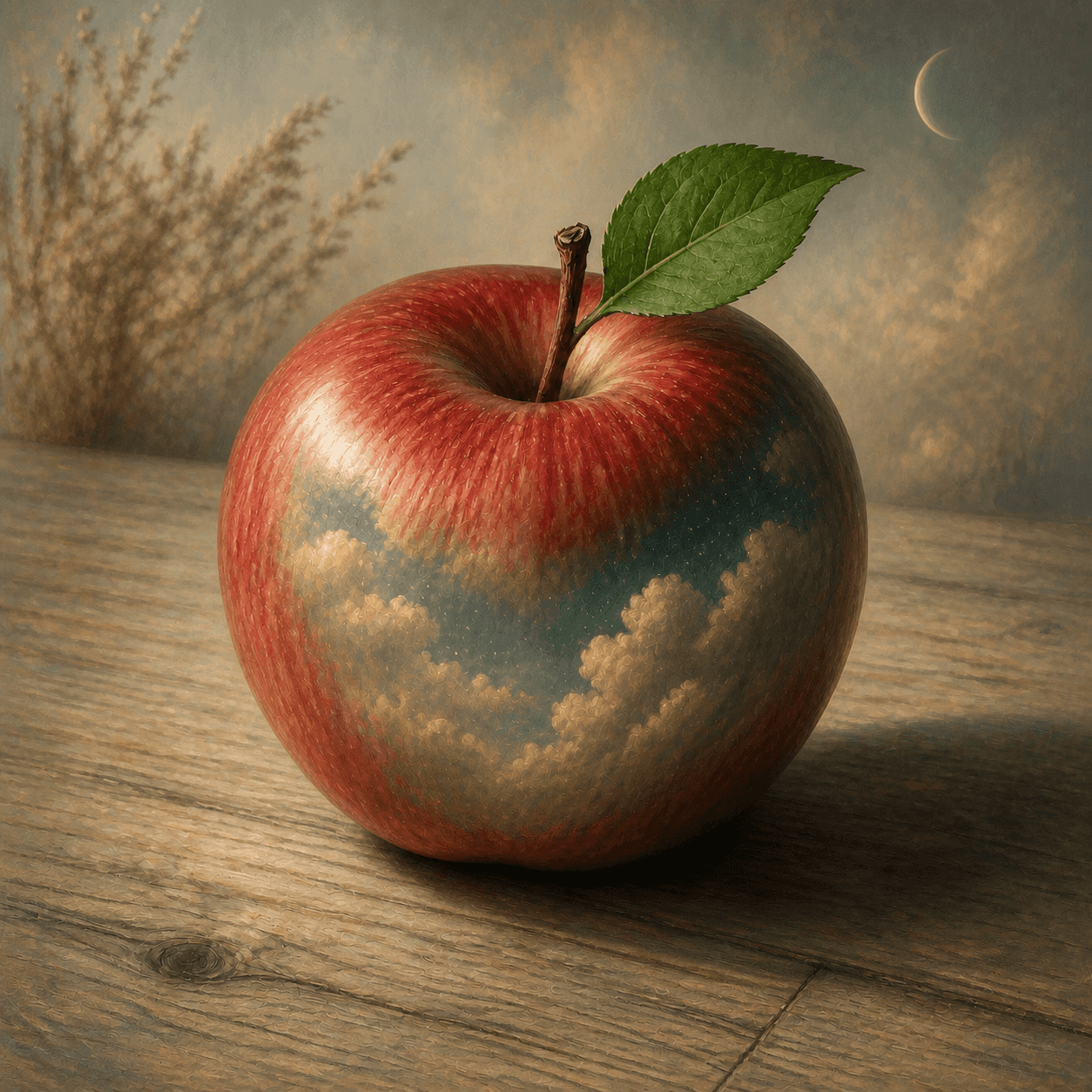
The apple is convincing—so why is the scene unsettling?
This teaching image keeps believable light and texture while embedding sky, clouds, and a crescent moon. Surrealism often gives impossible relations the surface authority of everyday reality.
- 01
Find the opening
The apple's lower skin becomes a window onto clouds; fruit and sky join without a rational seam.
- 02
Notice displaced scale
A distant moon occupies the same enclosed field as a tabletop object, compressing cosmic scale into near vision.
- 03
Read familiar as strange
Stem, leaf, wood, and light remain credible; that stability makes the impossible feel dream-certain.
- 04
Stay with the suspense
Dim light, empty background, and an unexplained conjunction suspend causality and hold the scene before an event.
In one sentence
Not making the world merely bizarre—
but loosening reason's control of reality
Surrealism was formally named by poet André Breton in his 1924 Manifesto. Shaped by psychoanalysis, dreams, and Dada's anti-rational experiments, it sought to admit the unconscious, desire, and chance into creation. Artists used automatic writing and drawing, hyper-real impossible scenes, and uncanny found-object combinations; there is no single Surrealist look.
VISUAL LANGUAGE
Visual DNA
Logic
Dream, free association
Method
Automatic, chance-led
Free line, frottage, decalcomania, and games weaken advance planning.Juxtaposition
Familiar yet incompatible
Ordinary objects collide through scale, material, or context.Surface
Illusionistic or biomorphic
Meticulous realism and free abstraction are parallel paths.Themes
Desire, body, psyche
Dreams, fear, eroticism, identity, and political revolution recur.Where it came from
From automatic writing to an international revolution of imagination
After World War I, Breton and others moved beyond Dada's revolt toward a sustained method for changing thought and life. They adapted Freud rather than forming a clinical school; exclusions, gendered power, and colonial gazes also complicate the movement's history.
Automatic writing comes first
Breton and Philippe Soupault collaborate on The Magnetic Fields, trying to bypass rational censorship.
The first manifesto appears
Breton defines Surrealism through psychic automatism; the Bureau of Surrealist Research opens in Paris.
Images and objects expand
Dalí's paranoiac-critical method, Magritte's image puzzles, and Surrealist objects widen the repertoire.
Exhibition and exile internationalise it
The Paris international exhibition turns space into an event; wartime exile carries networks into the Americas and beyond.
ARTISTS & WORKS
Meet it through four artists
Max Ernst
Used frottage, grattage, and collage so accidental textures could generate forests, monsters, and psychic landscapes.René Magritte
Used cool realism to place words, objects, and space in logical paradoxes.Salvador Dalí
Painted softened objects and double images with meticulous illusion, systematising paranoid association.Meret Oppenheim
Covered a cup and saucer with fur, bringing touch, desire, and a domestic object into conflict.How to recognise it
Ask why the relationship is impossible
- ✓Are familiar objects joined through irrational scale, material, or setting?
- ✓Does the image carry dreamlike certainty while withholding causal explanation?
- ✓Does the process involve automatism, chance, play, or free association?
- ✓Is it probing unconscious desire and psychic reality rather than supplying fantasy decoration?
STYLE RELATIONS
Different destinations beyond reason
Dada
Uses chance, absurdity, and readymades to attack war logic and art institutions.↗Surrealism
Organises anti-rational strategies into sustained inquiry into dreams, desire, and the unconscious.CURRENTMagical Realism
Embeds extraordinary events in everyday narrative but is not usually part of Breton's historical movement.↗REFERENCES
Sources & image note
The apple is a contemporary teaching interpretation focused on impossible conjunction within a convincing surface. One image cannot represent Surrealism across literature, painting, photography, film, and objects.