
Internet Aesthetics
Weirdcore
Weirdcore nudges ordinary places into an unexplained error: scale, text, face, and spatial relation fail at once, producing confusion before a small unease.
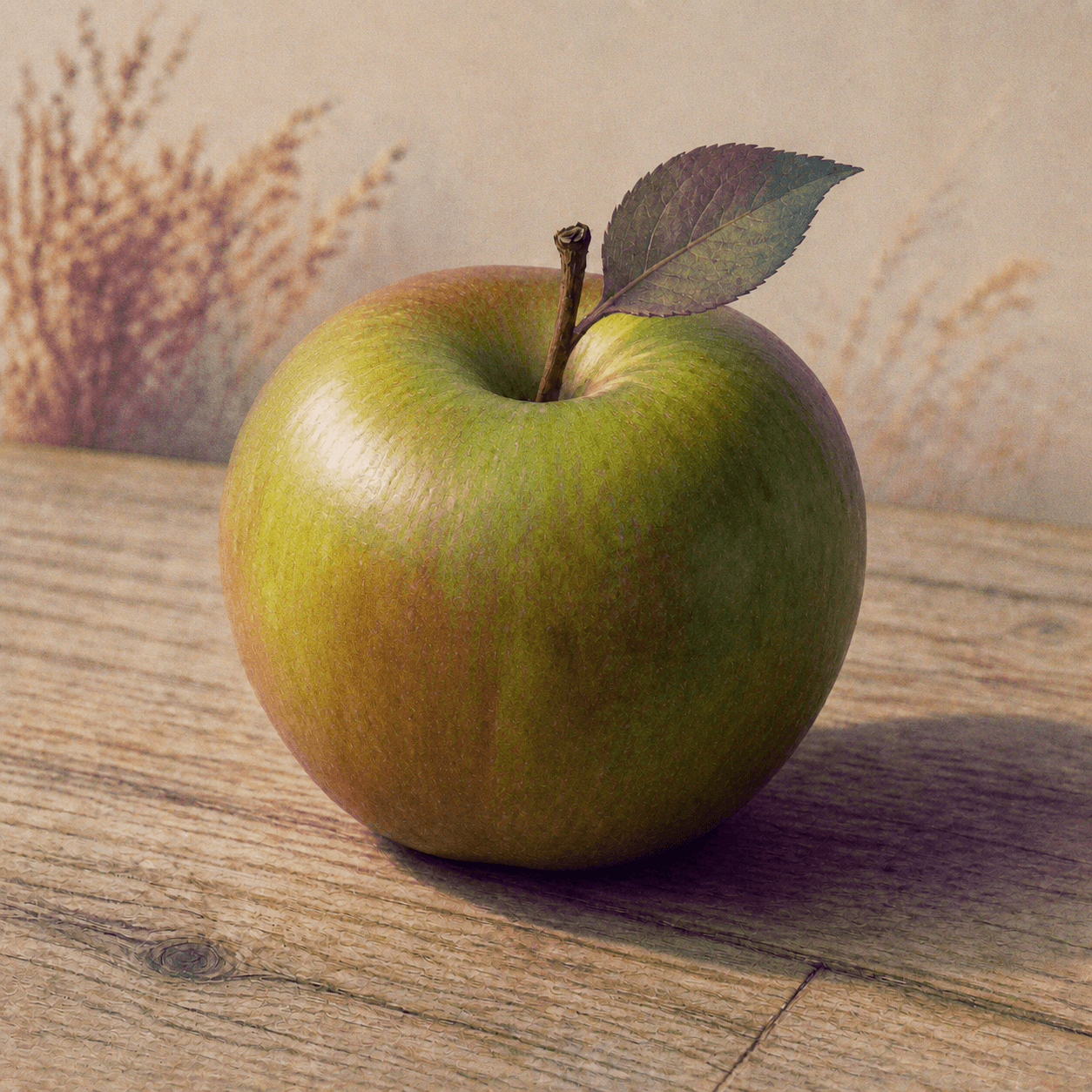
READ THE IMAGE
Do not hunt for a monster; see how every normal thing is made slightly wrong
This teaching image keeps the apple legible but prevents table, shadow, and background from becoming a stable place. Weirdcore tension often comes from the hesitation: I know what this is, but not why it is here.
- 01
See scale betray common sense
A tiny door, huge fruit, or object outside human scale interrupts spatial judgement first.
- 02
See text refuse explanation
Phrases styled as signs, pop-ups, or commands tend to open a question instead of completing a story.
- 03
See why the image stays dirty
Compression, flash, grain, and low resolution are not just nostalgic filters; they make the record feel untraceable.
- 04
See unease arise from relation
Place, object, and bodily trace fail to fit each other; violence or gore is unnecessary.
In one sentence
Slightly twist the scale, causality, and context of familiar imagery,
then keep the viewer inside the cognitive gap of “where is this?”
Weirdcore is a contemporary internet aesthetic named and remixed by online communities, not a historical movement with one rulebook. It often borrows low-fidelity photography, early-web graphics, collage, and surreal signs, arranging ordinary corridors, lawns, rooms, or objects into an unlocatable scene. Its effect can be absurd, comic, lonely, or uneasy. The point is not to frighten but to make familiar things lose their explainable relation.
VISUAL LANGUAGE
Cognitive-imbalance DNA
Wrong
Common sense shifts slightly
Noise
The source feels suspect
Compression scars, blown flash, and old graphics make the image feel like evidence forwarded too often.Break
Text will not navigate
Instruction, question, and label appear but cannot explain the space.Empty
The setting has no owner
School, mall, or lawn without an actor loses its normal purpose for a moment.Care
Discomfort can be controlled
Use absurdity and suspension rather than treating violence, trauma, or real distress as decoration.Where it came from
From Surrealist defamiliarisation and early-web low fidelity to hashtag-led collage communities, weirdcore turns “strange” into a shareable way of seeing
Research on internet aesthetics stresses that such labels are discussed, made, and revised by users on platforms, so their borders stay open. Weirdcore reuses Surrealist collage and the visual fragments of early webpages, old cameras, and compressed files. On Tumblr, image forums, and short-video platforms, creators connect similar feelings of disorientation through tags rather than a single author or canon.
Surrealism supplies defamiliarisation
Illogical object relation and dreamlike collage offer a historical reference for later strange image-making.
Early web leaves low-fidelity memory
Tiny images, flash photos, webpage text, and repeatedly compressed files become reusable material.
Communities name Weirdcore
Image boards, Tumblr, and forums gather related yet nonidentical strange images under a shared term.
Short video multiplies edits and branches
TikTok, edit templates, and algorithms keep weirdcore overlapping with and diverging from dreamcore and liminal space.
ARTISTS & WORKS
Meet it through four image cultures
Surrealist collage
Impossible relations between objects offer one distant precedent for weirdcore imagery.Early-web personal page
Small low-res images, abrupt type, and unstable interfaces become reusable texture.Anonymous image community
Members negotiate what counts as strange through repost, edit, and tag rather than an official definition.Short-video edit
Sound, caption, and image jump turn single-image displacement into rhythmic experience.How to recognise it
First test whether an ordinary thing sits in an unexplainable relation; then see whether image noise and text together weaken the place’s credibility
- ✓Do familiar objects contradict their scale, use, or location?
- ✓Does text open a question instead of offering complete world-building?
- ✓Do low fidelity, flash, or grain serve an untraceable-source feeling?
- ✓Does the unease come from defamiliarisation rather than substituting harm or horror for an idea?
STYLE RELATIONS
Three distorted scenes
REFERENCES
Sources & image note
The apple is a contemporary weirdcore teaching interpretation using low-fidelity texture, displaced space, and unexplained relation. It treats weirdcore neither as a mental-health diagnosis nor as a record of trauma or horror.