
African Art
African Masks
The wooden ‘face’ hung on a museum wall is only one part of a mask. Many African communities build characters from crest, helmet, face covering, cloth, leaf, fibre, and full-body costume; step, song, drum, prop, time of appearance, and permission to see make a masquerader into ancestor, nature force, social judge, or comic figure.
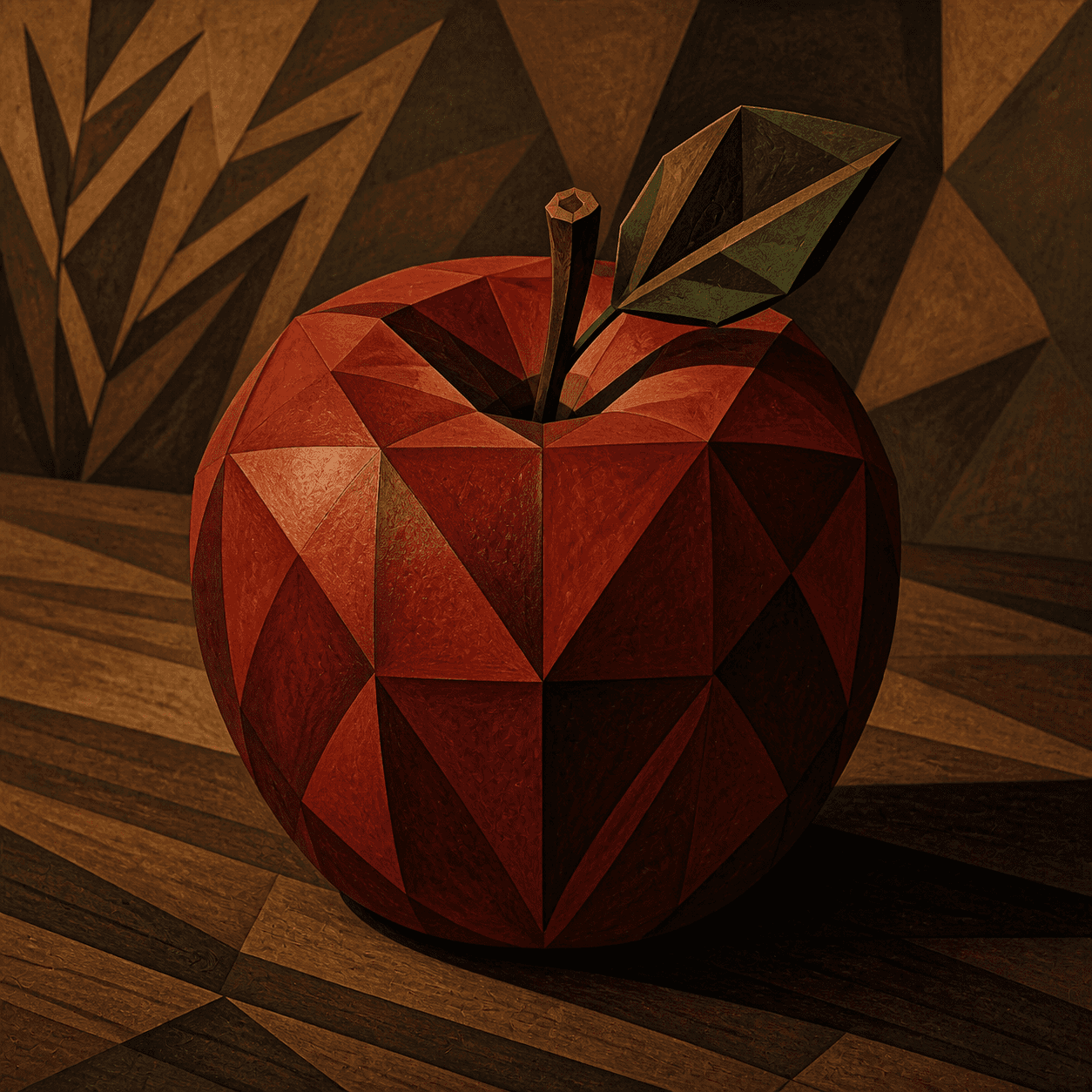
READ THE IMAGE
No wearable mask is actually present: identify what the image borrows and what performance it omits
Sharp red-brown facets cover the apple while background zigzags resemble enlarged carving and stage barrier. The image borrows a Western shorthand—African mask equals geometric distortion—without eye-mouth system, attachment, costume, or dancer.
- 01
See facets simulate a frontal gaze
Near bilateral symmetry and a central dark ridge resemble nose or eye socket, making a faceless apple read as face. Symmetry is an association, not an attribution.
- 02
Ask whether colour encodes a role
Red, ochre, black, and a little green divide mass as pigment might mark danger, age, gender, or animal feature; only community and performance records can establish meaning.
- 03
See whether the edge can join costume
Historic wooden headpieces often preserve holes, ties, basket caps, or fibre joins that secure and conceal the dancer. This closed apple has no wearable evidence.
- 04
See backdrop stand in for movement
Zigzag silhouettes and diagonal boards create tension but reveal no turning, stamping, crouching, or procession. Movement may identify a character more precisely than facial form.
In one sentence
Not an exaggerated wooden face—
but headpiece, full costume, role, knowledge rights, and live performance producing a temporary identity together
English ‘mask’ suggests a facial cover, yet many African traditions are better understood as masquerade. Wood may balance above the head, enclose it, or project from the forehead, while some ensembles use no wood. Costume removes daily identity and prescribed movement, sound, and prop bring a character into presence; carver, tailor, ritual expert, musician, singer, and audience co-create. A genre may serve initiation, funeral, farming, healing, justice, or entertainment and change as neighbours borrow it. Some characters restrict who may perform or see them by association, age, or gender, so public museum display does not reproduce the original regime of looking.
VISUAL LANGUAGE
Visual DNA
Wear
Form answers body and centre of gravity
Transform
A character is not the dancer's portrait
Ideal woman, ancestor, animal composite, forest force, or social satire materialises through face, costume, voice, and motion.Ensemble
Carved wood is one full-body layer
Raffia, cotton, leaf, feather, hide, bead, shell, metal, medicinal coating, and prop change silhouette, sound, and efficacy.Motion
Choreography is a recognition system
Spin, stamp, glide, crouch, whip, or slow procession signals temperament and difficulty; a display case deletes this dimension.Access
Seeing and concealment both matter
Night appearance, restricted grove, gender, and initiation level control transmission; masquerade can educate a public while guarding knowledge.Where it came from
From mobile and adaptive regional masquerades through the colonial museum's static ‘mask’ to continuing contemporary invention
Wood is perishable, so few early dates survive, and nineteenth-century headpieces need not represent timeless forms. Bwa wooden masks were adopted from neighbours and Baule Goli spread in the early twentieth century, evidence that travel, marriage, market, and competition renew tradition.
Rite, association, and season define characters
Ancestor memorial, initiation, farming, justice, and entertainment produce distinct casts whose materials are repaired, repainted, and replaced.
Kingdom, trade, and regional associations expand performance
Yoruba Gẹ̀lẹ̀dẹ́, Bamana and Senufo associations, Mende/Sande, and many others rely on specialist carvers, costume makers, and performers while exchanging across borders.
Colonial collection detaches the headpiece from the body
Mission suppression, military violence, and art trade remove pieces; European modernism praises abstract form while often deleting dancer, women's power, and local names.
Film, fieldwork, and living makers restore eventhood
Communities create new funeral, festival, and competition characters as urban cloth and political themes enter; museums attempt to show costume, sound, provenance, and restricted knowledge.
ARTISTS & WORKS
Meet form and action through four masquerade characters
Bamana ci wara antelope crest
An abstract antelope rises from a basket cap and raffia costume; paired male-female characters dance agricultural rhythm to honour excellent farmers and link land, skill, and cooperation.Mende/Sande sowei helmet mask
Glossy black helmet, lowered eyes, neck rings, and coiffure express composure, discipline, and maturity; the Sande women's association owns it and women masqueraders perform it.Yoruba Gẹ̀lẹ̀dẹ́ helmet mask
Male dancers in a marketplace wear a facial base and narrative superstructure while music honours the powers of ‘our mothers’; animals, occupations, and current events continually update it.Bamana/Senufo Kòmò helmet
A blacksmith carves a composite predator core and association experts add horn, feather, medicine, and sacrificial coating; nocturnal full-body performance addresses illness, dispute, and danger.How to recognise it
Reconnect the ‘face’ to body, character, association, music, and occasion
- ✓Is it face cover, helmet, crest, or all-cloth/leaf ensemble, and do eye holes, ties, perforations, basket cap, and wear show how it was worn?
- ✓What were the full costume, fibre border, prop, step, song, and fellow characters, and has a museum kept only the wooden part?
- ✓Which community, association, age, and gender made, owned, performed, and viewed it, and what are its local name and occasion?
- ✓When was it repainted, re-horned, re-costumed, or assigned a new role, and did missionary suppression, colonial taking, or market commission shape collection?
STYLE RELATIONS
Masquerade event, carved object, and Cubist faceting must not be collapsed
African Masks
Takes the complete masquerade as its unit: headpiece, costume, dancer, music, association, and audience make the character present.CURRENTAfrican Woodcarving
Includes figures, regalia, doors, stools, and power objects whose wooden biography need not centre on performance.↗Cubism
Fragments objects into multiple-view planes within Parisian modern art, encountering African sculpture but not continuing any African masquerade tradition.↗REFERENCES
Sources & image note
Frontal symmetry, red-black facets, and zigzag rhythm borrow the modern geometric idea of an ‘African mask.’ Because there is no wearable structure, role, costume, movement, or local name, the apple is a contemporary faceting exercise rather than a reconstruction.