
African Art
African Woodcarving
‘African woodcarving’ is not one visual style spread across a continent. Yoruba twin memorials, Kongo power objects, Chokwe court sculpture, Dogon commemorative figures, and functional objects arise from different communities, uses, and makers; tree choice, carving, additions, care, movement, and collection make the surfaces seen today.
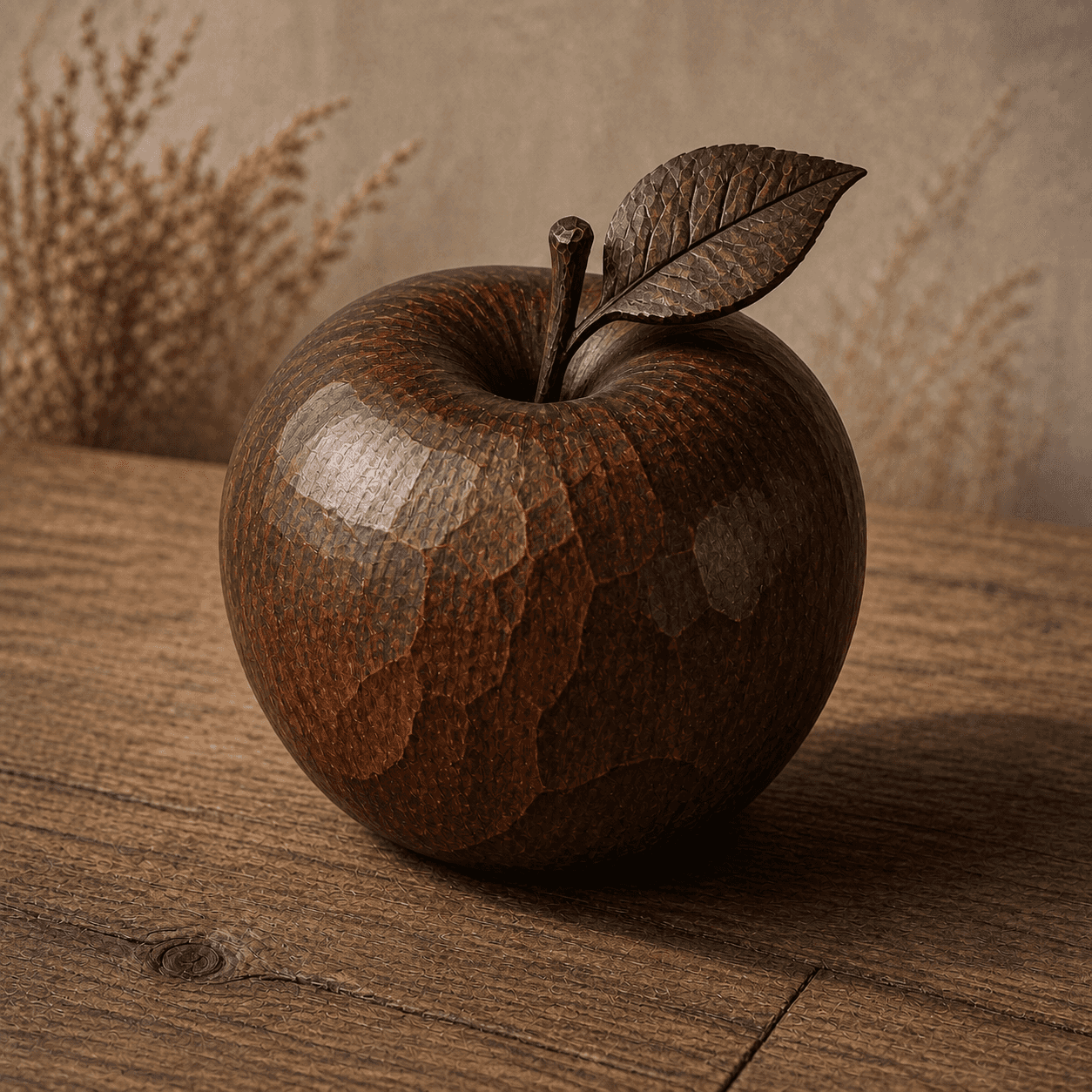
READ THE IMAGE
Do not call dark grain ‘primitive’: read subtractive process, surface biography, and the missing use context
Broad tool marks, fine cuts, and selectively burnished dark wood imagine the apple carved from a block. Without human imagery, community signs, additions, or ritual use, it represents no particular African tradition.
- 01
See mass removed from timber
The cavity, shoulders, and base turn in broad planes as if axe and adze established primary volume before chisel tightened transitions. Carving is subtractive; an error cannot be added back like clay.
- 02
See tool marks as process, not filter
Dense short cuts change direction with curvature while broad facets remain. Real traces explain shaping sequence rather than coat every inch evenly.
- 03
Ask what contact made the sheen
The upper-left highlight suggests oil or wax while recess and right side stay dark. Historic gloss may grow through handling, washing, oil, smoke, or offering rather than factory varnish.
- 04
Ask whether leaf and stem share the block
Thin leaf edge, vein, and stem differ structurally from the fruit, inviting inspection of one-block retention, later attachment, or modern manufacture; joinery is cultural evidence.
In one sentence
Not rough wood used to summarise ‘Africanness’—
but particular communities turning tree, tool, personhood, power, and repeated use into objects that act
Many sub-Saharan sculptures are cut from one block, but assembled thrones, doors, and composite figures also matter. Species may be chosen for durability, weight, colour, or symbolism, and felling or beginning can require restriction and offering. Completion of carving does not complete the work: a Yoruba ere ibeji acquires patina through family washing, feeding, and dressing; a Kongo nkisi receives empowering substances from a ritual specialist and becomes active in events; a mask becomes whole with costume, dancer, music, and audience. Colonial collection often removed attachments, names, and use histories, so the ‘pure wood sculpture’ in a museum may be only a decontextualised phase.
VISUAL LANGUAGE
Visual DNA
Subtraction
Volume is released along grain
Proportion
Conceptual importance reorganises the body
Enlarged head, compressed leg, emphatic belly, or gesture may speak of destiny, authority, ancestry, or fertility rather than anatomical failure.Surface
Patina records care and environment
Oil, sweat, smoke, clay, pigment, blood, drink, powder, and insects can become biography and should not all be cleaned to bare wood.Composite
A wooden core often works with other matter
Iron, mirror, bead, shell, cloth, fibre, and medicine may supply identity, sense, or efficacy; loss changes meaning.Function
A sculpture can be a participant
It may remember a person, secure an oath, assist divination, protect a community, or embody kingship; viewing is only one action.Where it came from
From long but perishable woodworking traditions through courts and Atlantic trade to colonial museums, modernist looking, and present-day claims
Tropical wood suffers insects, humidity, and handling, so few early survivors do not imply a short history. Dark patina alone cannot date an object; radiocarbon, species, tool mark, archive, and acquisition history must converge.
Wood connects ancestor, architecture, and daily use
Rare dry or protected contexts preserve early works, while archaeology, oral history, and later continuities show carving long predates European collecting.
States, trade, and specialist workshops expand commissions
Kongo, Yoruba, Chokwe, Kuba, and many other courts, associations, and households sponsor figures, doors, vessels, divination tools, and memorials as imported metal and beads enter composites.
Colonial taking turns active objects into anonymous ‘sculpture’
Military seizure, missionary suppression, trade, and ethnographic collection remove works; labels collapse makers into ‘tribe,’ while modernism favours form without function.
Scholarship, living artists, and communities rebuild names and contexts
Museums increasingly document makers, ritual specialists, women carers, performance, and provenance; contemporary carving, tourist markets, Christianity, and restitution debate keep traditions changing.
ARTISTS & WORKS
See wood enter four different social relations
Dogon Primordial Couple
Two bodies mutually support one another and join a shared seat, perhaps commemorating an elder or expressing complementarity and descent; weathering and offering become evidence of duration and use.Obembe Alaiye, male ere ibeji
Adult physiognomy is not a child's portrait but access to a departed twin. A mother's washing, oiling, dressing, and feeding keep glossy high points and indigo residue changing.Kongo nkisi nkondi power figure
A carved body receives medicines, mirror, and iron from an nganga and is activated through oath and request; each nail is the trace of a social act, not violent decoration.Chokwe ngundja royal seat
A European-backed chair is rebuilt with joined wood, leather, and brass tacks; daily and ritual figures on its rails make the chief's responsibility a social microcosm.How to recognise it
Begin with community, function, tool, and use history—not dark colour, exaggeration, and handmade feel
- ✓Does the label name a community, region, maker or workshop, date, and local object term rather than ‘African tribal carving’ alone?
- ✓Was it freestanding figure, architectural door, stool, divination tool, mask headpiece, or composite power object, and which attachments or performance are now missing?
- ✓How did axe, adze, chisel, and knife successively form mass and detail, and are grain, join, and repair visible?
- ✓Did handling, oil, smoke, offering, pigment, burial, or modern wax make the patina, and does provenance explain when it left its community?
STYLE RELATIONS
Carved object, masquerade, and European modern sculpture require separate frames
African Woodcarving
Ranges across many communities' figures, implements, court and ritual objects, stressing wood, subtraction, surface, and use biography.CURRENTAfrican Masks
Becomes whole only with headpiece, costume, dancer, music, association, and audience in a masquerade event.↗Expressionism
Uses subjective distortion for emotional intensity in twentieth-century Europe and encountered African collections through colonial museum and modernist systems.↗REFERENCES
Sources & image note
Dark wood, broad facets, dense cut marks, and local sheen make the teaching apple useful for observing subtraction and surface. It has no human proportion, community sign, empowering addition, or record of care and rite; it is a carving exercise only.