
Chinese Art
Blue-Green Landscape
Blue-green landscape turns terrain into a jewel-like order. Azurite and malachite do not merely colour an ink drawing; mineral body, repeated layers, and contour together construct an ideal world to travel and inhabit.
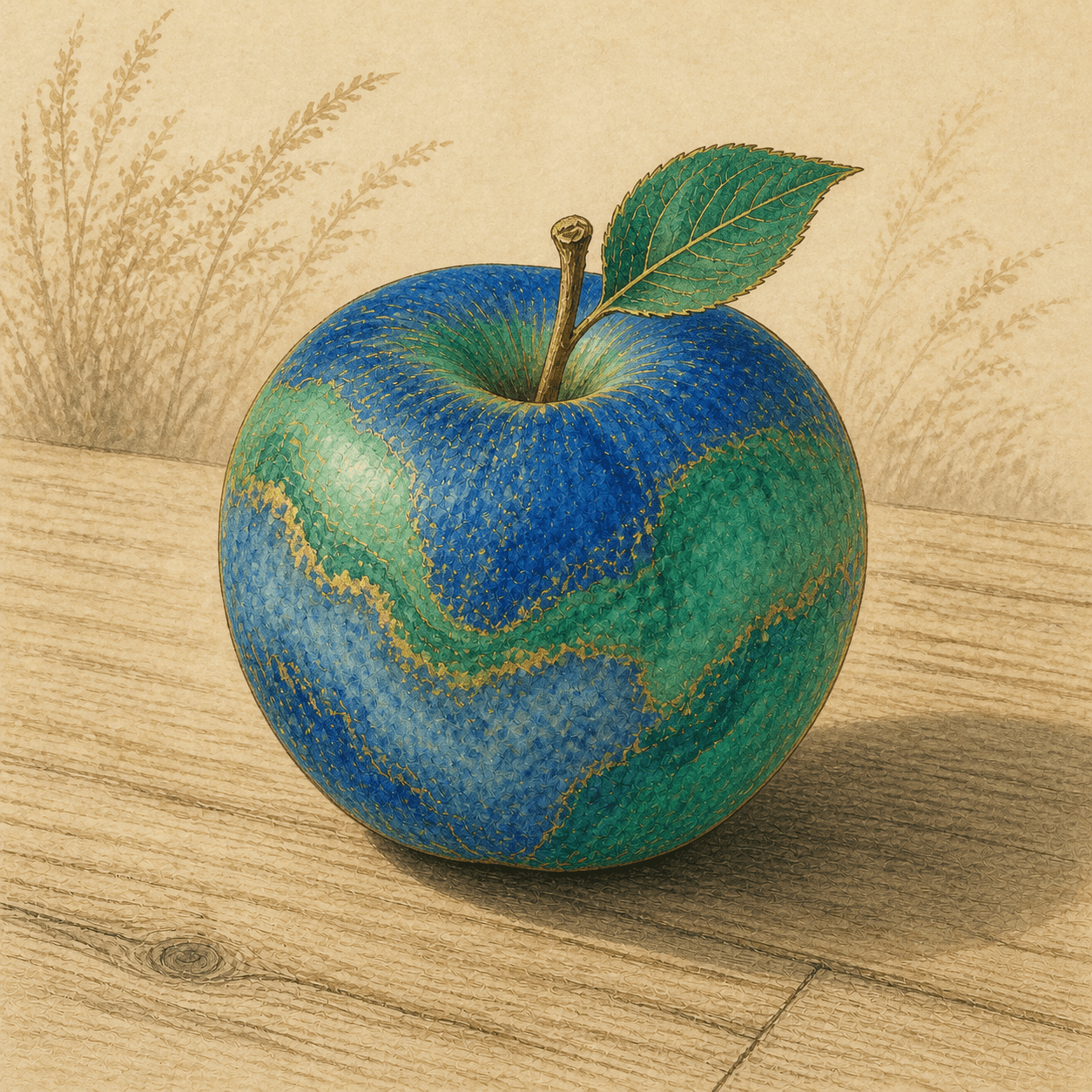
READ THE IMAGE
Forget the apple's natural red and read it as a mountain built from mineral colour
The teaching image translates fruit volume into peaks and waterways, using blue-green pigment and gold contour to reveal material logic rather than imitate an old painting.
- 01
See colour as matter
Saturated blue and green stay dense, luminous, and granular instead of following local apple colour; each layer has mineral body.
- 02
Follow gold as mountain skeleton
Fine gold holds the outer edge and divides the surface into winding ridges and waterways; ornament also performs structure.
- 03
Read the fruit as compressed terrain
Bands of blue and green rise and fall around the curve like peaks, valleys, and rivers nested within a round world.
- 04
See dense colour breathe against warm ground
Silk-beige background and pale ochre remain open, supporting cool minerals so splendour retains distance and air.
In one sentence
Not blue and green added to an ink mountain—
but ideal terrain built through mineral, contour, and layers
Blue-green landscape makes mineral azurite and malachite conspicuous. Artists often establish a linear and ink framework, add ochre foundations, then build repeated colour layers; gold contour can produce the related gold-and-blue-green mode. ‘Large’ and ‘small’ blue-green describe differing intensity and relations with brushwork rather than fixed recipes. The mode could serve court ritual, immortal realms, and visions of prosperity, yet literati also used it to voice archaism and withdrawal. It is neither mere decoration nor one academy style.
VISUAL LANGUAGE
Visual DNA
Mineral
Azurite and malachite have weight
Contour
Line gives the terrain bone
Ink, coloured, or gold outlines articulate ridge, tree, and building so dense colour keeps structure.Layer
Ochre ground, ink texture, and glaze coexist
Warm foundation and cool colour interpenetrate; spatial colour comes from process, not one flat fill.Travel
The scroll unfolds continuous country
High, deep, and level distance can meet in one image as the eye moves like a traveller.Meaning
Landscape carries ideal order
Immortal realm, retreat, antiquity, and imperial flourishing can all be imagined through sumptuous terrain.Where it came from
From early independent landscape to court panorama and literati archaism, blue-green was never only colour
Blue-green did not simply vanish when ink painting rose. Mineral colour repeatedly joined figure, architecture, ruled line, scholar brushwork, and political narrative to acquire new purposes.
Early blue-green establishes landscape language
The attributed Spring Excursion joins fine line, blue-green slopes, and layered space; traditions associated with Li Sixun and Li Zhaodao link sumptuous country to court imagination.
Court production expands mineral colour to monumental scale
Wang Ximeng's nearly twelve-metre handscroll connects six landscape sections through mineral blue-green, ochre, fine brush, and minute human life.
Archaism becomes literati expression
Qian Xuan, Zhao Mengfu, and others revisit Tang–Song colour and deliberately archaic space to negotiate antiquity, identity, and contemporary choice.
Professional, scholar, and court uses keep changing
Suzhou masters such as Qiu Ying refine coloured narrative; Wang Hui's Kangxi tour invokes classical landscape to join inspection, legitimacy, and imperial order.
ARTISTS & WORKS
Meet it through four works
Attributed to Zhan Ziqian, Spring Excursion
Blue-green slopes, tiny travellers, and water connect a spring world, making the image central to histories of independent landscape and early colour.Wang Ximeng, A Thousand Li of Rivers and Mountains
Six sections rise and settle across the handscroll as intense minerals, precise handling, and minute activity form an ideal prosperous realm.Qian Xuan, Dwelling in the Floating Jade Mountains
Level islands and restrained blue-green join dwelling, memory, and scholar choice, showing that mineral colour can carry literati meaning.Wang Hui and assistants, Kangxi Southern Inspection Tour, Scroll Three
Classical blue-green and expansive terrain record imperial travel while invoking Tang–Song golden ages and Qing cultural legitimacy.How to recognise it
Do not merely spot blue and green; test whether matter, line, and route cooperate
- ✓Do blue and green show mineral coverage, layering, and luminosity rather than a generic digital gradient?
- ✓Do contour, ink texture, ochre ground, and colour coats build the mountain together rather than tint a finished monochrome?
- ✓Do multiple distances and continuous routes invite the eye to travel beyond a single scenic viewpoint?
- ✓Does splendour serve a specific context—immortal realm, antiquity, ritual, retreat, or political order?
STYLE RELATIONS
One terrain, different materials and cultural tasks
Ink Landscape
Uses ink register, texture stroke, emptiness, and moving viewpoint to organise mountain experience.↗Blue-Green Landscape
Builds ideal, sumptuous terrain through mineral blue-green, contour, and repeated colour layers.CURRENTLiterati Painting
Uses poetry, calligraphy, social exchange, and brush cultivation for identity, in ink or blue-green colour.↗REFERENCES
Sources & image note
The apple interprets blue-green material and space through mineral colour, gold line, and warm silk ground. It is a contemporary teaching example, not a historical work.