
Chinese Art
Literati Painting
Literati painting is not a monochrome look. It treats painting as cultivated conversation, bringing brush trace, poetry, old models, friendship, and judgements of character onto one surface.
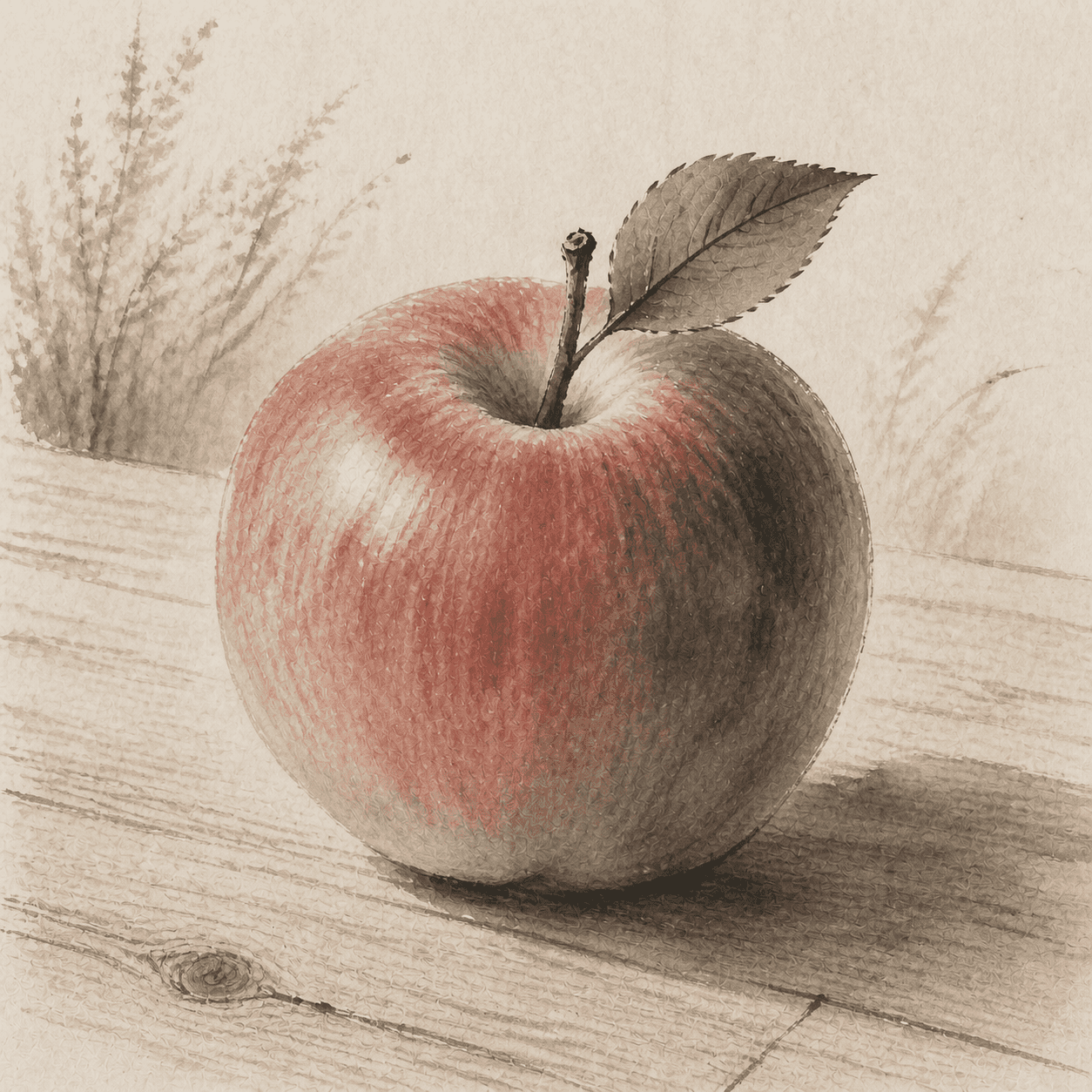
READ THE IMAGE
Do not ask only whether it looks pale; read how each trace records a choice
Paper texture, pale ink, and restrained red suggest literati values. The teaching image copies neither a master's brush nor a historical inscription.
- 01
See the hand remain in the mark
Short strokes are not polished into a seamless skin. Repetition, pressure, and turn describe the apple while preserving action like handwriting.
- 02
See colour answer the ink bones
Red lightly washes the centre and highlight while dark ink, leaf vein, and contour hold structure; colour is measured support, not spectacle.
- 03
See blank paper carry breath
Open ground separates apple from distant plants like a pause. It also evokes the cultural room in which poem, colophon, and seal might join the image.
- 04
See an everyday thing bear character
The common apple appears restrained, solitary, and firm. Literati painters likewise used bamboo, plum, rock, old tree, or studio to voice integrity, friendship, and retreat.
In one sentence
Not amateur painting made sparse—
but cultural identity built through poetry, calligraphy, and brush choices
Literati painting describes ideals developed and championed by people trained in classics, poetry, and calligraphy. It does not make professional illusionism the only measure of excellence, but values calligraphic handling, creative transformation of old styles, inscription, and the social life of gifts and gatherings. Ink on paper, landscape, bamboo, rock, old tree, and retreat are common, yet colour, fine handling, court office, and market exchange are not excluded. ‘Literati’ names a historical identity and claim of value, not a visual filter.
VISUAL LANGUAGE
Visual DNA
Trace
Calligraphic brush reveals disposition
Antiquity
Meet old masters rather than duplicate them
Borrowed compositions and strokes declare lineage; transforming precedent positions the present painter.Three perfections
Poetry, calligraphy, painting interpret one another
A poem is not a caption; words, script, image, and seals jointly alter rhythm and meaning.Exchange
A work is also a social act
Gift, gathering, journey, studio-name image, and colophon make the scroll a network across time.Untrammelled quality
Finish and likeness are not supreme
Awkwardness, sparseness, desolation, or strangeness can voice character, but require visible judgement.Where it came from
From Northern Song scholar consciousness to an orthodoxy repeatedly rewritten through Yuan, Ming, and Qing
Not every educated person's work is literati painting, and the category was never naturally outside court or market. It formed through institutions, identities, and collecting networks, then later theorists redrew its canon.
Scholar-officials propose different standards
Su Shi, Wen Tong, Mi Fu, and others privilege poetry-calligraphy cultivation, expressive intent, and ink play; bamboo, old tree, rock, and cloud mountain become charged subjects.
Archaism and calligraphic brush transform the field
Zhao Mengfu and the Four Yuan Masters reinterpret Tang–Song precedents amid Mongol rule and retreat culture; mind-landscape, inscription, and private exchange mature.
Wu School culture broadens the ecology
Shen Zhou and Wen Zhengming join garden, poetry society, gift, and painting in Suzhou life; Dong Qichang later reorganises history through Northern and Southern schools.
Orthodoxy, individuality, and market pull against one another
The Four Wangs sustain Dong's lineage while Bada Shanren and Shitao challenge old methods through stronger personhood; epigraphy and academies later reshape brush values.
ARTISTS & WORKS
Meet it through four works
Attributed to Su Shi, Wood and Rock
Twisted tree, circling rock, and colophons turn objects into an argument about brush and character; attribution remains debated.Zhao Mengfu, Autumn Colors on the Qiao and Hua Mountains
Made to recall a friend's homeland, level twin peaks, archaic colour, and written brush turn place into memory and a manifesto of antiquity.Ni Zan, Rongxi Studio
Sparse trees, empty water, distant hills, and inscription join gift exchange, displacement, and imagined character in one restrained structure.Wen Zhengming, The Zhenzhang Studio
Studio, old trees, host, and visitor stage an ideal space of collecting and judgement; the painting itself arose from literati exchange.How to recognise it
Do not ask whether it merely looks inky; read who uses which tradition to address whom
- ✓Does handling display calligraphic pressure, turn, and rhythm as expression rather than conceal the hand?
- ✓Do poem, colophon, script, seal, and image modify one another instead of acting as later decoration?
- ✓Does the work enter a specific relation through archaism, gift, gathering, journey, or studio theme?
- ✓Does sparseness or awkwardness result from cultivated selection rather than excuse weak structure?
STYLE RELATIONS
Method, material, and social identity are not the same thing
Xieyi
An expressive method of selection and written rhythm available to professional and scholar painters alike.↗Literati Painting
A historical claim about cultivation, exchange, old methods, and self-expression.CURRENTInk Landscape
A genre organising mountains through ink register, texture stroke, and travelling space, in court or literati practice.↗REFERENCES
Sources & image note
The apple suggests literati viewing through pale ink, paper texture, written marks, and restrained colour. With no poem, seal, or actual gift context, it is an entry point—not a complete literati work.