
Chinese Art
Ink Landscape
Ink landscape does not remove colour from nature; brush, ink, blank paper, and moving viewpoint turn mountains and water into a world to travel, behold, wander, and inhabit.
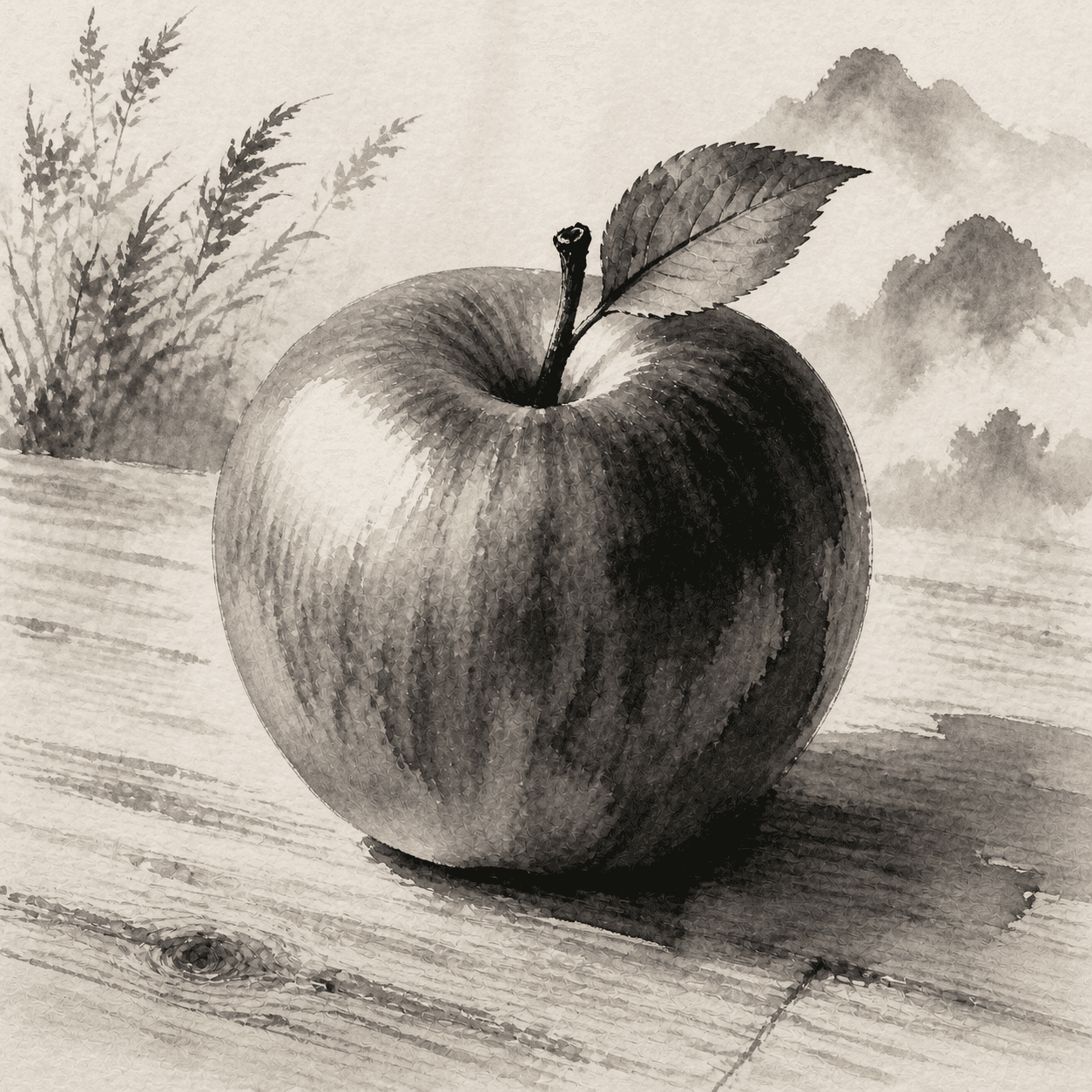
READ THE IMAGE
An apple becomes landscape: volume reads as peaks and hollows, paper white as cloud
A foreground object meets distant mountains through ink layers. This teaching image translates landscape language rather than copying an old painting.
- 01
See more than one black
Pale left, dense hollow, dark leaf, and wet distant peaks form depth as ink carries light, matter, and distance.
- 02
See texture strokes build mass
Directional marks round the apple as cun strokes explain geological structure through repeated brush action.
- 03
See blank become cloud and water
Untouched paper between peaks divides and connects space; white is moving qi, not painted sky.
- 04
Travel between near and far
The eye meets an immense apple, crosses its leaf, then reaches peaks; scale organises a route rather than realism.
In one sentence
Not a monochrome copy of scenery—
but brush-and-ink relations between humanity and the larger world
Shanshui means mountains and waters and also a tradition of world order, retreat, and journeys of mind and body. An artist need not copy one site from one position, but can combine directions, seasons, and memories as viewers unroll a handscroll or move vertically through a hanging scroll. Contour gives bone, cun describes rock, dots and washes grow vegetation and mist, and blank paper becomes water and sky. Court, literati, professional, and regional painters all shaped it; ink landscape may also include pale colour.
VISUAL LANGUAGE
Visual DNA
Ink
Five tonal registers make space
Cun
Stroke becomes geological structure
Hemp-fibre, axe-cut, raindrop, and other textures join observed terrain to historical language.Emptiness
Cloud, water, qi, and time
Blank paper separates land while keeping weather, path, and breath flowing.Viewpoint
Dispersed, moving, unfolding
The viewer crosses near, middle, and far without a camera's single instant.Figure
Small but essential
Traveller, boat, and dwelling set scale and make nature a space of life, retreat, or government.Where it came from
Landscape grew from narrative setting into a major way to think cosmos, politics, and self
Its history is not a march toward likeness. Northern Song monument, Southern Song fragment, Yuan mind-landscape, and Ming–Qing archaism answer different social and visual problems.
Landscape becomes independent
Nature shifts from story setting toward subject as blue-green colour, layered space, and theory develop.
Regional terrain and monumental order mature
Jing Hao, Guan Tong, Dong Yuan, Juran, Fan Kuan, and Guo Xi build northern and southern systems.
Fragment and poetic void change viewing
Ma Yuan, Xia Gui, and others concentrate mood through corner composition, mist, album leaf, and fan.
Mind-landscape, archaism, and lineage flourish
Zhao Mengfu, the Four Yuan Masters, and later painters use calligraphic brush and old styles for identity, friendship, and inward terrain.
ARTISTS & WORKS
Meet it through four works
Fan Kuan, Travelers among Mountains and Streams
A colossal peak dwarfs a mule train; raindrop texture and waterfall make northern terrain both observed and cosmic.Guo Xi, Early Spring
Cloud-scroll rock, crab-claw branches, and layered mist guide the eye upward through winter becoming spring.Ni Zan, Rongxi Studio
Sparse trees, empty water, and distant hills use dry pale ink to make simplicity a language of personhood and exchange.Huang Gongwang, Dwelling in the Fuchun Mountains
Hemp-fibre strokes and shifting ink join hills and villages as the handscroll walks along the river and looks back.How to recognise it
Do not ask only whether colour is absent; ask how ink makes space inhabitable
- ✓Do water, layering, and brush character create distance, matter, and weather?
- ✓Are rocks organised through specific cun strokes rather than uniform tonal shading?
- ✓Does blank paper actively work as cloud, water, sky, and path?
- ✓Does viewing move across scroll and multiple viewpoints, linked to human scale, dwelling, and ideas?
STYLE RELATIONS
Different organisations of colour, brush, and identity
Ink Landscape
Uses ink register, texture stroke, emptiness, and moving viewpoint to organise mountain experience.CURRENTBlue-Green Landscape
Uses mineral blue and green, gold line, and layered colour for ideal terrain and sumptuous order.↗Literati Painting
Builds identity through poetry, calligraphy, friendship, and brush cultivation, in monochrome or colour.↗REFERENCES
Sources & image note
The apple translates object volume into peak and valley, using distant mountain and paper white to suggest landscape space. It is a contemporary teaching image, not a monochrome filter.