
Illustration
Botanical Illustration
Its task is not merely to make plants beautiful, but to select and clarify identifiable structure: arrangement, veins, flowers, fruit, sections, scale, and life stages may all become evidence.
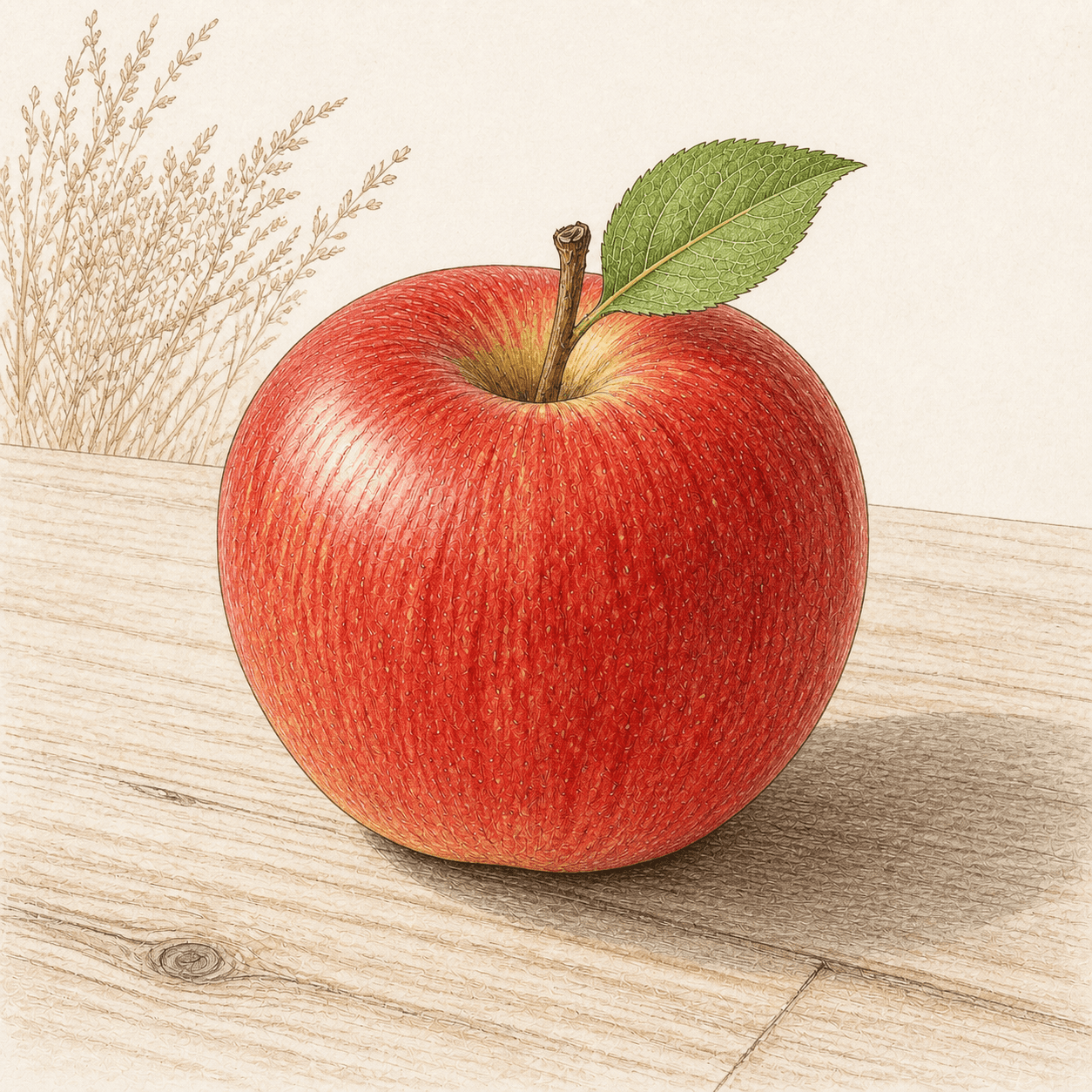
READ THE IMAGE
The apple looks realistic, but verifiable plant structure matters most
Crisp edge, skin lenticels, stem attachment, and leaf venation move seeing beyond a generic red apple. Yet this remains a teaching interpretation: a rigorous species plate may also require flower, seed, section, scale, and scientific name.
- 01
Read the hierarchy of veins
Midrib, secondary veins, and fine reticulation remain distinct enough to compare.
- 02
Inspect the stem attachment
The stem is not a decorative dash; cavity and woody texture explain connection.
- 03
Keep countable surface traits
Lenticels and longitudinal marks remain clues to cultivar and maturity.
- 04
Separate specimen from setting
Background plants recede into pale brown line so scientific attention stays on one subject.
In one sentence
Do not copy one plant in front of you—
synthesise the evidence most useful for identification
Botanical illustration draws on living plants, specimens, microscopy, and consultation to present morphology and diagnostic traits accurately. An artist may combine parts from different seasons, viewpoints, or scales on one plate; that synthesis is why illustration can outperform a single photograph for taxonomy. Botanical art allows more aesthetic freedom, while scientific botanical illustration must remain verifiable and comparable.
VISUAL LANGUAGE
Specimen DNA
Structure
Accurate, checkable
Selection
Diagnostic
Features that distinguish a species lead rather than indiscriminate detail.Composite
Across time and scale
Flower, fruit, seed, section, and enlargement can share one plate.Annotation
Scale and name
Bars, numbers, scientific names, and captions make a usable record.Technique
Clarity first
Watercolour carries colour; ink and stipple preserve tiny structure in reproduction.Where it came from
From herbal identification to taxonomic plates, plant images work between beauty and evidence
Manuscript herbals supported recognition of useful plants. Print and overseas collecting widened species exchange, while eighteenth-century taxonomy increased the need for comparable structure. Cameras, microscopes, and digital tools now join the process without replacing analytical selection.
Herbals transmit plant knowledge
Images copied with texts aid medicinal and food identification, but repeated copying can distort form.
Printed floras emerge
Woodcut multiplies images, and observation gradually corrects inherited conventions.
Taxonomy and exploration demand plates
Gardens, voyages, and publishing record new species; section, enlargement, and colour become standard tools.
Images still enter scientific description
Artists work with taxonomists, specimens, living material, and microscopy to clarify evidence a photograph cannot show at once.
ARTISTS & WORKS
Meet it through four makers
Maria Sibylla Merian
Places plants and insect life cycles in ecological relation rather than isolated display.Georg Dionysius Ehret
Combines exact anatomy, lucid composition, and Linnaean-era classification in eighteenth-century plates.Pierre-Joseph Redouté
Balances floral structure, tonal colour, and publishing beauty through stipple engraving and watercolour.Margaret Mee
Records Amazonian plants and habitats over decades, linking close observation with conservation.How to recognise it
Ask whether the image could support identification, not just a natural mood
- ✓Are organ proportion, attachment, and venation clear and credible?
- ✓Are flower, fruit, seed, section, or enlargement used as diagnostic information?
- ✓Is background removed or subordinated to protect specimen reading?
- ✓Do scale, scientific name, numbering, or caption make the image citable?
STYLE RELATIONS
Three ways of looking at plants
REFERENCES
Sources & image note
The apple imitates a natural-history plate through crisp contour, close texture, and a subordinated background, but lacks full species context, sections, scale, and scientific name; it cannot replace a scientific plate.