
Illustration
Line Illustration
When colour and modelling recede, line must carry boundary, action, material, and tone. Drawing less does not mean less work; every mark becomes more responsible.
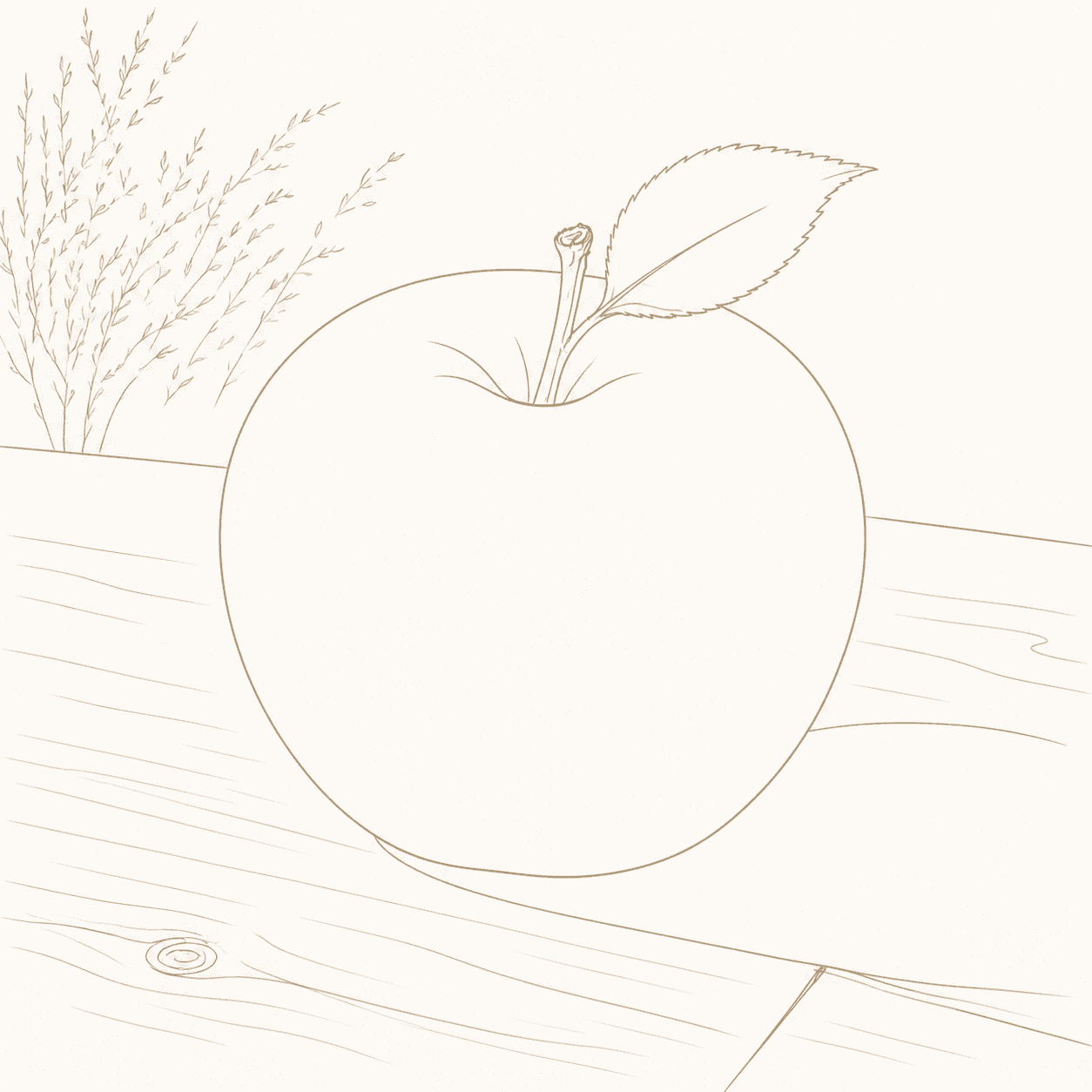
READ THE IMAGE
Almost unfilled, yet the apple's weight remains
The contour holds, short arcs explain the cavity, and lighter lines push timber and plants back. Weight, direction, interruption, and space create hierarchy.
- 01
Edit the contour
The outer edge continues while occluded edges stop to explain overlap.
- 02
Use structure instead of shading
A few inner arcs explain cavity and veins.
- 03
Layer with line weight
The subject is steadier and darker; background branches are finer and lighter.
- 04
Treat space as form
The empty apple interior is not unfinished; contour encloses its volume.
In one sentence
Choose the object's essential boundaries and forces with line—
then let space complete the rest
Line illustration builds images from contour, gesture, construction, hatching, or continuous line; colour, when present, usually supports the line. It may record observation, exaggerate rhythm, shape character, or explain structure. It is not an unfinished sketch but a final language designed for reproduction, narrative, and information.
VISUAL LANGUAGE
Line DNA
Contour
Selective, clear
Weight
Hierarchical, focused
Thickness and darkness separate subject, detail, and background.Rhythm
Directional, spaced
Speed and interval express action and touch.Space
Active, formative
Undrawn areas carry composition, light, and breath.Reproduction
Economical, adaptive
Monochrome lines suit print, embroidery, icon, and animation.Where it came from
From engraved reproduction to digital paths, line remains economical and personal
Line runs through incisions, manuscripts, and prints. Modern publishing made black-and-white drawing an efficient reproductive language; twentieth-century artists showed that few contours could hold complex space and feeling.
Print and book illustration
Woodcut, engraving, and etching use contour and hatching for tone, knowledge, and story.
Black-and-white drawing modernises
Beardsley exploits line-block print, black-white space, and curve for radical published images.
Contour moves toward economy
Matisse and others explore form, gesture, and figure-ground with sparse line.
Paths and animated strokes
Vector curves, pressure pens, and stroke animation carry line across scale and time.
ARTISTS & WORKS
Meet it through four makers
Aubrey Beardsley
Elegant contour, black-white contrast, and grotesque content transform fin-de-siècle illustration.Henri Matisse
Simplified contour becomes direct thought while figure and ground are actively balanced.Arthur Rackham
Rhythmic pen line and wash build fairy-tale trees and characters.Quentin Blake
Fast, trembling, highly selective line gives figures movement and humour.How to recognise it
Test whether each kind of line carries distinct information
- ✓Do breaks and connections explain occlusion?
- ✓Do weight, darkness, and density create hierarchy?
- ✓Does direction correspond to structure, action, or material?
- ✓Without fill, does the image remain complete rather than merely sketched?
STYLE RELATIONS
The role of line in three images
REFERENCES
Sources & image note
The apple is a contemporary contour exercise intentionally reducing hatching to foreground weight and space. Line illustration also includes woodcut, comics, technical drawing, and dense pen work.