
Illustration
Flat Illustration
Volume becomes editable fields, silhouettes, and rhythm so a story reads quickly on a small screen, poster, or motion sequence.
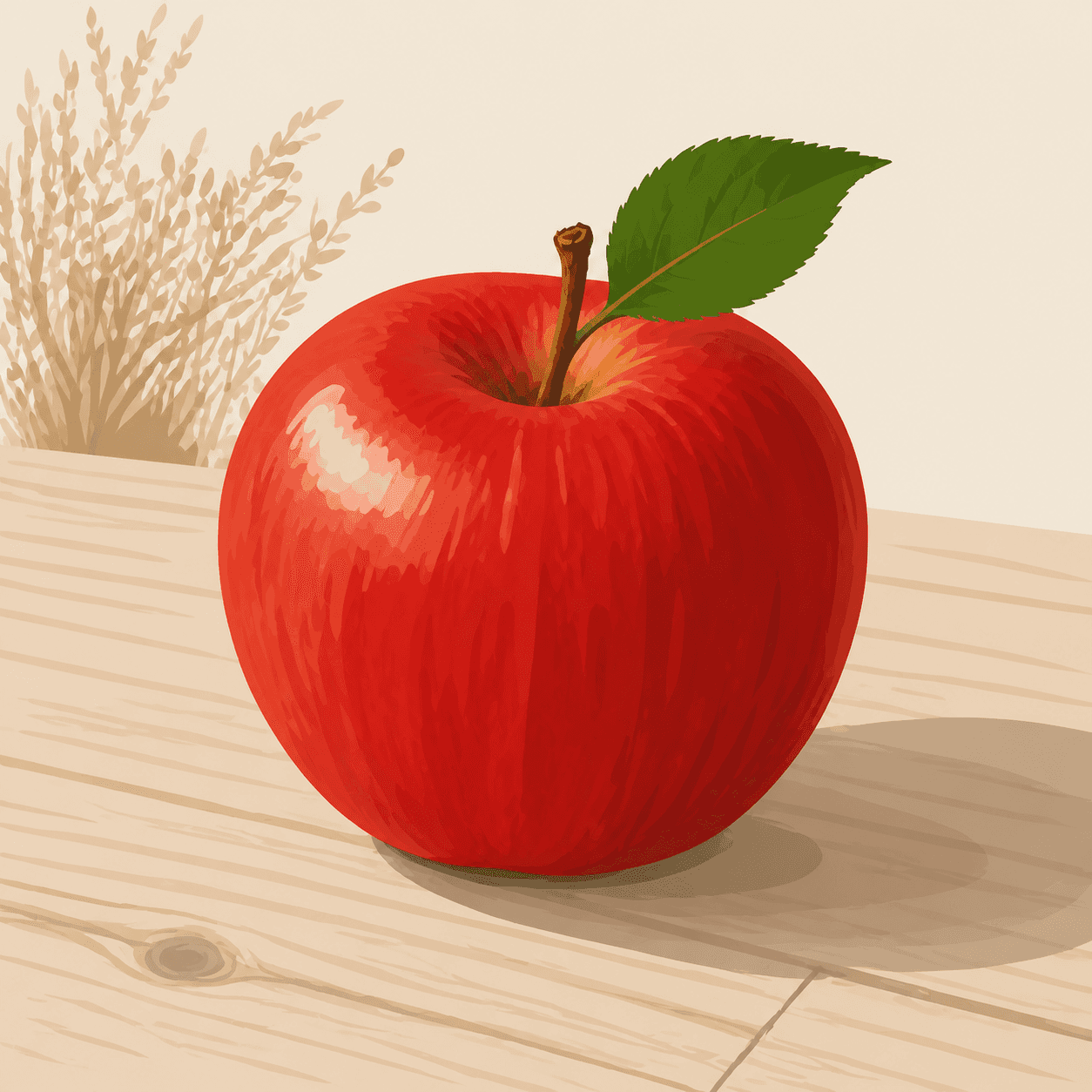
READ THE IMAGE
It is not without volume; volume is compressed into a few relations
The apple still has light, shade, cast shadow, and texture, but each becomes a clearly bounded shape. Flat illustration is not zero gradients; every field must read as character, material, or space.
- 01
Read silhouette first
Contour and leaf remain instantly legible when reduced.
- 02
Read limited values
Light red, dark red, and highlight fields replace continuous smooth modelling.
- 03
See graphic texture
Skin and wood become repeated marks rather than natural randomness.
- 04
Follow layered space
Apple, table, and plants use overlap, colour difference, and shadow for depth.
In one sentence
Break reality into its most distinctive shapes—
then rebuild story through colour and rhythm
Flat illustration constructs narrative images from silhouette, solid or limited-value colour, generalised line, and simplified space. Texture, shadow, and hand-drawn edge may remain when they support clear regions. It relates to but differs from flat interface design: illustration handles character, scene, and narrative tone; interface design handles information and interaction.
VISUAL LANGUAGE
Shape DNA
Silhouette
Primary, clear
Colour
Limited, sectional
Each field carries object, light, or hierarchy.Space
Overlapping, layered
Occlusion and scale replace detailed perspective.Texture
Patterned, controlled
Marks or paper grain add character without breaking boundaries.System
Reusable, animatable
Character parts and scenes support families and motion.Where it came from
Print limits forced simplification; digital media turned it into a system advantage
Posters, cut paper, screenprint, and children's publishing long used clear fields. Modernism connected simplification to mass communication; vector software made shapes easy to scale, reuse, and animate.
Poster and lithography
Large colour areas and strong silhouettes serve street distance and limited inks.
Modern commercial images
Kauffer, Bass, and Harper bring abstraction, collage, and geometry to advertising, film, and nature education.
Vector drawing spreads
Curves, fills, and layers make clean shapes a basis of digital production.
Product illustration systems
Brands build reusable characters, scenes, and motion components as interface communication.
ARTISTS & WORKS
Meet it through four makers
E. McKnight Kauffer
Compresses Cubist and Futurist ideas into modern posters readable at distance.Saul Bass
Condenses film themes through torn-paper silhouette, strong colour, and kinetic composition.Charley Harper
Distils animals and ecological relations into geometry and visual wit.Miroslav Šašek
Builds city-book rhythm from simplified figures, landmarks, and space.How to recognise it
Test whether simplification forms a usable visual system
- ✓Can the subject be recognised from silhouette and major colour fields?
- ✓Are values limited and each field purposeful?
- ✓Does texture obey the shape instead of imitating every natural detail?
- ✓Can characters and scenes stay consistent across series, sizes, and motion?
STYLE RELATIONS
Three uses of flatness
REFERENCES
Sources & image note
The apple is a contemporary teaching interpretation of silhouette, limited value, graphic texture, and layered space. Flat illustration is not one historical movement or software recipe.