
Illustration
Geometric Illustration
Circles, triangles, polygons, and grids replace free contours, turning an object into a visual rule that can be extended and transformed.
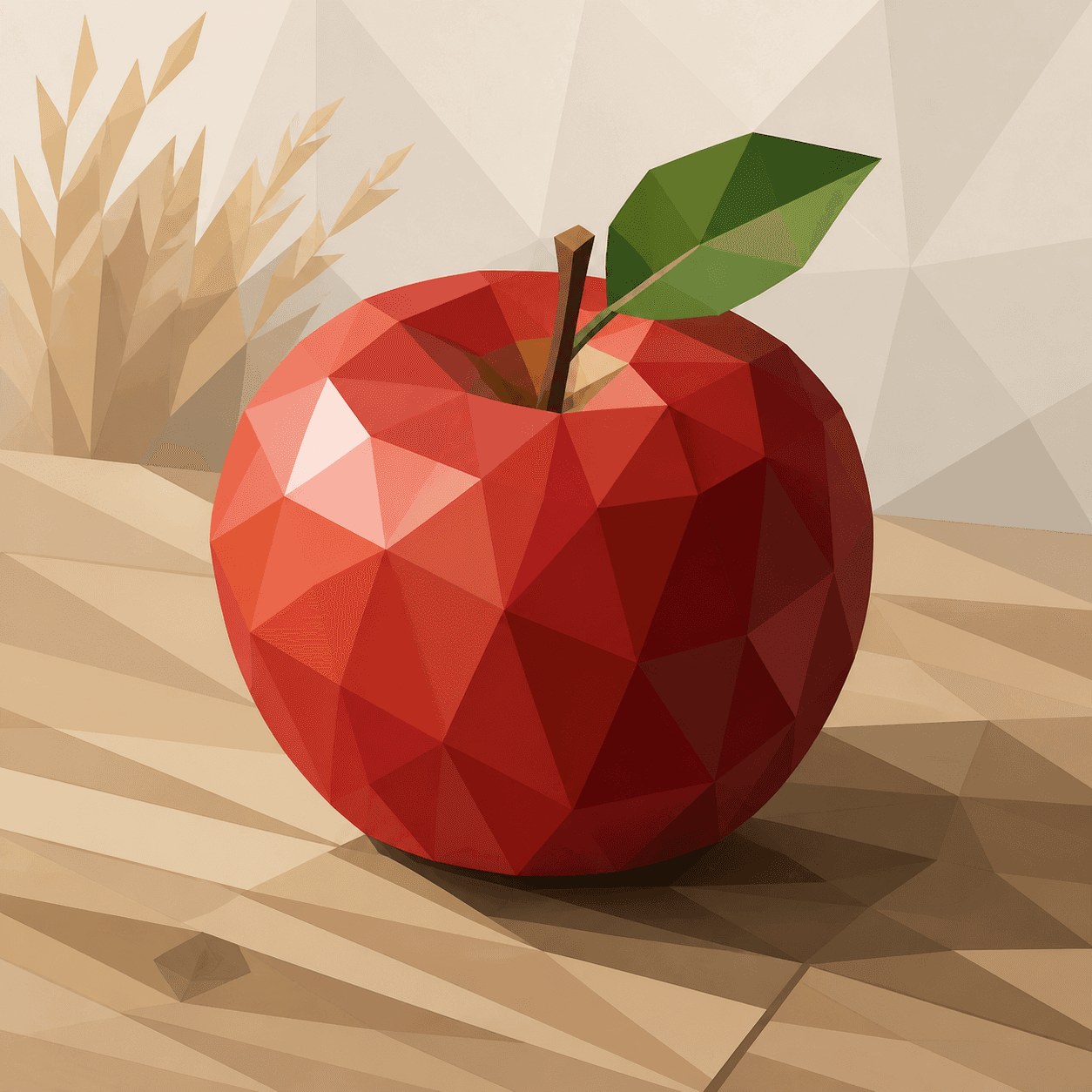
READ THE IMAGE
The apple remains recognisable, but its surface becomes a geometric system
Triangular facets divide the curve; leaf and background obey the same polygonal grammar. The force comes from one rule across the image, not random triangles.
- 01
Approximate contour with modules
Straight segments collectively form a round apple; recognition depends on overall proportion.
- 02
Let facets carry light
Colour jumps replace smooth gradients to model turning planes.
- 03
Keep one local grammar
Leaf, stem, table, and background all follow polygonal division.
- 04
Control focus through density
The subject uses denser, stronger facets while the background grows larger and paler.
In one sentence
Set a geometric grammar first—
then approximate object and story with limited modules
Geometric illustration constructs figurative or abstract images through basic shapes, grids, repetition, symmetry, or polygonal subdivision. It may remain entirely flat or use value to create low-poly volume. The issue is not whether triangles appear, but whether shape, angle, proportion, and repetition form one coherent rule while preserving identity.
VISUAL LANGUAGE
Module DNA
Unit
Limited, explicit
Boundary
Straight, angular
Free curves become segments or rigorously built arcs.Light
Discrete facets
Value jumps describe spatial turning.Rhythm
Repetition, variation
Changes in scale and direction create motion.System
Computable, extensible
Modules support generation, animation, and responsive reuse.Where it came from
Modern art broke the world into structure; communication turned structure into a tool
Cubism disrupted single viewpoint, Constructivism and Bauhaus organised society and communication with geometry, and modern posters converted those methods into rapidly legible imagery. Vector and 3D meshes extended modular composition.
Cubism decomposes form
Multiple viewpoints and planar division change how objects are built.
Geometry enters design education
Constructivism, De Stijl, and Bauhaus use basic form, grid, and colour as a modern grammar.
Poster and editorial graphics
Kauffer and others turn abstract structure into recognisable mass communication.
Vector and low polygon
Paths, generative systems, and 3D meshes make geometric rules easy to vary and animate.
ARTISTS & WORKS
Meet it through four makers
El Lissitzky
Uses axes, solids, and spatial tension across exhibition, book, and political communication.László Moholy-Nagy
Treats light, photography, type, and geometry as cross-media experiment.E. McKnight Kauffer
Turns Cubist and Futurist structure into advertising readable at distance.Charley Harper
Distils animal behaviour and ecology into minimal geometric relations.How to recognise it
Find the generating rule, not geometry alone
- ✓Can you name the basic units used by the image?
- ✓Do subject, detail, and background share angles and subdivision logic?
- ✓Do colour changes carry volume, rhythm, or information?
- ✓After reduction, do essential proportions and features survive?
STYLE RELATIONS
Three degrees of modularity
REFERENCES
Sources & image note
The apple is a contemporary low-poly teaching interpretation, only one branch of geometric illustration; circular modules, grid construction, and abstract narratives also belong.