
Illustration
Decorative Illustration
Decoration is not added after the subject is finished. Motif, border, repetition, and fill reorganise the whole surface so an image can act as story, pattern, and applicable design at once.
READ THE IMAGE
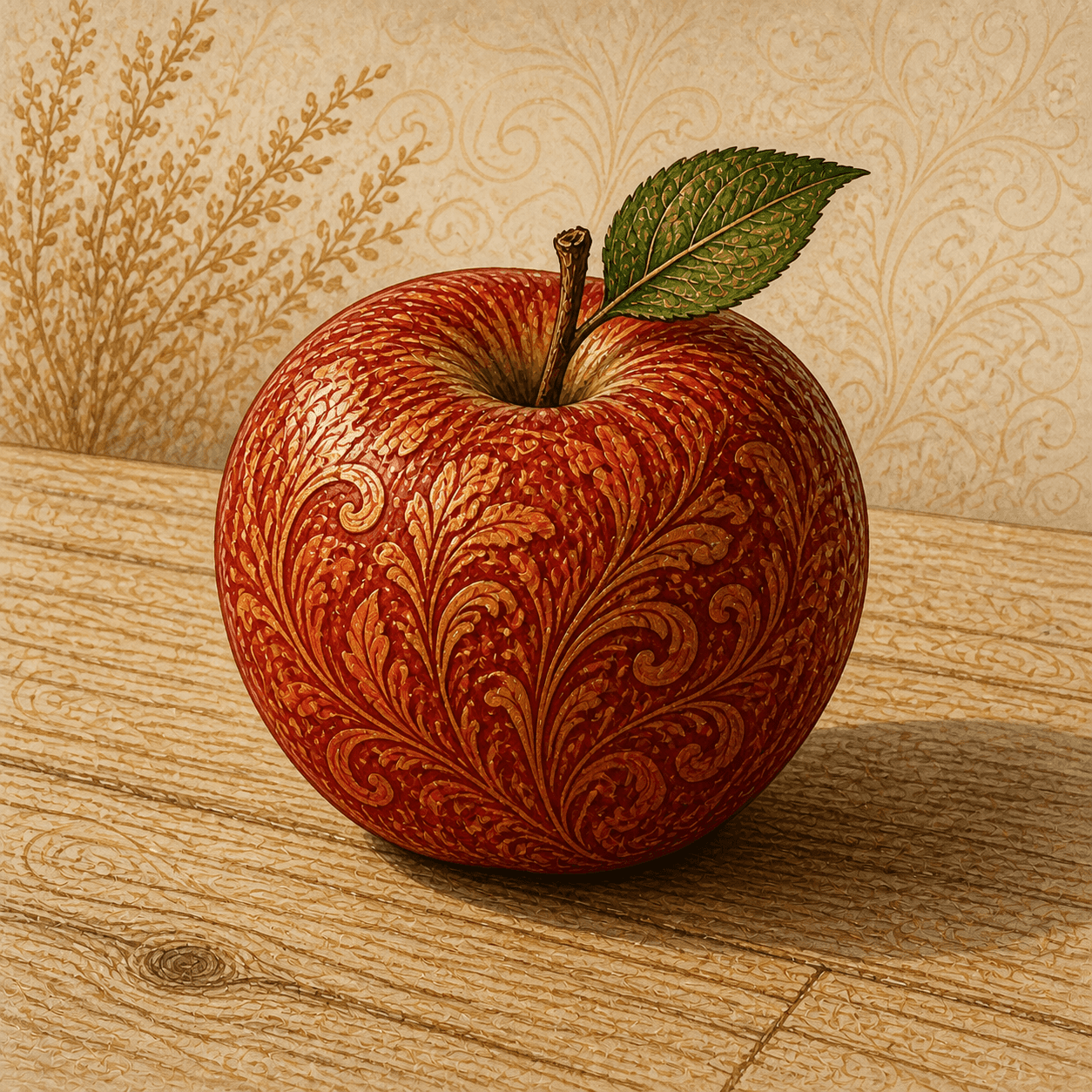
The apple keeps volume, but its skin becomes a designed surface
Gold scrolls grow from the base and branch sideways with the curve; paler related motifs echo behind. The issue is not how much ornament appears, but how motif responds to contour, focus, and viewing distance.
- 01
Follow how the motif grows
Leaves branch from a central stem in traceable order rather than random coverage.
- 02
Find change inside repetition
Curl direction, leaf size, and density vary enough to avoid mechanical cloning.
- 03
Fit pattern to its carrier
Gold marks turn across the apple and taper near its edge, preserving volume.
- 04
Use hierarchy to prevent noise
High-contrast dense ornament belongs to the subject; background repeats the language in pale line.
In one sentence
Treat an object as a bounded, scaled surface—
use pattern to build order and pleasure
Decorative illustration prioritises formal organisation and surface pleasure, often turning figurative subjects into repeatable, extensible, or page-bound motifs. It may carry narrative, but does not primarily model depth or explain information. Unlike autonomous pattern design, it retains an illustrated subject or scene; unlike casual embellishment, every element answers rhythm, symmetry, scale, and substrate.
VISUAL LANGUAGE
Pattern DNA
Motif
Distilled, reusable
Rhythm
Repeat, vary
Changes of interval, direction, and size move the eye over the surface.Structure
Symmetric, radial, continuous
Grid or axis holds abundant detail in legible order.Fill
Controlled density
Positive and negative form share space without vacancy or congestion.Carrier
Adaptive, translatable
Design responds to trim, packaging folds, textile repeat, or curved object.Where it came from
Ornament travelled with materials and trade; pattern books made it a portable vocabulary
Plant, geometric, and animal motifs have long occupied architecture, manuscript, textile, and object. Printed ornament sheets and sample books let makers borrow across regions. Industrial production enlarged the market while design reformers reconsidered nature, machinery, and beauty in daily life.
Surface carries identity and order
Scroll, geometry, and animal pattern enter architecture, metal, ceramic, textile, and manuscript, changing with belief and trade.
Ornament prints become shared libraries
European motif sheets and pattern books supply makers of furniture, ironwork, vessels, and interiors.
Industry provokes design reform
Mechanised wallpaper and textile markets expand; Morris and others rebuild repeat from nature and historic craft.
Illustration joins brand and surface systems
Decorative language spans publishing, packaging, fashion, and screens, with vectors and parameters accelerating families.
ARTISTS & WORKS
Meet it through four designers
Étienne Delaune
Circulates scroll, grotesque, and symmetric motifs through fine prints adaptable to many crafts.Owen Jones
Organises cross-cultural ornament as lessons in colour and construction, while revealing Victorian limits of classification.William Morris
Distils garden plants, manuscripts, and textiles into balanced natural form and flat repeat.Alphonse Mucha
Integrates figure, vegetal curve, halo, and border into a unified poster surface.How to recognise it
Find the skeleton beneath a rich surface
- ✓Can you isolate a basic motif that repeats and transforms?
- ✓Is pattern organised by axis, radial centre, border, or continuous grid?
- ✓Do positive forms and gaps create rhythm together?
- ✓Could the design adapt to a page, package, or textile as size and edge change?
STYLE RELATIONS
Three neighbouring surface languages
REFERENCES
Sources & image note
The apple embosses scroll and foliage into its skin and extends related pale pattern behind. It is a contemporary decorative exercise combining several historical vocabularies, not one place or period.