
Illustration
Collage Illustration
Cut material enters a new image carrying its former texture, time, and use. Collage works because fragments build a new subject without fully forgetting what they once were.
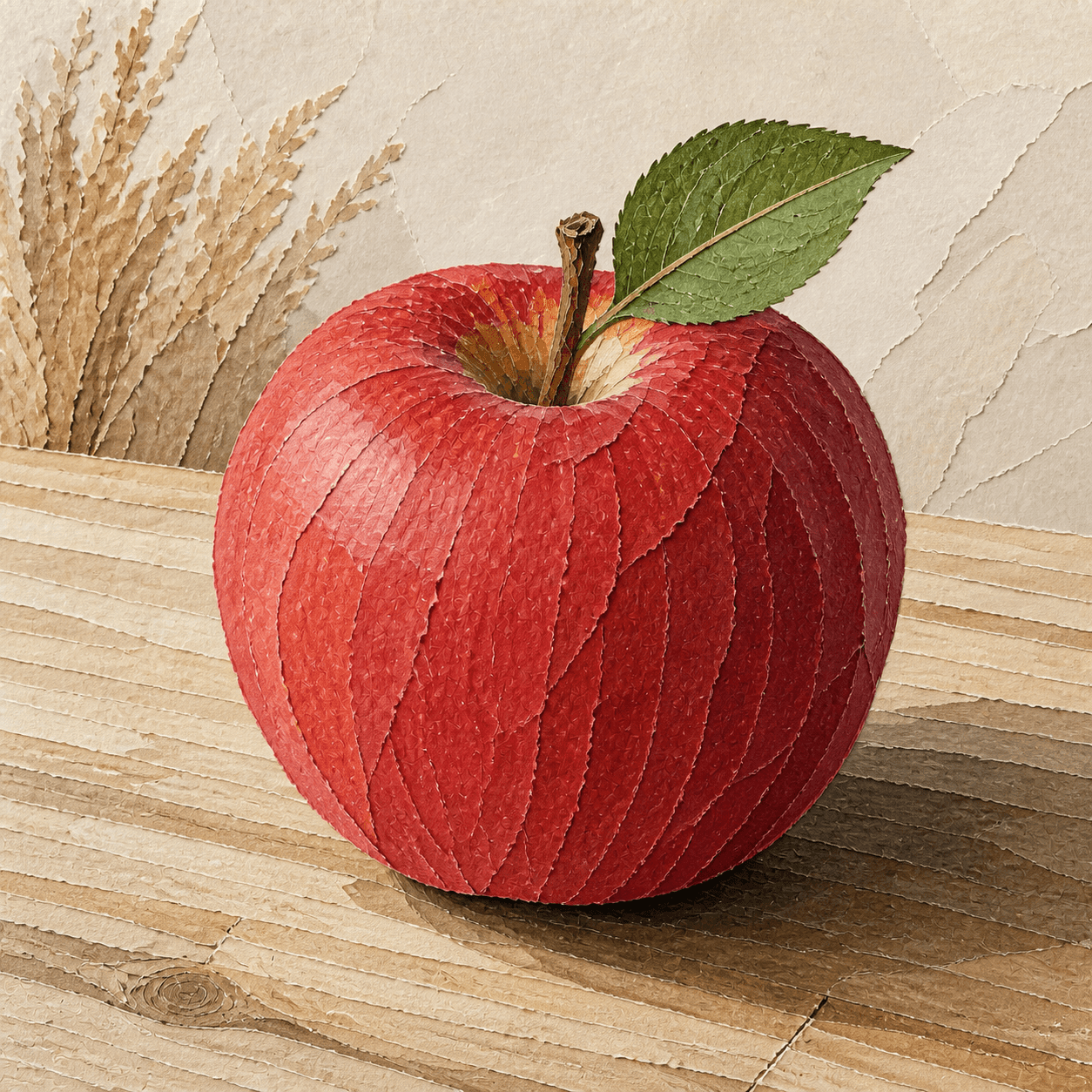
READ THE IMAGE
The apple becomes whole, but its seams refuse to disappear
Red strips overlap with the curve, torn edges acting as contour and value. Table, background, and leaf keep different fibres. Collage does not disguise material as seamless painting; assembly itself remains visible.
- 01
Read the action in an edge
Irregular tears record the hand's direction and give contour speed and touch.
- 02
Build volume through overlap
Narrow strips tile over one another, their seams wrapping the apple's curve.
- 03
Assign roles through material
Skin, leaf, timber, and wall use distinct textures; substance creates separation.
- 04
Preserve the construction
Background cracks and paper relief remain, declaring the image an assembled object.
In one sentence
Move existing fragments into new relations—
let source and new image speak together
Collage illustration cuts and recombines paper, print, photography, textile, or digital fragments, building images through shape, seam, overlap, and difference of origin. It can describe a coherent scene or use semantic conflict for satire, memory, or fantasy. Digital collage belongs when layers retain heterogeneous sources and an assembled logic, even without physical glue.
VISUAL LANGUAGE
Fragment DNA
Material
Heterogeneous, historic
Edge
Cut, torn
An edge defines shape and exposes the making gesture.Layer
Overlap, occlusion
Paper order creates space, time, and editorial relation.Scale
Able to jump
Colliding proportions produce humour, dream, or critique.Meaning
Born in juxtaposition
Sense emerges between fragments rather than from one source alone.Where it came from
Once everyday material entered art, reality became both medium and editable text
Scrapbooks predate modernism. Around 1912 Braque and Picasso pasted wallpaper and newsprint into Cubist pictures. Dada photomontage used mass-media fragments against war and politics; collage later entered publishing, identity narratives, and digital imagery.
Albums and photocollage
Domestic makers combine photographs, watercolour, and print in fantasies of displaced scale.
Cubism introduces real material
Newsprint, faux wood wallpaper, and labels interrupt illusion and assert the physical surface.
Dada and Surrealism expand meaning
Photomontage cuts mass media apart for political satire, chance, and dream.
Identity narrative and digital hybridity
Bearden rebuilds community and memory; scans, layers, and masks move source combination into contemporary media.
ARTISTS & WORKS
Meet it through four makers
Georges Braque
Carries printed paper into Cubist composition so real texture questions depicted space.Hannah Höch
Cuts press images of bodies, machines, and words to critique gender and Weimar society.Henri Matisse
Cuts directly into colour, repeatedly moving paper forms until drawing and carving converge.Romare Bearden
Rebuilds Black community, migration, and memory through syncopated magazine, photograph, and paper fragments.How to recognise it
Test whether difference between fragments makes meaning
- ✓Can you see boundaries left by cutting, tearing, pasting, occlusion, or digital masks?
- ✓Are differences of texture, colour temperature, and resolution deliberately retained?
- ✓Does layer order make space or narrative rather than arbitrary pile-up?
- ✓Do sources gain new meaning once removed and juxtaposed?
STYLE RELATIONS
Three material relations
REFERENCES
Sources & image note
The apple is a contemporary torn-paper exercise focused on fibre, seam, and overlap direction. Historical collage often uses news photographs, words, and found print, where semantic collision matters more than craft texture.