
Chinese Art
Dunhuang Murals
Dunhuang murals are not an antique texture. They are a visual cosmos built through a millennium of cave-making, where devotion, trade, donors, music, dance, and regional traditions meet across walls and ceilings.
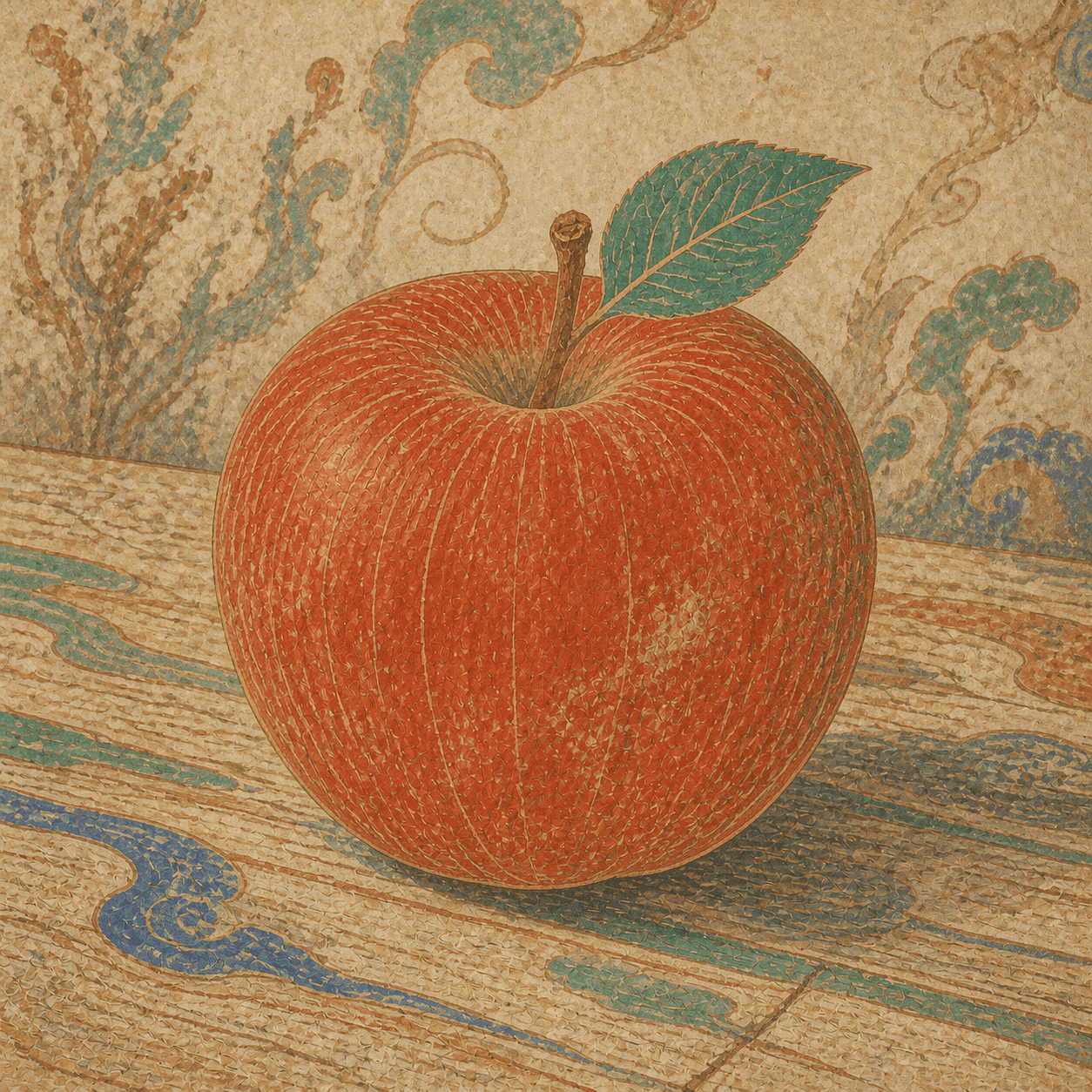
READ THE IMAGE
See the wall before the image: wear belongs to cave time, not a filter
Earth red, mineral green and blue, line, and vine scroll suggest Dunhuang experience. The apple is no Buddhist subject, and the setting reproduces no cave.
- 01
See earth red set the temperature
Ochre-red and fine lines shape the fruit, close to earthen plaster and the vermilion systems common in Dunhuang dress, architecture, and ornament.
- 02
See mineral colours pass through time
Leaf and vines retain blue-green under warm ground and abrasion. Mineral colour feels deposited in a wall rather than freshly filled.
- 03
See line organise form and story
Vertical fruit marks, leaf veins, and vine contours establish shape. Dunhuang line likewise coordinates gesture, flying drapery, and continuous narrative.
- 04
See the fragment belong to a larger room
Cloud, vine, and patterned bands leave the frame, recalling imagery distributed across wall, niche, corridor, and ceiling rather than isolated as easel painting.
In one sentence
Not ‘flying-apsara style’ decoration—
but a total image of cave architecture, ritual, and medieval life
Dunhuang murals usually mean the paintings in the Dunhuang cave complexes, above all Mogao. Artisans coated conglomerate caves with earthen plaster, then used drawn outlines and mineral or earth pigments for deities, sutra illustrations, Buddha lives and jatakas, donors, ornament, and secular life. Images work with sculpture, niche, ceiling, and ritual route. Indian, Gandharan, Central Chinese, Sogdian, Tibetan, Khotanese, and other sources were absorbed into a changing local system.
VISUAL LANGUAGE
Visual DNA
Space
The whole cave is the work
Line
Contour animates figure and ribbon
Elastic drawing maintains body, rhythm, and narrative clarity within planar colour.Colour
Mineral and earth pigments change through time
Cinnabar, ochre, blue, and green meet plaster, darkness, chemical change, and conservation history.Narrative
One wall can hold many times
Jataka, sutra tableau, and daily scene unfold in sequence, juxtaposition, and encircling fields.Exchange
A Silk Roads grammar of mixture
Faces, costume, instruments, pattern, and buildings record circulation and local reinvention.Where it came from
A millennium at Mogao is not one style but a site repeatedly built, sponsored, and translated
Cave date, regime, and donor group change figure proportion, shading, line, composition, and subject. Reducing Dunhuang to High Tang apsaras erases most of its history.
Early caves form transcultural Buddhist imagery
Northern Liang, Northern Wei, and Western Wei jatakas, Thousand Buddhas, and meditation images retain Central Asian traits while absorbing Central Plains costume and line.
Large caves and sutra tableaux create expansive worlds
Unification and Silk Roads exchange support Pure Lands, preaching scenes, apsaras, music, dance, and architecture with confident bodies and integrated colour.
Local regimes and donor families sustain construction
Eighth- to tenth-century caves reflect Tibetan governance and Zhang- and Cao-family networks, with donor portraiture and multilingual culture especially visible.
Images accumulate and form new combinations
The Mount Wutai map, esoteric subjects, and Western Xia styles expand the system; construction wanes by the fourteenth century after a millennium of layering.
ARTISTS & WORKS
Meet it through four caves
Cave 257, Jataka of the Deer King
The nine-coloured deer's tale runs in episodes along a wall; gesture, landscape, and captions organise moral narrative for sequential reading.Cave 220, Medicine Buddha tableau
Buddha, attendants, lamp trees, music, and dance create a vast assembly where religious ideal meets Early Tang costume and social life.Cave 112, pipa dancer
A dancer turns while playing the lute behind the back; ribbon and curve translate music into the body's rhythm in a famous Middle Tang detail.Cave 61, Map of Mount Wutai
Mountains, monasteries, roads, towns, and travellers fill the long wall, combining sacred geography, transport knowledge, and early cartography.How to recognise it
Do not identify only apsaras and cracks; return image to cave, period, and function
- ✓Does imagery work with niche, ceiling, corridor, or ritual movement rather than an independent canvas?
- ✓Do line, flat colour, shading, and mineral-earth pigments reveal a specific period and conservation state?
- ✓Does the subject belong to a functional system of Buddha life, jataka, sutra tableau, icon, donor, or ornament?
- ✓Do costume, instrument, architecture, and figure type reveal exchange among China, India, Central Asia, Tibet, and elsewhere?
STYLE RELATIONS
Different ways images work in sacred and popular space
Dunhuang Murals
Organise devotion, donation, narrative, and Silk Roads exchange within an entire cave.CURRENTHan Stone Relief
Cuts funerary ritual, myth, and social life into stone, often known through black-and-white rubbings.↗Chinese New Year Print
Enters homes through colour woodblock and seasonal display, centring auspicious beings and secular story.↗REFERENCES
Sources & image note
The apple suggests Dunhuang visual language through earth red, mineral blue-green, vine scroll, and worn plaster. It is neither a mural fragment nor a conversion of sacred imagery into product ornament.