
Chinese Art
Han Stone Relief
Han pictorial stones are not ancient picture books. Built into tomb chamber, shrine, and gate, they reorder daily life, historical virtue, and immortal cosmos inside an architecture for the dead.
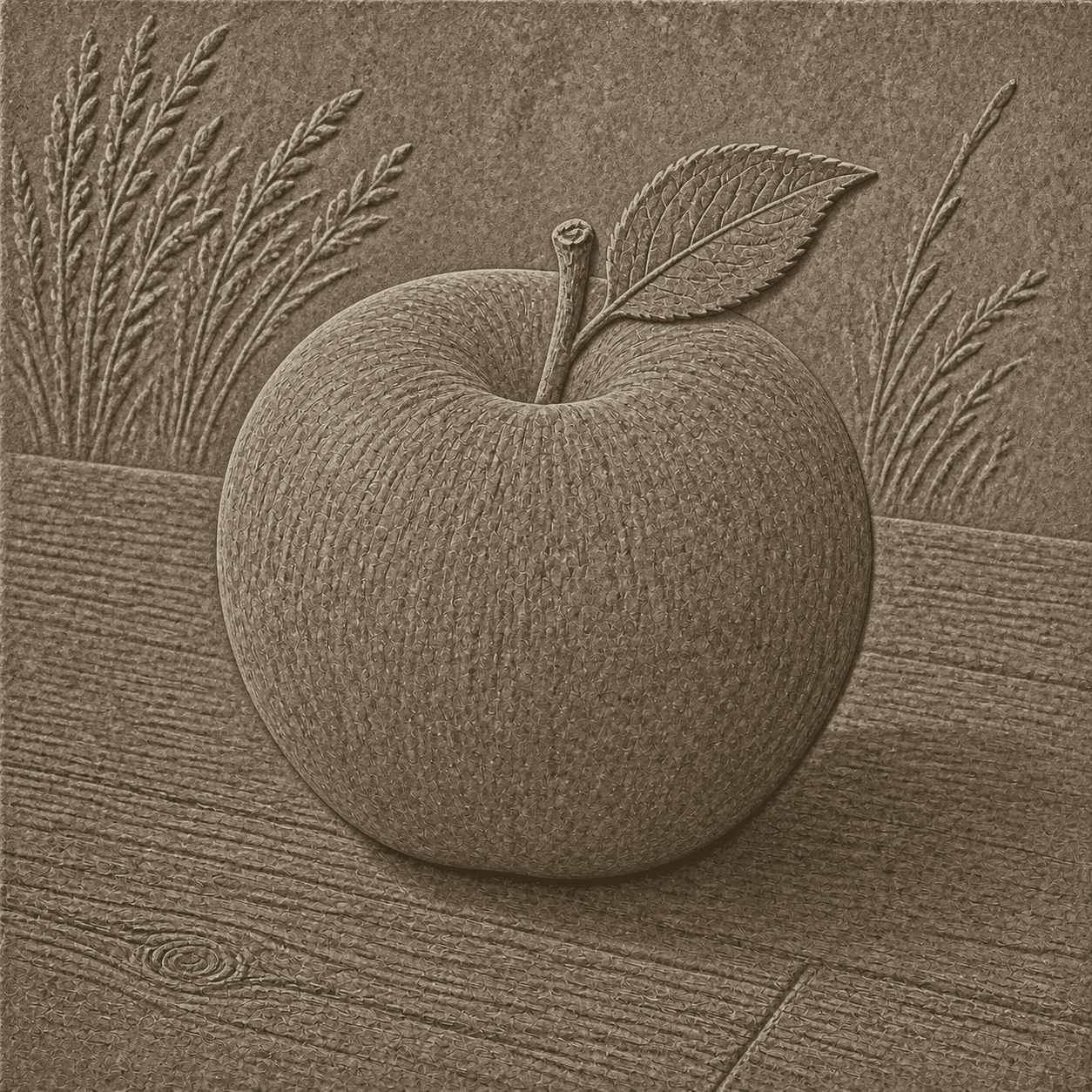
READ THE IMAGE
Do not begin with a rubbing; imagine the chisel making an image appear under raking light
Brown-grey stone, low relief, and dense incision evoke Han pictorial stone. Historical makers combined line engraving, ground reduction, and varying relief.
- 01
See height, not only black and white
Apple and leaf rise slightly above the ground while fine texture and hollow cut inward; raking light moves along edges, making image from level changes.
- 02
See incision compress volume
Dense curved marks do not imitate soft brushwork. Directional cuts use shallow depth to explain roundness.
- 03
See silhouette precede detail
Plant, fruit, and ground separate through firm outer profiles. Han scenes likewise keep chariot, procession, figure, and building legible at distance.
- 04
Return the fragment to architecture
Plants and horizontal bands leave the frame, reminding us that one slab once joined lintel, pillar, and tiered walls to organise an afterlife world.
In one sentence
Not simply painting on stone—
but architectural images that build a world for the dead and declare order to the living
Han pictorial stones are carved architectural elements serving tombs, funerary shrines, gates, and sarcophagi. Incision, low relief, and reduced-ground carving show processions, banquets, entertainments, farming, kitchen work, historical exemplars, filial children, auspicious signs, and immortal realms such as that of the Queen Mother of the West. Images coordinate with door, chamber, upper and lower zones, and ritual action. Together they affirm family status and ideal life while protecting, instructing, and guiding the deceased toward an ordered afterlife.
VISUAL LANGUAGE
Visual DNA
Stone
Chiselled level determines viewing
Silhouette
Outline carries speed and status
Chariot, human, animal, and pavilion remain readable as compressed profiles in crowded scenes.Tiers
Bands and registers organise narrative
Above and below, inside and outside link daily life, historical virtue, guardianship, and ascent.Formula
Repeated motifs form regional vocabularies
Procession, banquet, Fuxi-Nüwa, Xiwangmu, and directional creatures recombine through workshops.Rubbing
Later black and white changed the object
Rubbings aid study and circulation but flatten stone colour, relief depth, architectural position, and possible paint.Where it came from
As tombs became underground houses, Eastern Han patrons joined society and cosmos in carved architecture
Pictorial stone was never one uniform imperial style. Economy, available stone, artisan lineage, and regional tomb structure shaped traditions in Shandong, Nanyang, Sichuan, and beyond.
Underground tombs become multi-room buildings
Hollow brick, pictorial brick, sarcophagus, and stone element increasingly carry images as the tomb becomes a dwelling for continued existence.
Shrines and pictorial stone expand
Ritual could address above-ground shrine and underground chamber as historical tales, labour, life, and divine guardians form complex programmes.
Regional workshops and elite commemoration peak
Wu shrines, Yinan, Nanyang, and Sichuan remains show varied carving; processions, feasts, omens, and ascent reach monumental scale.
Rubbing and antiquarian study create a second life
Scholars copy, catalogue, and recarve Han images. Access increases while conflation, retouching, and loss of context complicate evidence.
ARTISTS & WORKS
Meet it through four monuments
Wu Family Shrines, Shandong
Rulers, filial exemplars, virtuous women, myths, processions, and banquets crowd the chambers; inscriptions linked to 151 and a long history of rubbings made the site canonical.Beizhai pictorial-stone tomb, Yinan
Lintels, pillars, and chamber walls continuously stage processions, feasts, acrobatics, and supernatural beings; architectural position drives narrative.Nanyang pictorial stones, Henan
Forceful humans and animals, combat, chariots, and myth use different depths of ground removal and incision as a regional workshop language.Tai-family pavilion panel
The Queen Mother of the West and attendants order a heavenly court like an earthly one; incision and low relief become ‘painting with a chisel.’How to recognise it
Identify material and original setting before reading above, below, inside, and route
- ✓Does actual relief arise from incision, removed ground, or shallow carving rather than a printed rubbing effect?
- ✓Do firm silhouettes, bands, registers, and repeated motifs suit an architectural element?
- ✓Do subjects combine labour and banquet, historical virtue, auspicious marvel, and immortal ascent?
- ✓Can the slab be returned to chamber, shrine, gate, or sarcophagus so position informs meaning?
STYLE RELATIONS
Wall, stone, and printed paper give images different lives
Han Stone Relief
Uses carved tomb elements to organise social, ethical, and immortal worlds, later circulated through rubbings.CURRENTDunhuang Murals
Uses line, colour, sutra tableau, and patronage across cave walls for Buddhist ritual and narrative.↗Chinese New Year Print
Uses reproducible woodblock and seasonal hanging in household doors, walls, and New Year life.↗REFERENCES
Sources & image note
The apple stresses relief height, incision, and stone colour so Han pictorial stone is not reduced to a black-and-white rubbing. It matches no excavated component and simulates no tomb orientation.