
Printmaking
Etching
Etching lets an artist draw freely through a protective ground before acid bites the exposed line into copper. Recesses hold ink; damp paper enters them under pressure and receives a fine, richly inked image.
READ THE IMAGE
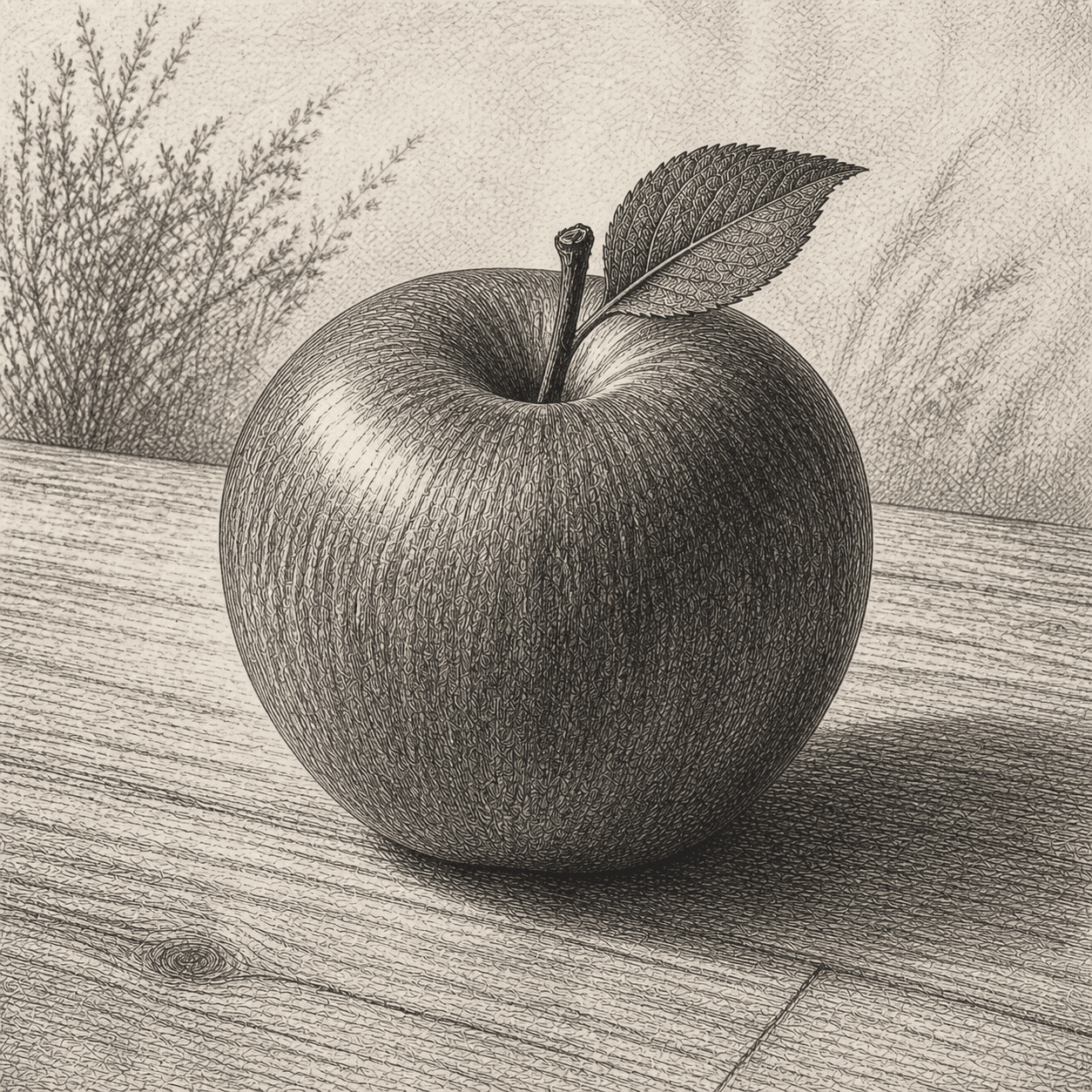
The apple's greys accumulate from line density, depth of bite, and wiping—not brushed shading
Traceable curves cover the form. Crosshatching tightens on the dark flank, while residual surface ink softens the shadow. Needle-like leaf and background marks explain why etching can resemble direct drawing.
- 01
Read the needle's freedom
Contour and veins turn fluently, without the regular swell of a burin pushed through metal.
- 02
Let density become value
Paper carries light; sparse lines make half-tone; repeated crossings construct dark.
- 03
Find plate tone in the reserve
A faint grey may come from deliberately retained surface ink, lending air to blank paper.
- 04
Look for evidence of pressure
An actual impression often bears a plate mark as damp paper is pressed into inked recesses.
In one sentence
Draw through wax as freely as on paper—
then let acid turn that line into an ink-holding groove
Etching is intaglio. A metal plate receives an acid-resistant ground; a needle exposes rather than deeply carves the metal. Acid bites those openings. After the ground is removed, the plate is inked and its surface wiped; roller pressure forces damp paper into the recessed line. Stopping-out and repeated bites vary depth and tone.
VISUAL LANGUAGE
Recessed-line DNA
Line
Free, minute
Bite
Time controls depth
Longer exposure generally deepens grooves and their ink capacity.Wipe
Sets each impression's weather
A clean wipe gives bright reserve; retained plate tone builds smoky middle grey.Press
Damp paper enters line
Heavy pressure transfers detail and can leave a rectangular plate mark.State
One plate keeps changing
Added line, stop-out, drypoint, and scraping generate distinct states of one image.Where it came from
From acid decoration on armour to the intaglio process painters most readily made their own
Late-fifteenth-century German craftsmen redirected armour etching toward paper impressions. Unlike engraving into copper, a needle merely opened the ground, making individual draftsmanship accessible. In the seventeenth century Rembrandt joined etching, drypoint, wiping, and paper choice so every impression could be remade.
Daniel Hopfer redirects armour etching
An Augsburg workshop turns metal-decoration chemistry into printable images.
Renaissance painters adopt it
Dürer, Parmigianino, and Bruegel exploit a line that stays close to drawing.
Rembrandt expands state and impression
Roughly three hundred plates vary through revision, ink, wipe, and paper.
The painter-printmaker returns
French revivalists reject mechanical reproduction; artists continue independent experiment and serial narrative.
ARTISTS & WORKS
Meet it through four artists
Daniel Hopfer
Transforms armour-shop acid work into prints and demonstrates an early range of metallic texture.Rembrandt van Rijn
Mixes etching, drypoint, and burin, then varies wipe, ink, and paper so one plate carries several kinds of light.Francisco Goya
Combines etched narrative with aquatint tone for satire, nightmare, and testimony to war.Louise Bourgeois
Uses hard- and soft-ground line and the physical plate impression to revisit body, architecture, memory, and relation.How to recognise it
Read recess, plate tone, and pressure before naming every fine-line print an etching
- ✓Are lines fine and freely drawn through ground rather than gouged white or regularly cut by a burin?
- ✓Do crosshatching, repeat bites, or aquatint build the darks?
- ✓Is reserve faintly toned by wiping while recessed lines remain richer?
- ✓Does the sheet show a rectangular plate mark around a compressed image area?
STYLE RELATIONS
Three print mechanisms
REFERENCES
Sources & image note
The apple is a contemporary interpretation emphasising minute line, crosshatching, and grey plate tone. A screen cannot convey the full plate mark, raised ink, or compressed paper fibre of an actual copperplate impression, so it demonstrates process logic rather than complete physical evidence.