
Printmaking
Lithograph
Lithography neither cuts relief nor bites a recess. Greasy crayon or tusche draws directly on a flat stone, and oil-water repulsion makes printing ink attach only to the image.
READ THE IMAGE
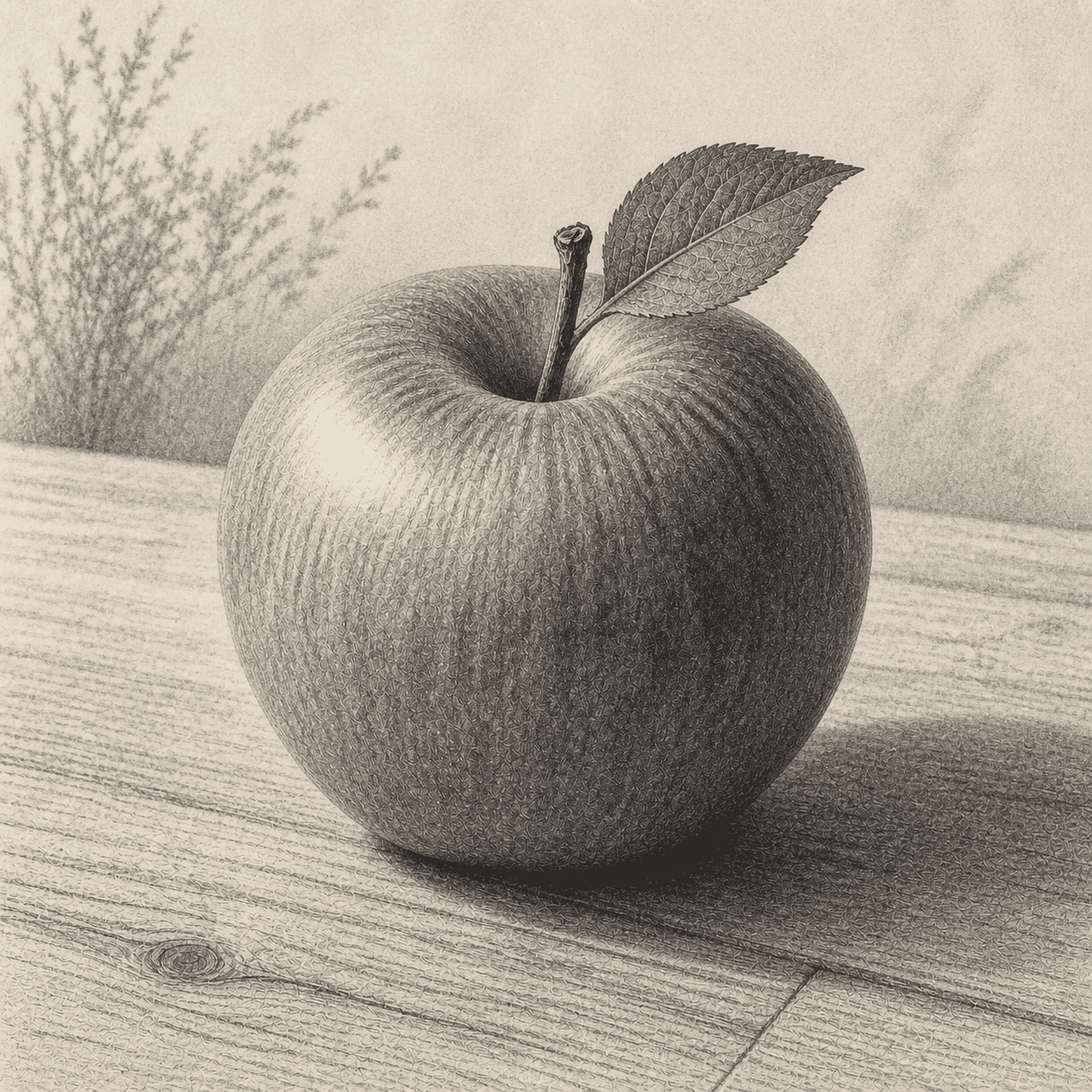
The apple resembles a pencil drawing, but its greasy marks can receive ink repeatedly
Fine fruit grain records crayon meeting a grained stone; background and shadow shift like rubbed drawing. There is no gouge or recessed intaglio line. The matrix remains physically flat.
- 01
Read broken crayon grain
Light pressure catches stone peaks; layered darks progressively close the gaps.
- 02
Keep the immediacy of drawing
Line, broad side, wash, and rubbed haze survive—why painters were drawn to lithography.
- 03
Place black and white on one level
Greasy image accepts ink while damp non-image areas repel it.
- 04
Remember this is an impression
The stone is dampened, rolled, and pressed repeatedly; the print reverses its matrix.
In one sentence
Draw directly on a flat stone—
let oil seek oil while water protects the white
Invented by Alois Senefelder at the end of the eighteenth century, lithography uses greasy crayon or tusche on limestone or a prepared metal plate. Gum arabic and a mild acid establish oil-loving image and water-loving reserve. Before every inking the matrix is dampened; oily ink rejects that film and adheres only to the drawing, which a press transfers to paper.
VISUAL LANGUAGE
Planographic DNA
Plane
No relief or recess
Drawing
Closest to paper gesture
Crayon, tusche, brush, spatter, and rubbing retain their character.Water
Protects the reserve
A moisture film occupies non-greasy areas and blocks oily ink.Oil
Finds the image
The roller deposits ink only on treated greasy marks.Colour
One matrix per colour
Traditional chromolithography requires separate stones or plates and registration.Where it came from
From a playwright's cheap music printing to mass imagery and the modern art poster
Around 1796–98 in Bavaria, Senefelder found that oil-water repulsion could reproduce writing and music from limestone. Lithography spread through news, satire, maps, and commerce. By the late nineteenth century, larger colour printing let Toulouse-Lautrec and peers remake the urban poster.
Senefelder invents lithography
Greasy writing on limestone becomes a repeatable chemical print process for scripts and music.
News, satire, and reproduction
Direct drawing and economical editions let Daumier and others work inside mass circulation.
Colour lithography and modern poster
Larger stones and separated colour join Japanese-print influence in Paris street culture.
Artist-printer collaboration
Metal plates, photolithography, and workshop practice extend the process while hand drawing survives.
ARTISTS & WORKS
Meet it through four makers
Alois Senefelder
Develops oil-water repulsion into a full planographic system for text, music, and image.Honoré Daumier
Uses forceful lithographic drawing to satirise politics, law, and Parisian life through popular journals.Henri de Toulouse-Lautrec
Turns flat colour, contour, spatter, and registration into the public face of modern nightlife.Ruth Asawa
At Tamarind, translates line, folded structure, and botanical observation into experimental collaborative printing.How to recognise it
Seek replicated greasy drawing—not gouge or recessed line
- ✓Does the image retain crayon grain, tusche brush, spatter, or rubbed drawing?
- ✓Do lines lack relief fracture and the ink-rich edges of intaglio grooves?
- ✓Can broad value remain continuous yet granular like a grained stone?
- ✓In colour, do separate printed layers overlap or misregister slightly?
STYLE RELATIONS
Three print mechanisms
REFERENCES
Sources & image note
The apple simulates lithographic crayon on a grained surface and a broad value range. A digital image cannot prove actual dampening, rolling, and pressure, so it teaches planographic appearance rather than serving as a physical impression.