
Printmaking
Woodcut
Woodcut does not draw black on paper. It removes what must not print from a block; the surviving relief is inked, covered, and pressed before a reversed image transfers to the sheet.
READ THE IMAGE
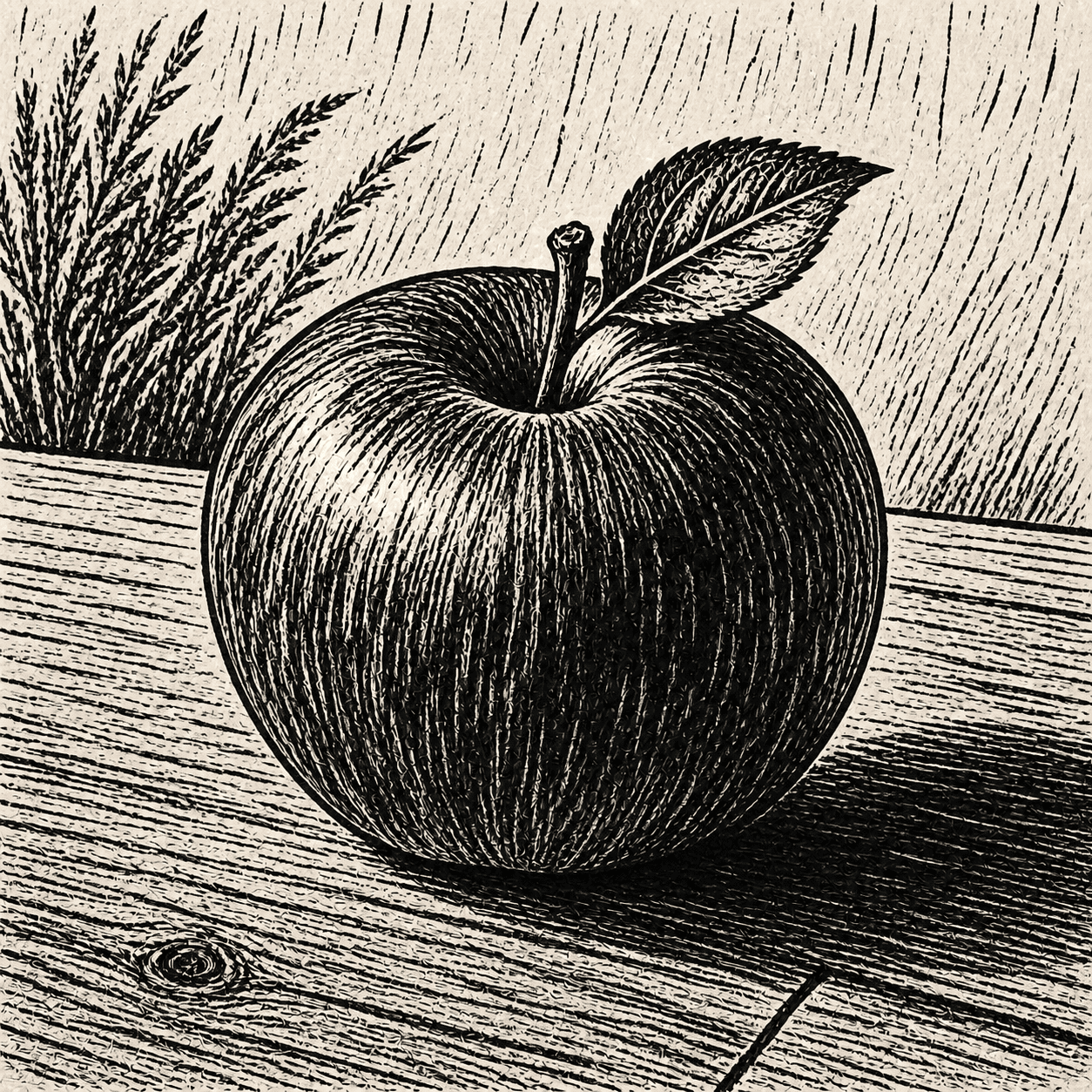
Every white line on the apple is cut out of a future black printing surface
Curved white gouges release the fruit from a dark block. Background cuts retain hand pressure and rhythm, while the shadow relies on a broad uncut relief. Woodcut vision always thinks in positive and negative shape.
- 01
Read white line before black line
Highlights are paper exposed where wood was removed, so marks split, taper, and change width.
- 02
Test whether black can stand alone
The dark flank and cast shadow form a stable mass without detail dissolving their weight.
- 03
Make the gouge follow structure
Curves orbit the cavity and volume; horizontal table cuts distinguish another surface.
- 04
Keep material accident
Uneven ink, grain, and broken edge record wood and pressure instead of smooth vector contour.
In one sentence
Cut away what should not print—
use the remaining relief to organise black, white, and repeatable force
Woodcut, among the oldest print processes, is relief printing. Knife and gouge lower the block around lines and shapes that remain raised, receive ink, and transfer to paper by rubbing or press. The print reverses the block. Multiple colours normally require separate blocks—or progressive reduction—and registration marks to align them.
VISUAL LANGUAGE
Relief DNA
Figure-ground
Cut white, retain black
Gouge
Directional resistance
Wood fibre, tool profile, and the pushing hand shape each edge.Reversal
Block mirrors print
Letter, direction, and composition require backward planning.Pressure
Transfer, not brushing
Ink film, paper moisture, and printing method vary impressions from one block.Edition
Repeatable, never identical
Wear, hand inking, and registration preserve difference within multiplication.Where it came from
From East Asian sutra and image transmission to European print revolution and Expressionist revival
Woodblock printing has a long East Asian history, with early surviving paper examples tied to Buddhist transmission. Woodcut appeared in Europe around 1400. After movable type, its shared relief surface made it ideal for book illustration. Twentieth-century Expressionists deliberately revived the resistance and fracture of the block.
East Asian block printing matures
Texts and Buddhist images circulate through carved wood, paper, and hand rubbing.
European books and independent prints
Relief blocks print beside type; Dürer drives complex line and black-white modelling to a peak.
Japanese ukiyo-e develops colour registration
Designer, carver, and printer coordinate cherry blocks and kentō guides for precise polychrome impressions.
Expressionism rediscovers resistance
Brücke artists and Kollwitz use rough cut, black mass, and grain for modern body, anxiety, and war.
ARTISTS & WORKS
Meet it through four makers
Albrecht Dürer
Proves through dense cut line, crosshatching, and publishing networks that woodcut can carry grand narrative and subtle value.Katsushika Hokusai
Within designer-carver-printer collaboration, coordinates multiple blocks into flat colour, contour, and spatial rhythm.Ernst Ludwig Kirchner
Keeps gouge and fractured contour visible, cutting directly against academic smoothness.Käthe Kollwitz
Compresses grief into monumental groups through broad black, simplified bodies, and few white cuts.How to recognise it
Find relief logic before accepting a simulated woodcut filter
- ✓Do white marks feel removed from black, with tool width and fibre resistance?
- ✓Do black mass and reserve remain legible when the image is reduced?
- ✓Does shade arise from repeated cuts, density, and paper—not a continuous smooth gradient?
- ✓In colour work, can one read separate blocks, registration, or slight printed misalignment?
STYLE RELATIONS
Three print mechanisms
REFERENCES
Sources & image note
The apple is a contemporary interpretation amplifying reversal, curved white cuts, and grain-like broken edges. It is not a scan of an actual impression, so it teaches relief logic rather than documenting every trace of wood, ink, and pressure.