
Digital Art
Holographic
Holographic style borrows the visual cues of holograms and diffraction film: colour slides with angle, and a surface feels like a transparent spatial record rather than neon light emitting by itself.
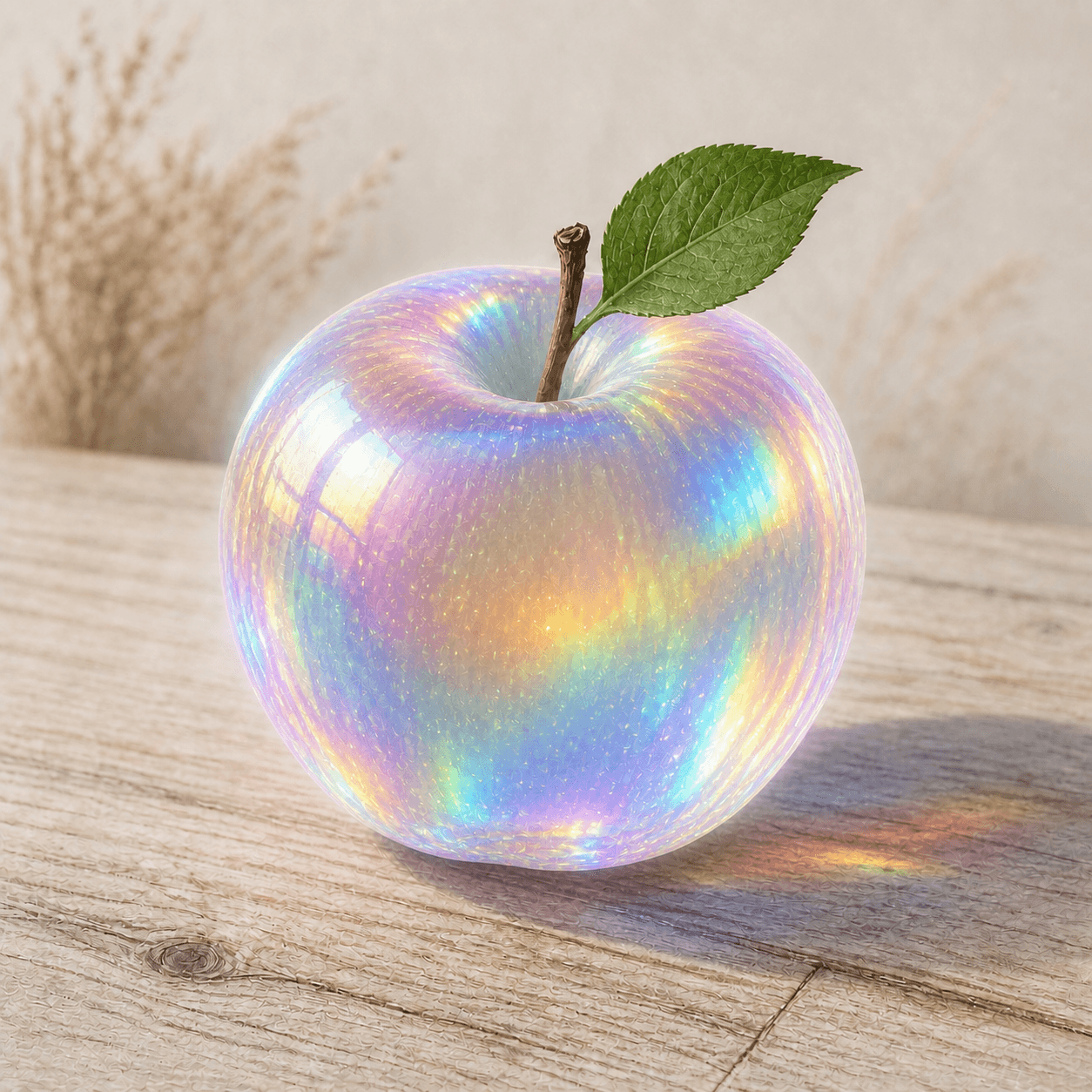
READ THE IMAGE
The apple's colour seems inscribed in a film; shift your viewpoint and its spectrum shifts too
Its skin carries controlled iridescent striation and cool translucency, with slight echo and refraction at the edge. Highlights do not behave like an independent neon source: green, cyan, and magenta appear through illumination and viewing angle.
- 01
Let colour drift with view
Iridescence should change across a face or striation, not sit as a fixed rainbow texture.
- 02
Organise spectrum with fine structure
Parallel or curved micro-lines give colour direction and suggest diffraction rather than arbitrary dye.
- 03
Use transparency for depth
Echo, reflection, and slight parallax can imply spatial information stored in a thin layer.
- 04
Ask where brightness comes from
Holographic surfaces reflect environment; strong emission without lighting logic reads as neon instead.
In one sentence
Use angle-sensitive iridescence,
diffractive striation, and spatial echoes to evoke a surface recorded by light waves
A strict hologram records and reconstructs a light wavefront: coherent object and reference beams make an interference structure which diffracts light to reproduce spatial information, so viewing angle changes what is seen. Design’s “holographic” style often borrows diffraction film, rainbow reflection, scan line, and transparent echo. It need not be a physical hologram, but it should retain a causal relation among angle, microstructure, and illumination.
VISUAL LANGUAGE
Diffractive-surface DNA
Spectrum
Colour follows angle
Striation
Microstructure gives direction
Fine parallel lines, arcs, or grids make iridescence orderly.Layer
Transparency is not disappearance
Film, reflection layer, and echo can retain front and back information together.Parallax
Relative motion suggests depth
As viewer or object moves, interior imagery can shift or switch slightly.Light
Environment activates the surface
Iridescence needs something to reflect; it should not glow equally everywhere.Where it came from
From laser-recorded interference patterns to rainbow holograms, card security, and diffraction film, holographic vision binds image, material, and viewing position
Holographic imaging records interference from object and reference light and reconstructs a wavefront under suitable illumination. MIT materials teach diffraction, rainbow, reflection, and synthetic holograms together. As embossed films and security print spread, angle-changing iridescence became familiar in packaging, tickets, and fashion materials.
Theory and lasers make holography practicable
Coherent sources and interference recording enable viewable holographic images.
Art and rainbow holography grow
Artists and researchers explore depth, colour, and white-light display.
Security and commercial materials spread
Embossed diffraction structures enter cards, packaging, and authentication.
A design vocabulary emerges
Film, screens, and AR borrow iridescence, transparent layer, and parallax—without all being true holograms.
ARTISTS & WORKS
Meet it through four cases
Dennis Gabor
Proposed holography's principle and later received the Nobel Prize, establishing the concept of recording a wavefront.Stephen Benton
Developed rainbow holography for more accessible white-light viewing and broad visual influence.MIT Museum hologram collection
Art and technical works show how holograms can be both scientific record and spatial image.Security diffraction film
Microstructures make angle-changing colour for tickets, packaging, and identification.How to recognise it
Find angle-sensitive iridescence and microstructure first, then test whether transparent layers, depth cues, and environmental light agree
- ✓Does spectrum change with striation, curvature, or viewing direction instead of static rainbow fill?
- ✓Can fine lines, grids, or film layers explain the iridescence?
- ✓Do echo and transparency clarify space rather than erase the subject?
- ✓Does brightness depend on environmental reflection rather than undifferentiated emission?
STYLE RELATIONS
Three angle-sensitive lustres
Holographic
Diffraction iridescence, microstructure, transparent layers, and parallax borrow holographic imaging's language.CURRENTMetal
Environment reflection, roughness, and curvature organise mirror or brushed highlights.↗Neon Art
Continuous luminous tubing, bright core, and bloom in darkness shape night signage.↗REFERENCES
Sources & image note
The apple is a holographic-style teaching interpretation using diffractive iridescence, microstructure, and transparent echo. It is not an optical hologram or a recreation of any security mark.