
African Art
Kente
Kente is not a red-yellow-green-black check printed on any product. Asante and Ghanaian-Togolese Ewe specialists weave long narrow bands on horizontal looms, then cut, reverse, sequence, and stitch them edge to edge as large prestige wrappers; design name, material cost, draping, and occasion make identity.
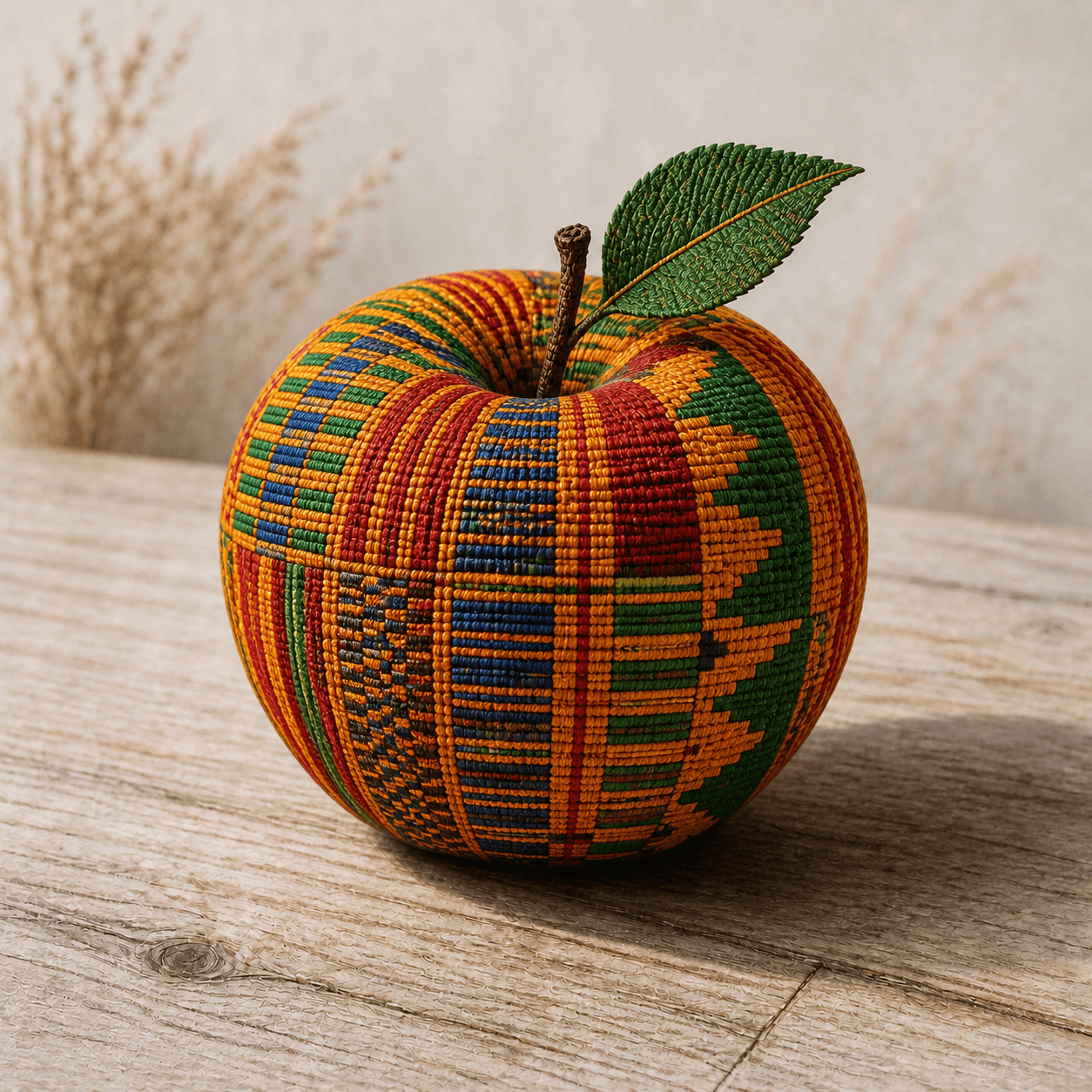
READ THE IMAGE
Follow the seams back into narrow bands, then see how warp and weft make blocks instead of merely counting colours
Red, yellow, green, and blue strip-weave texture curves around the apple. It reveals banding but obscures the planar sequence of weaving a long strip, cutting it, rearranging it, and sewing it into cloth.
- 01
Find vertical bands and seams
Several upright zones divide the fruit with heavier boundaries. A real kente grid begins with loom width and selvedges stitched together.
- 02
Separate warp stripe from supplementary weft
Fine vertical colour lines resemble the warp foundation while raised horizontal rectangles and steps resemble extra weft floating above; their crossing generates rhythm.
- 03
See offset resist a mechanical checkerboard
Red, blue, and green blocks do not align across every neighbouring band; reversals and intervals create diagonal movement. Weavers compose through sequencing, not a seamless tile.
- 04
See curvature exaggerate textile thickness
Yarn becomes cord-like grain and bands radiate into the apple cavity. Actual kente drapes and folds; its pattern is not a rigid embroidered shell fixed to volume.
In one sentence
Not a Pan-African-colour printed check—
but narrow band, woven structure, named design, and ceremonial drape stitching technique, status, and memory into cloth
Kente's visual unit is the long band determined by loom width. A double-heddle horizontal treadle loom makes warp stripes, and chosen intervals receive supplementary weft or weft-faced blocks; the finished strip is cut into equal lengths, oriented and sequenced, then hand- or machine-sewn along selvedges. Asante practice is closely tied to court, clan, and restricted designs, while Ewe work often includes more figurative inserts, letters, and lengthwise designs without borders, though differences are not absolute. Names may invoke proverb, person, event, or virtuosity, and colour meanings change by cloth, commission, and time. Internet charts giving every colour one universal virtue cannot replace provenance.
VISUAL LANGUAGE
Visual DNA
Narrow strip
Loom width establishes the grammar
Warp/weft
Ground stripe and insert carry different tempos
Continuous warp sets the vertical skeleton while supplementary floats and weft-faced blocks intensify, recolour, and name local intervals.Assembly
Reversal and offset compose the field
Adjacent strips can turn, flip, and shift so blocks answer across seams without becoming a perfectly symmetric grid.Naming
Design joins cloth to language and event
Names such as Oyokoman, adweneasa, and sika futuru invoke clan, ‘exhausted skill,’ gold dust, and social memory and must be checked object by object.Drape
Fold and body complete the work
A large man's cloth commonly wraps toga-like over the left shoulder while women's ensembles use smaller cloths; walking, sitting, and ceremony alter visibility.Where it came from
From West African strip weaving and Asante court patronage through imported silk and Ewe invention to independence ceremony and global Pan-African sign
Spider-weaver origin stories and competing claims of priority carry cultural value but are not documentary chronology. Cotton, regional loom practice, trans-Saharan and Atlantic trade, royal control, and weaver migration all shape the tradition.
Regional strip weaving supplies the technical base
West African weavers long make narrow cotton cloth; as the Asante state forms, a royal weaving centre near Kumasi connects costly designs with court rank.
Imported silk expands colour and royal luxury
Weavers unravel European and Asian silk goods for bright yarn, increasing supplementary-weft work while Asante rulers restrict some designs and materials.
Asante and Ewe workshops absorb colonial markets and new fibre
Cotton, silk, rayon, and synthetics mix; Ewe artists insert animals, objects, letters, and people, machine stitching joins bands, and naming follows fashion.
Ghanaian independence and diaspora give new political life
Nkrumah wears kente in state ritual and red-yellow-green-black enter Pan-African vision; graduation stoles, churches, fashion, and prints globalise recognition while blurring woven and printed.
ARTISTS & WORKS
Meet structure, patronage, and circulation through four cloths
Asante royal Oyokoman man's cloth
A broad red warp stripe framed by yellow and green runs through joined silk bands. Design connects the ruling Oyoko clan and Prempeh II's court while fibre and scale mark rank.Asante sika futuru/adweneasa cloth
Dense supplementary weft fills nearly all available space like gold dust; adweneasa, ‘the weaver's skill is exhausted,’ displays labour, mathematical order, and elite commission.Ewe susuvu man's wrapper
Twenty cotton strips combine geometry, bird, person, or object within borderless warp; front and reverse bands may be mixed for total rhythm, reflecting more fluid Ewe naming.Kente in Nkrumah-era independence ceremony
Draped prestige cloth brings chiefly language into a modern republic and Pan-African politics. Meaning comes from body, speech, and historical occasion rather than colour chart alone.How to recognise it
Test woven structure, band assembly, Asante/Ewe difference, and wearing context layer by layer
- ✓Can you see real warp-weft interlace, supplementary floats, selvedges, and strip seams, or has industrial print simulated checks on broad cloth?
- ✓How are bands cut, reversed, offset, and joined, and are men's or women's dimensions and drape correctly described?
- ✓Was it made by an Asante or Ewe weaver, and are region, design name, fibre, commissioner, and occasion evidenced?
- ✓Does colour meaning come from this cloth's oral history, archive, or weaver, or from one global symbolic chart applied to everything?
STYLE RELATIONS
Woven structure, industrial surface pattern, and carved material need separate readings
Kente
Uses narrow loom, warp-weft insert, band stitching, and ceremonial drape to make Asante and Ewe prestige textile.CURRENTMemphis
An Italian 1980s design group uses industrial laminate, speckle, and geometric collage against modernist taste, not a weaving tradition.↗African Woodcarving
Builds figures and objects through subtractive timber, cared-for surface, and social use under another material logic.↗REFERENCES
Sources & image note
Vertical bands, red-yellow-green-blue blocks, and granular yarn evoke kente, but the teaching image hardens a soft plane around a volume and hides true selvedge seams and reverse floats. It demonstrates band and warp-weft rhythm only.