
Korean Art
Korean Minhwa
Korean minhwa is not merely court painting made ‘naively,’ nor a label for every anonymous old Korean picture. It turned wishes for children, longevity, office, marriage, protection, and family virtue into hangable, replaceable images, making the home a stage for aspiration and social order.
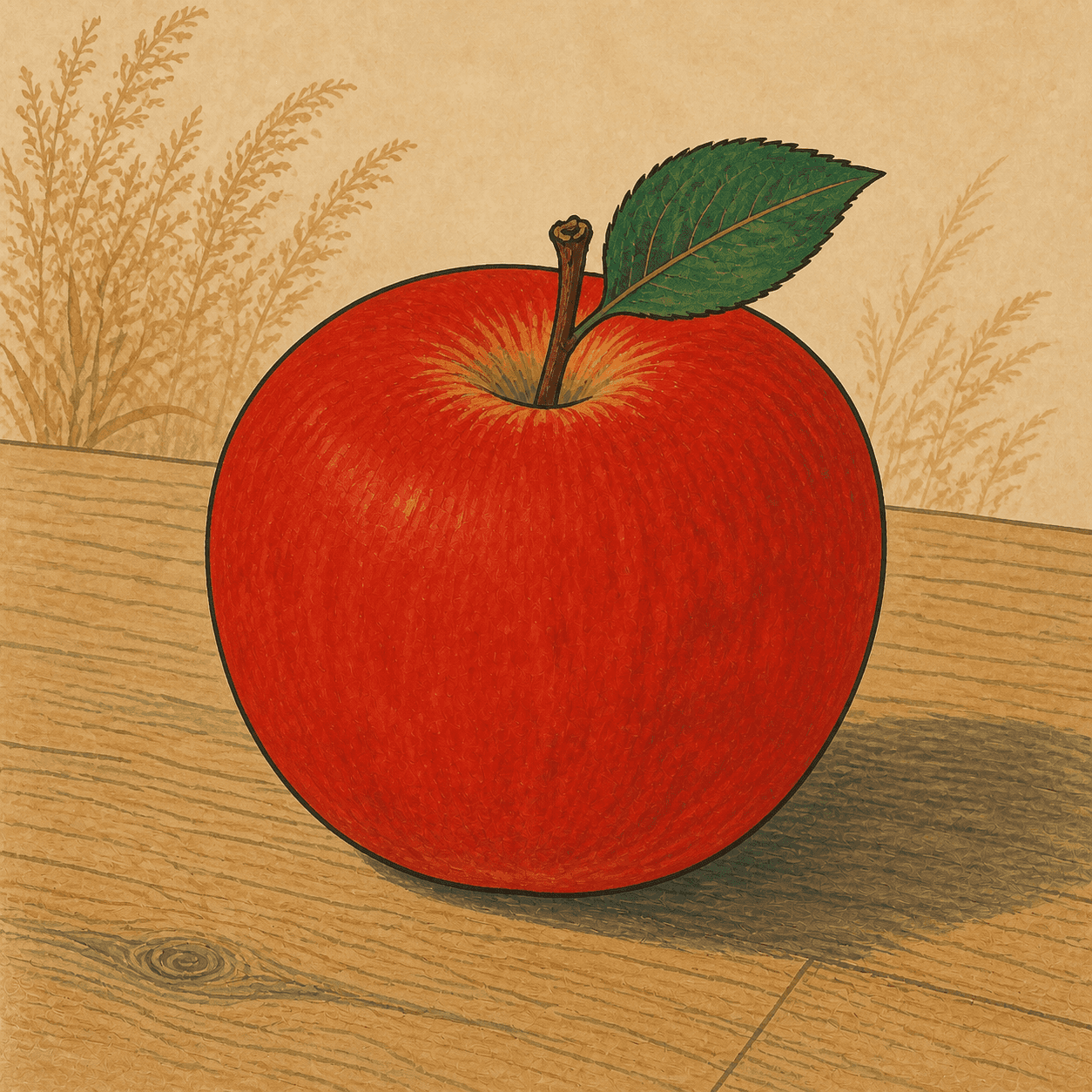
READ THE IMAGE
Before calling contour and red ‘childlike,’ ask what wish the image was meant to perform at home
Strong outline, full vermilion, frontal enlargement, and warm paper suggest minhwa. Historical paintings depend on constellations of emblems; the apple is not a fixed central motif.
- 01
See contour turn object into emblem
A nearly even dark line seals the fruit so recognition comes before red colour. The edge is clearer than one seen in natural light, useful across a room or screen.
- 02
See vermilion carry a wish
Red occupies nearly the entire body while modelling yields to brilliance. Minhwa colour often communicates celebration, vitality, and protection directly.
- 03
See scale cancel ordinary still-life relations
The apple rises almost the full image height as plants retreat. Real proportion yields to thematic rank, as tiger, peony, or books become protagonists in different screens.
- 04
See plane and shadow coexist
A cast shadow remains at lower right while the fruit flattens and the background lacks one unified perspective. Late decorative painting can absorb realist clues without surrendering emblematic plane.
In one sentence
Not one brush manner—
but symbolic decorative painting moving across late-Joseon court, market, home, and ritual
Minhwa is a modern category systematised in the twentieth century around Joseon paintings that originally bore different names, functions, and production levels. Makers could be court painters, urban professionals, itinerant painters, or regional artisans; models moved among royal ceremony, scholars' rooms, bridal quarters, New Year doors, and religious settings. Rebus, material property, story, and combination built meaning: pomegranate seeds evoked descendants, peony wealth, books and studio objects learning and office, while a tiger could repel evil and be teased by a magpie. ‘Folk’ therefore names a network of reuse and repainting, not isolation from the court.
VISUAL LANGUAGE
Visual DNA
Emblem
Objects form a grammar of wishes
Screen
Image enters domestic and ritual space
Folding panels divide a room and build a setting, opened for wedding, birthday, New Year, or study.Frontality
Important things enlarge and unfold
Scale, stacking, and multiple viewpoints keep each item readable; one vanishing point is not the priority.Colour
Bright pigment and ink line carry auspice
Mineral blue-green, vermilion, powder white, and black form bold contrast, often becoming more graphic in later works.Circulation
Court models travel and mutate
Royal Ten Longevity and chaekgado screens are reworked by professionals while folk tiger-magpie imagery enters modern national memory.Where it came from
From royal auspicious screens and scholars' studios to commodity cities, household ritual, and the modern category ‘minhwa’
Joseon culture was never only literati ink. Economic growth, seasonal custom, women's quarters, examination hopes, and traded goods widened the market for colour decoration; anonymity does not mean absence of skill or labour structure.
Court and elite decorative genres mature
Ten Longevity Symbols, peony, Sun-Moon-Five-Peaks, and scholar's objects serve royal and elite settings; Qing curiosities and perspective stimulate chaekgado.
King Jeongjo promotes chaekgado
The king uses packed bookshelves to embody learning and rule; court painters develop illusionistic cabinets before homes adapt the genre toward office and possession.
Urban markets multiply variants
Professional painters produce tiger-magpie, characters, flora, fish and crab, and longevity screens; workshops and customers make designs brighter, more abstract, and witty.
Minhwa is named, collected, and revived
Colonialism and modernisation displace original settings; scholars and collectors establish the category while contemporary painters renew pigments and symbols and debate anonymity, class, and gender.
ARTISTS & WORKS
Meet it through four image systems
Tiger and Magpie
A magpie announces good news above a mottled tiger that protects yet looks comic. Satire of authority is possible, but should not replace evidence from a specific setting.Ten-panel Chaekgado screen
Books, bronzes, ceramic, stationery, flowers, fruit, and imported curios pack illusionistic shelves, joining scholarship, collecting desire, global trade, and social ascent.Eight-panel Munjado screen
Characters for filial piety, fraternity, loyalty, trust, propriety, righteousness, integrity, and shame fill with fish, birds, plants, and stories, merging instruction with pattern.Ten Longevity Symbols screen
Sun, cloud, mountain, water, pine, bamboo, deer, turtle, crane, and fungus create a supernatural land of long life for royal celebration and household birthday.How to recognise it
Read emblem system, furnishing function, and production level—not one word such as ‘naive’
- ✓Do tiger-magpie, books, characters, peony, fish, or longevity beings form an interpretable system of wishes?
- ✓Was it a multi-panel screen, door image, or hanging picture, and for which room, festival, wedding, birthday, or rite; what is lost when panels are separated?
- ✓Do plane, reverse perspective, saturated colour, and exaggeration preserve legibility and symbolic rank rather than prove inability to render realism?
- ✓Can court painter, refined professional workshop, regional version, and modern imitation be distinguished while models still move across classes?
STYLE RELATIONS
Household wish, seasonal print, and commercial publishing use different systems
Korean Minhwa
Embeds ethics, protection, office, marriage, fertility, and longevity in Joseon household and ritual through screens and hangings.CURRENTChinese New Year Print
Uses woodblock replication and annual pasting to renew door gods, drama, and auspicious imagery through another production system.↗Ukiyo-e
Uses publisher, carver, and printer collaboration for Edo actors, places, fashion, and urban consumption.↗REFERENCES
Sources & image note
Strong contour, vermilion, enlarged scale, and paper tone interpret minhwa decoration, but the apple lacks a historical screen format and emblem constellation; it cannot replace tiger-magpie, bookshelves, characters, or Ten Longevity Symbols.