
Japanese Art
Ukiyo-e
Ukiyo-e is not a generic ‘Japanese flat style.’ It was Edo's commercial image network, where publisher, designer, carver, and printer turned actors, sights, fashion, and desire into affordable, collectible, quickly renewed media.
READ THE IMAGE
See a printed object before looking for a ‘Great Wave style’
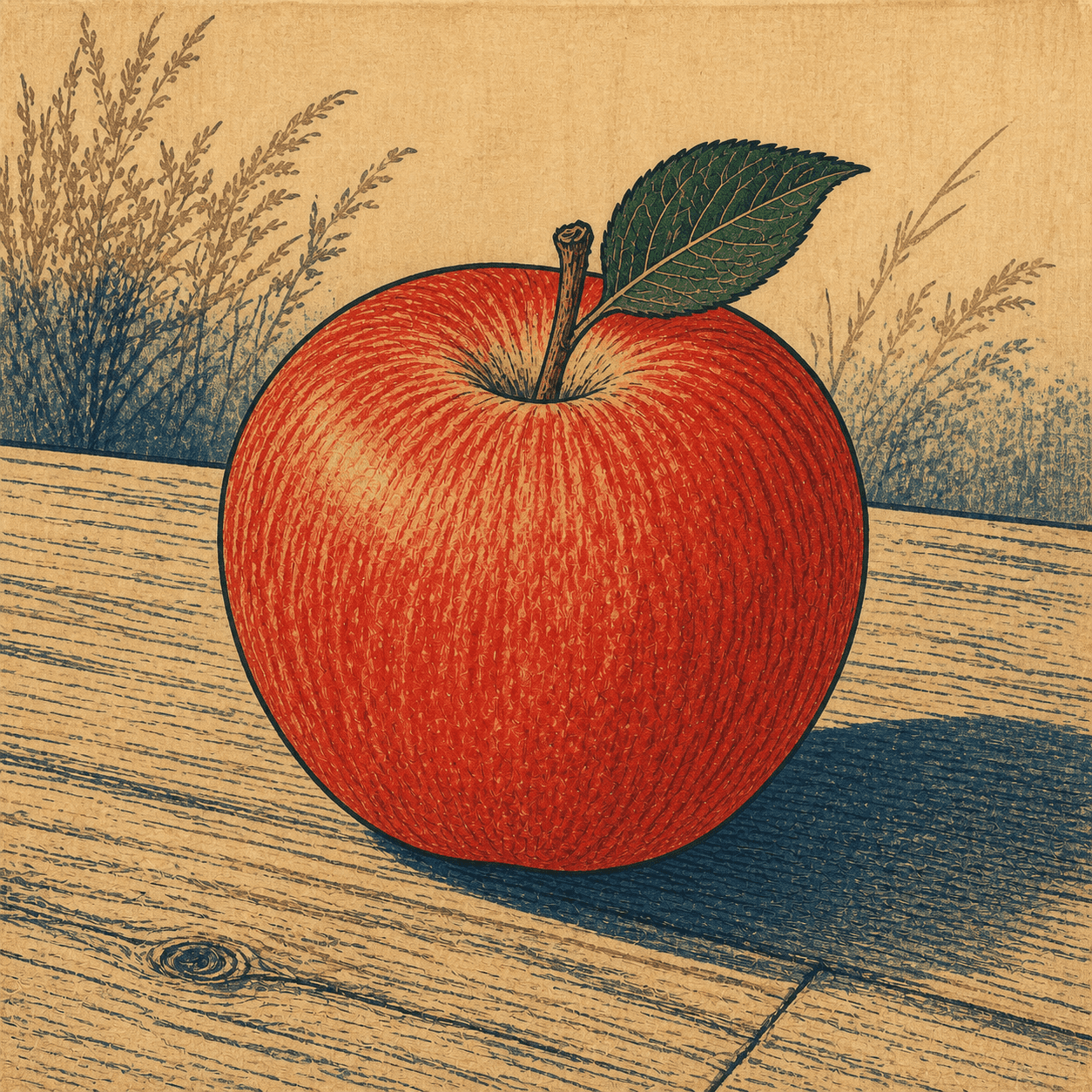
Bold key line, vermilion and indigo blocks, warm washi, and assertive cropping evoke nishiki-e. The apple belongs to no historical series.
- 01
See key line govern colour
Continuous dark edges lock fruit, leaf, and stem so registered red texture can vary without losing the form.
- 02
See few blocks make sharp contrast
Vermilion, dark green, and indigo occupy discrete fields while paper supplies highlight; volume comes through colour shape more than oil-like shading.
- 03
See diagonal turn still life into an instant
The table edge climbs across the sheet, fruit sits slightly off centre, and plants leave the frame, creating the energy of a cropped urban glimpse.
- 04
See blue shadow become pattern
The lower-right shadow compresses into one indigo mass answering the plants. It balances the page rather than obeying natural light alone.
In one sentence
Not every Japanese woodblock print—
but an image culture made and consumed around Edo's ‘floating world’
Ukiyo-e means ‘pictures of the floating world.’ A Buddhist homophone for sorrowful transience was recast in Edo as present pleasure and fashion, especially entertainment districts, kabuki, travel, and urban celebrity. The school includes painting but is most influential through commercial woodblock. A publisher chose subject, capital, and distribution; the artist supplied a design; a carver pasted it face-down on cherrywood for key and colour blocks; a printer used registration notches and a baren on washi. It was collaborative media, not reproduction of one artist's autonomous original.
VISUAL LANGUAGE
Visual DNA
Key block
Black line builds a reproducible world
Registration
Kentō makes separate blocks meet
Corner and edge notches position damp washi for each colour; slippage and block wear also reveal an impression's history.Plane
Colour shape and crop outweigh unified perspective
Enlarged foreground, diagonal, void, and edge cut create speed and tension within a small sheet.Printing
Gradation and embossing belong to the printer
Bokashi, blind embossing, mica, and other effects depend on water, pigment, pressure, and repeated control.Publishing
Images update with the market
Series, actor fame, censor seals, publisher marks, and reprints locate each design inside urban information flow.Where it came from
From monochrome Edo pictures to polychrome nishiki-e, famous places, and global modernity
Its development depended on urban population, publishing, kabuki, and travel. The celebrated ‘floating world’ also involved censorship, exploitation in licensed quarters, and commercial competition.
Edo genre imagery and monochrome prints establish the field
Hishikawa Moronobu and others move pleasure, romance, and beauty from illustrated book to single-sheet ink prints and hand colour for townspeople.
Nishiki-e matures as multicolour registration
Technology and market around Suzuki Harunobu allow many blocks to meet precisely on one sheet as publisher, carver, and printer specialisation deepens.
Beauty and actor portraits reach new intensity
Kitagawa Utamaro examines pose and fashion through large heads while Tōshūsai Sharaku exaggerates face and role psychology in fan culture.
Landscape, warrior, and news expand before transformation
Hokusai and Hiroshige popularise place series; Kuniyoshi develops warrior and satire; photography, lithography, and modern society alter the old publishing system.
ARTISTS & WORKS
Meet it through four works
Suzuki Harunobu, Visiting a Shrine on a Rainy Night
Slender figures, night weather, and textiles meet in soft polychrome, showing early nishiki-e marketing poetry and urban fashion.Kitagawa Utamaro, Three Beauties of the Present Day
Three celebrities share an ideal face but differ through eye, gesture, and crest, revealing large-head portrait and name consumption.Katsushika Hokusai, Under the Wave off Kanagawa
Great wave, Fuji, and boats join Prussian blue, disruptive scale, and curved force in the Thirty-Six Views of Mount Fuji.Utagawa Hiroshige, Sudden Shower over Ōhashi and Atake
Bridge diagonal, ruled rain, and open far bank turn weather into rhythm while printed blue gradation builds depth.How to recognise it
Judge publishing collaboration, key-block colour, and subject market together
- ✓Can key line, separate colour blocks, kentō registration, and printer effects be distinguished from uniform digital outlines?
- ✓Do enlarged foreground, edge cropping, diagonals, and bare paper generate planar tension?
- ✓Do actor, beauty, place, or warrior connect to a series, publisher, censorship, and urban consumption?
- ✓Is it painting, monochrome print, nishiki-e, or later recut reproduction, and does impression quality change the reading?
STYLE RELATIONS
Court narrative, Zen ink, and urban publishing are different systems
Ukiyo-e
Uses collaborative commercial woodblock and contemporary Edo subjects for an urban mass market.CURRENTYamato-e
Builds courtly narrative, season, and famous-place traditions centuries before ukiyo-e.↗Rinpa
Reworks decorative nature on gold-silver ground across painting, craft, and design lineages.↗REFERENCES
Sources & image note
The apple interprets nishiki-e through key line, registered colour, paper reserve, and crop. With no publisher, censor seal, or edition history, it is not an Edo print.