
Japanese Art
Rinpa
Rinpa is neither a fixed academy with an unbroken master-pupil line nor a decorative recipe of ‘gold plus flowers.’ Artists separated by generations deliberately revisited classical literature and earlier works, repeatedly redesigning poetry, painting, calligraphy, ceramic, lacquer, and textile.
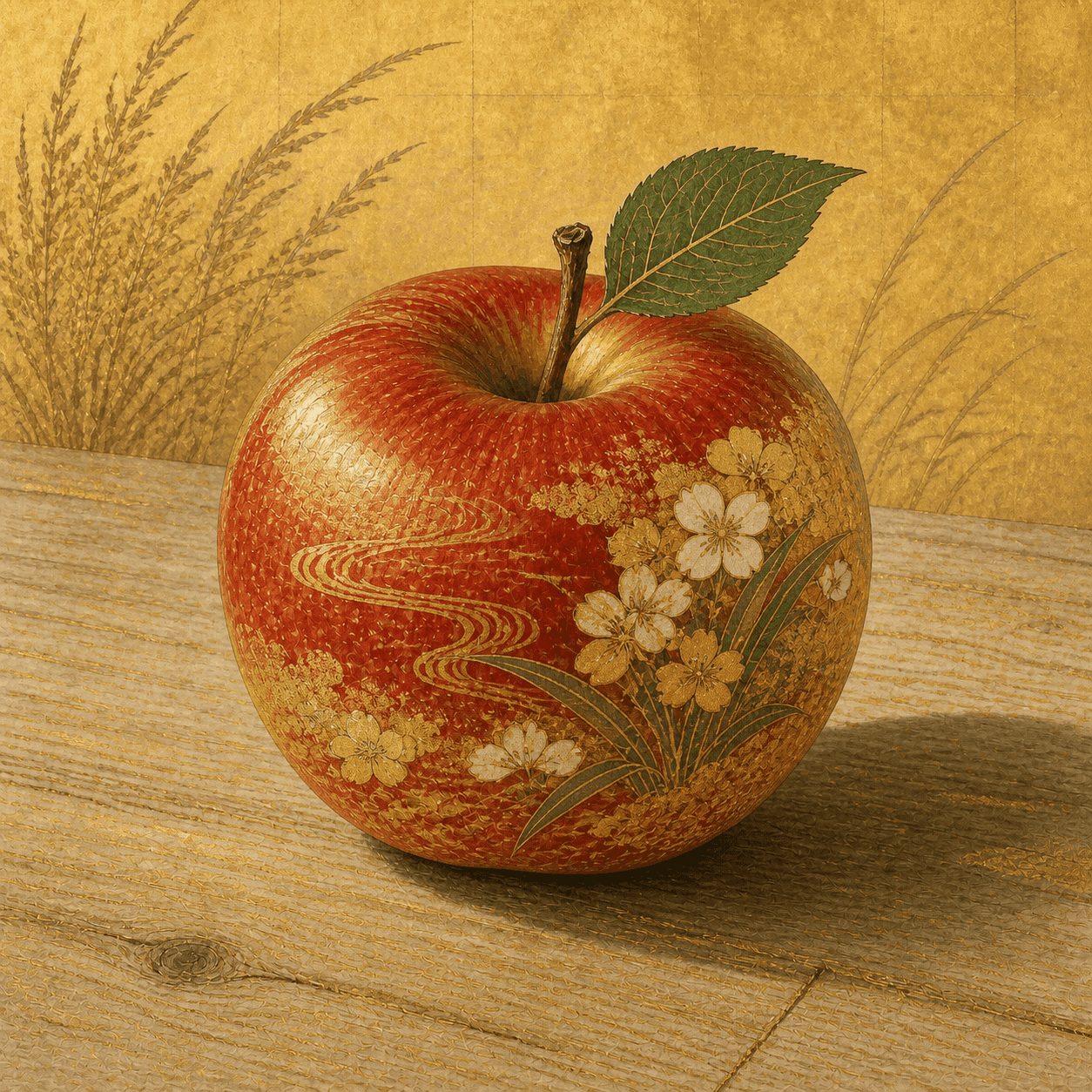
READ THE IMAGE
Look past golden splendour to see nature compressed into a rhythm that can migrate across media
Gold-leaf seams, a vermilion field, water curves, and spring grasses laid directly over the apple suggest Rinpa materials and design logic without quoting one historical object.
- 01
See gold as material and space
Square foil seams remain visible. Gold does not imitate sky; it reflects the viewing room and compresses ordinary depth into changing light.
- 02
See the fruit become an object surface
The apple's volume flattens as golden water and flowers cross its curve, like lacquer, ceramic, or kosode pattern relocating nature onto a thing.
- 03
See curves replace realistic water
A few parallel gold lines merely signify a stream, yet their tightening and release steer the eye. Rinpa often turns phenomena into reusable design.
- 04
See clustering and vacancy make rhythm
Flowers mass at lower right while upper left retains red ground and water. Uneven density gives the form the unfolding tempo of a screen rather than all-over fill.
In one sentence
Not an unbroken hereditary ‘school’—
but an aesthetic genealogy repeatedly invented through copying, commemoration, and redesign
In early seventeenth-century Kyoto, townsman-calligrapher Hon'ami Kōetsu and painter Tawaraya Sōtatsu brought Heian poetry, tales, and yamato-e motifs into decorated paper, calligraphy, fans, and screens. Roughly a century later, Ogata Kōrin and his brother Kenzan studied and reorganised that legacy, moving bold designs through lacquer and ceramic. In nineteenth-century Edo, Sakai Hōitsu used collecting, copying, exhibitions, memorial ritual, and the printed Kōrin Hyakuzu to construct a lineage; Suzuki Kiitsu extended it. Because the name Rinpa only stabilised in modern art history, it describes deliberate acts of looking back and remaking more than one organised workshop.
VISUAL LANGUAGE
Visual DNA
Metal
Gold and silver bring ambient light inside
Abstraction
Nature contracts into edge, field, and rhythm
Wave, flower, leaf, and bird stay legible while continuous space gives way to patterned repetition and interruption.Tarashikomi
Wet colour blooms inside wet colour
A second ink or pigment is dropped before the first dries, producing rims, pools, and accidental texture especially associated with Sōtatsu.Classic
Allusion can omit the complete story
Eight Bridges, Ise, Genji, waka, and seasonal plants condense to a few objects that invite a learned viewer to complete the reference.Craft
Design migrates between materials
Floral curves pass among painting, ceramic, maki-e, textile, and print; each resistant material reshapes the composition in return.Where it came from
From Kyoto townsmen and courtly revival to Kōrin's redesign and Hōitsu's deliberate Edo genealogy
Rinpa did not develop as one stable studio line. Different cities, classes, and media selected predecessors anew at historical turns, while modern exhibitions and design history further organised the category.
Kōetsu and Sōtatsu join word, image, and paper
Saga books, poem sheets, fans, and screens connect Kyoto townsmen, court taste, and craft; Sōtatsu's gold, plane, and tarashikomi establish key resources.
Kōrin and Kenzan reread their predecessors
Raised in a luxury textile family, the brothers knew classical clothing and objects; Kōrin simplified Sōtatsu while Kenzan made writing, painting, and ceramic one surface.
Hōitsu constructs a memorial lineage in Edo
Kōrin's death centennial, an exhibition, and Kōrin Hyakuzu turn scattered images into reproducible history; Edo Rinpa stresses season, fine line, and lyricism.
Kiitsu and modern design keep transforming it
Suzuki Kiitsu enlarges plants and estranges scale; print, craft, international fairs, and design culture make Rinpa an enduring resource for recombination.
ARTISTS & WORKS
Meet it through four works
Tawaraya Sōtatsu, Wind God and Thunder God Screens
Two deities press against opposite edges of gold while the central void becomes limitless sky; drums, wind sack, and bodily arcs confront each other across folds.Ogata Kōrin, Irises Screens
Blue-green blossoms repeat, shift, and pause on gold; an Eight Bridges episode from Ise is compressed into a flower field with the bridge omitted.Ogata Kenzan and Kōrin, Hexagonal Dish with Jūrō
Kenzan shaped and inscribed the ceramic while Kōrin painted the figure; irregular form and iron pigment prove Rinpa exceeds screen painting.Suzuki Kiitsu, Morning Glories Screens
Blue flowers and green vines flood gold without soil or trellis; dense growth becomes an almost abstract visual wave.How to recognise it
Judge material, classical translation, and redesign across generations together
- ✓Does gold or silver carry reflection, interval, and space rather than merely supply luxury backdrop?
- ✓Are natural motifs edged, repeated, cropped, and separated by void to generate rhythm across a folding screen or object?
- ✓Do tarashikomi, boneless colour, metallic pigment, or maki-e create material effects beyond digital pattern overlay?
- ✓How does the work revisit waka, tales, yamato-e, or an earlier design, and is it early Kyoto, Kōrin–Kenzan, Hōitsu–Kiitsu, or a modern revival?
STYLE RELATIONS
Classical narrative, urban publishing, and decorative redesign follow different routes
Rinpa
Through intergenerational homage and cross-media design, compresses classical literature and nature into rhythms on metallic ground.CURRENTYamato-e
Uses Japanese tales, seasons, and places to organise court painting and handscroll narrative, one major resource for Rinpa.↗Ukiyo-e
Uses publisher, carver, and printer collaboration to circulate Edo celebrities, fashion, and sights as commercial images.↗REFERENCES
Sources & image note
Gold seams, red field, water, and flower pattern interpret Rinpa design on the apple. No modern still life can reproduce screen folding, calligraphy, object function, or a historical literary allusion.