
Modern Art
Neo-Expressionism
After Conceptualism and Minimalism, painting retook monumental canvas through rough gesture, historical imagery, and uneasy bodies.
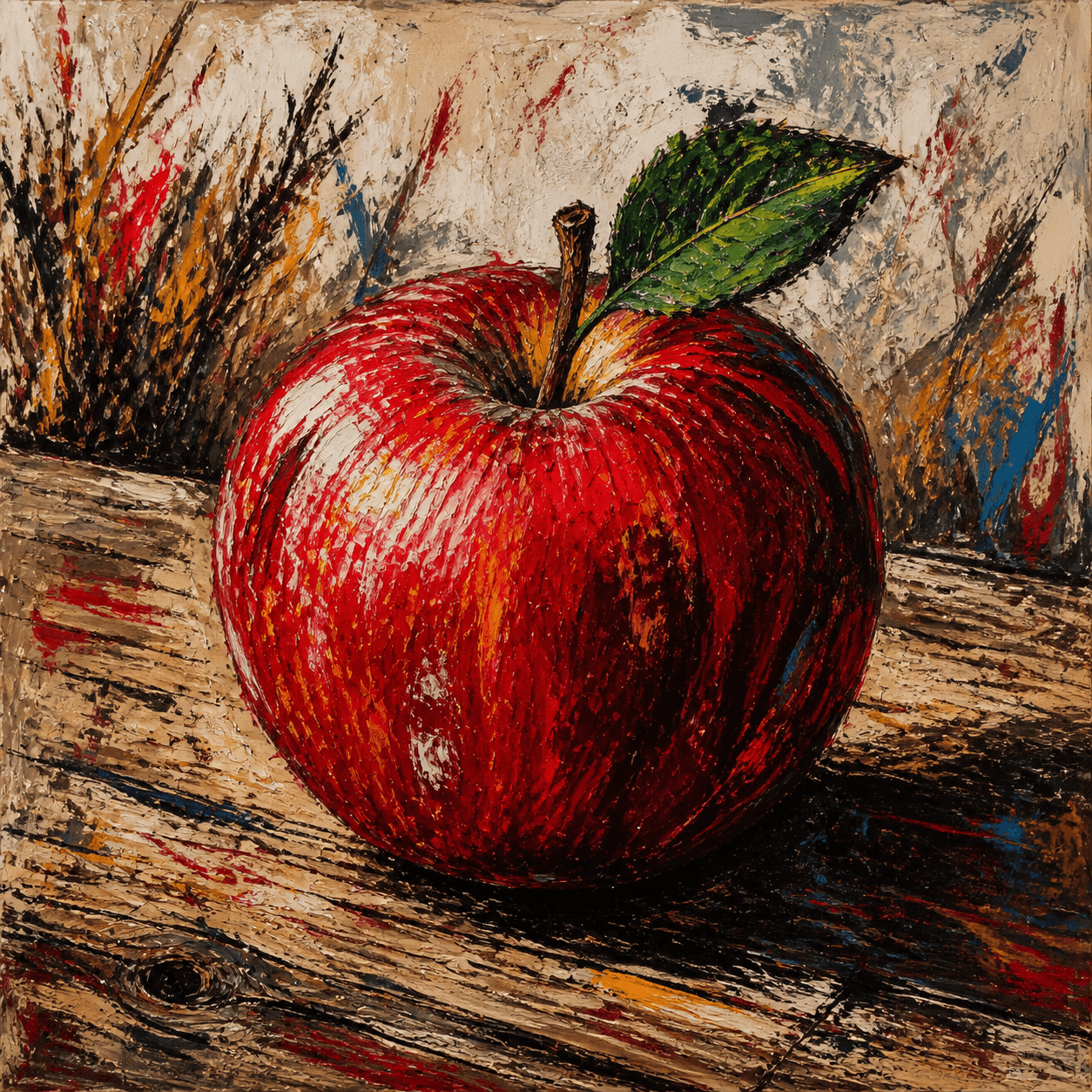
READ THE IMAGE
The apple remains recognisable, but every mark resists a smooth surface
Impasto, scraping, jumping contour, and red-black strokes invading the ground cue Neo-Expressionism. The point is not roughness alone, but renewed conflict among figuration, history, and painterly action.
- 01
Read build-up and removal
Red is dragged, piled, and scraped back, preserving manufacture like a wound.
- 02
Keep the image in view
The apple does not dissolve into pure abstraction; a recognisable object carries symbol, memory, and narrative.
- 03
Feel chromatic conflict
Red, black, ochre, and sharp blue reject natural light for heat, danger, and instability.
- 04
See the ground act too
Sweeps and splashes cross table, wall, and subject, turning the whole canvas into collision.
In one sentence
Not reviving early Expressionism—
but contesting painting anew in a postmodern context
Neo-Expressionism is a broad critical label for figurative painting resurgent across several regions in the late 1970s and 1980s. Large scale, forceful colour, rough touch, myth, body, and history returned amid debate over whether painting had ended after Minimal and Conceptual art. German Neue Wilde, Italian Transavanguardia, and New York scenes had distinct politics and cultures rather than one programme.
VISUAL LANGUAGE
Visual DNA
Surface
Heavy, distressed
Image
Legible yet distorted
Figures, animals, objects, and signs return without conventional realism.Scale
Monumental, frontal
Canvases confront viewers at bodily scale.Imagery
History, myth, street
Art history, national trauma, graffiti, and popular signs collide.Attitude
Tense, ironic
Claims of sincerity coexist with quotation, performance, and market awareness.Where it came from
‘Is painting back?’ becomes an international argument
Artists had already renewed figuration and narrative in the 1970s. In the 1980s museums, galleries, and markets bundled different national practices into a new painting wave. Women and non-white artists were often excluded from its heroic-male story, making the label itself a critical object.
Baselitz inverts the image
Upside-down figures and landscapes keep subject matter present while forcing attention to structure and surface.
Local painting languages gather
Artists in Germany, Italy, and the US revisit history, myth, body, and street imagery differently.
International exhibitions fix the label
The Venice Biennale, A New Spirit in Painting in London, and Zeitgeist in Berlin promote a transnational account.
Market success provokes backlash
Prices, celebrity, and heroic masculinity surge while appropriation and institutional critique challenge the story.
ARTISTS & WORKS
Meet it through four artists
Georg Baselitz
Used rough surfaces and inverted figures to interrupt narrative reading and influence younger German painters.Anselm Kiefer
Embedded straw, lead, ash, and heavy paint in German history, myth, and postwar memory.Jean-Michel Basquiat
Compressed anatomy, crowns, words, and Black history into urgent layered fields beyond the ‘street genius’ stereotype.Susan Rothenberg
Repeated horse outlines to join bodily scale, sign, and forceful painterly surface.How to recognise it
Read rough surface together with loaded imagery
- ✓Are impasto, scraping, drips, and revisions materially active?
- ✓Is recognisable imagery distorted, covered, or sign-like rather than traditionally realistic?
- ✓Do myth, history, bodies, or street language carry cultural conflict?
- ✓Does the work belong to the 1970s–80s response to conceptualised, low-gesture art?
STYLE RELATIONS
Three historical meanings of expression
Expressionism
Early-20th-century distortion responds to modern city, psyche, and social crisis.↗Abstract Expressionism
Postwar New York centres abstract gesture or colour field, process, scale, and psyche.↗Neo-Expressionism
Returns figuration, history, and rough painting within the postmodern 1970s–80s.CURRENTREFERENCES
Sources & image note
The apple is a contemporary teaching interpretation foregrounding impasto, scraping, and residual figuration. Neo-Expressionism is a contested international label, not one German or New York style.