
Printmaking
Risograph
The Risograph began as a high-speed office digital duplicator in 1980. Artists now treat its one-colour drums, translucent ink, dot grain, and registration drift as a language of independent publishing.
READ THE IMAGE
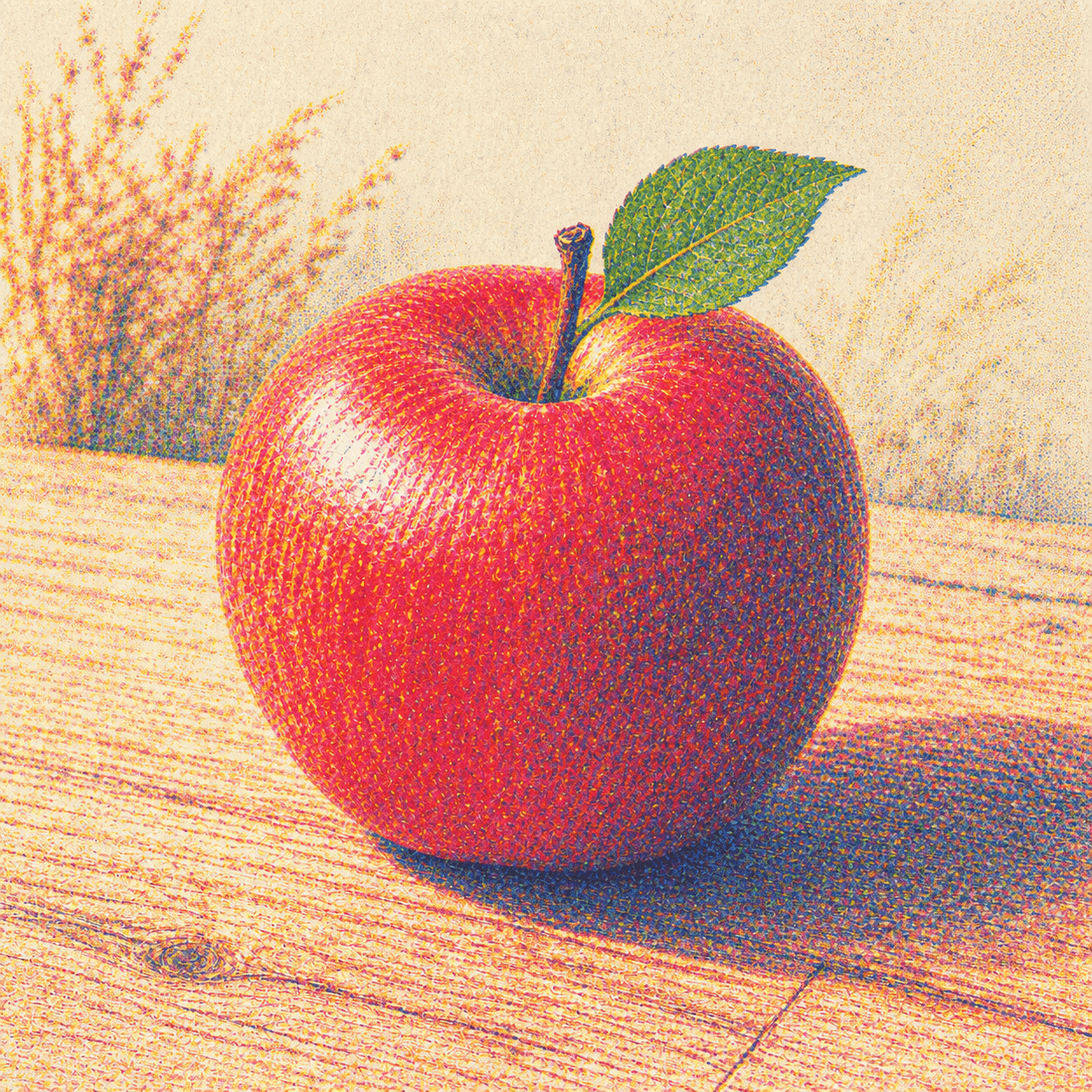
Pink, yellow, and blue do not imitate CMYK; spot inks mix through physical overlap
Magenta carries the fruit, yellow warms light, and blue builds shade and leaf green. Grain and edge shift remain visible, recording several separate passes through the machine.
- 01
Read spot colour
Fluorescent pink, yellow, and blue stay distinct before making orange, violet, and green at overlap.
- 02
Count repeated paper passes
Every drum change sends the sheet again, so feed and paper movement shift registration.
- 03
Let dots carry value
Screens or dither convert tone into proportions of holes that a master can open.
- 04
Watch ink enter uncoated stock
Colour dries matte and spreads slightly; heavy coverage may offset, show through, or band.
In one sentence
Turn a digital separation into a disposable master—
then push each spot ink through a fast rotary drum
Riso names a brand and digital stencil system, not every stencil print. The machine thermally makes a thin one-colour master and wraps it around an ink-filled drum. As sheets pass, ink moves outward through its holes. Each drum contains one spot colour, so multicolour work requires separation, drum changes, and additional passes.
VISUAL LANGUAGE
Drum DNA
Colour
Spot, vivid
Stencil
Ink passes through master
Every pixel resolves into open or closed area in a modern mimeographic process.Overlap
Translucent mixture
Few inks generate more hues, making separation a design act.Shift
Registration drifts
High-speed feeding and paper movement keep colour edges from perfect agreement.Run
Efficient in multiples
After master-making, copies move quickly and unit cost falls—ideal for posters and zines.Where it came from
From a postwar Japanese mimeograph business to office duplicator and independent-publishing tool
RISO began in 1946 as a mimeograph service and developed emulsion inks and master equipment in the 1950s. Its first RISOGRAPH system arrived in 1980; the 1984 RISOGRAPH 007 integrated master-making and printing. Surplus school and office machines later entered art studios worldwide.
RISO begins with mimeograph and ink
Noboru Hayama builds a printing business and develops domestic emulsion ink.
The first RISOGRAPH systems launch
Automatic inking offers low-cost, high-speed office stencil duplication.
Integrated and digital master-making
The 007 becomes a ‘printing robot’; digital input then broadens the workflow.
Independent publishers claim machine character
Zines, posters, comics, and art books turn shift, grain, and spot ink into identity.
ARTISTS & WORKS
Meet it through four practices
Noboru Hayama
Moves from postwar mimeograph service and emulsion ink to an integrated machine and ideal of accessible copying.Knust Press
Develops stencil-printed books from Dutch independent publishing and social movement contexts, becoming an early Riso reference.Temporary Services
Uses inexpensive multiples for collaborative distribution and debate about art labour rather than precious originals.Contemporary Riso studio networks
Reconnect design, printing, and community through workshops, art-book fairs, and small-edition exchange.How to recognise it
Read spot separations, paper, and machine error—not a coloured-noise preset
- ✓Can the image be decomposed into few spot inks with legible overlap colours?
- ✓Do separations shift slightly in a consistent feed direction?
- ✓Does value come from screen or dither rather than continuous spray?
- ✓Does matte ink sit in uncoated stock with show-through, offset, or drum variation?
STYLE RELATIONS
Three reproduction languages
REFERENCES
Sources & image note
The apple simulates three Riso spot inks, repeated feeding, and visible screening. Actual machines, drums, papers, and master settings produce different grain and shift, while fluorescent ink cannot be represented accurately on screen.