
Printmaking
Screenprint
Screenprinting turns taut mesh into a reusable stencil. A squeegee forces ink through open areas; each colour normally receives its own screen and printed layer.
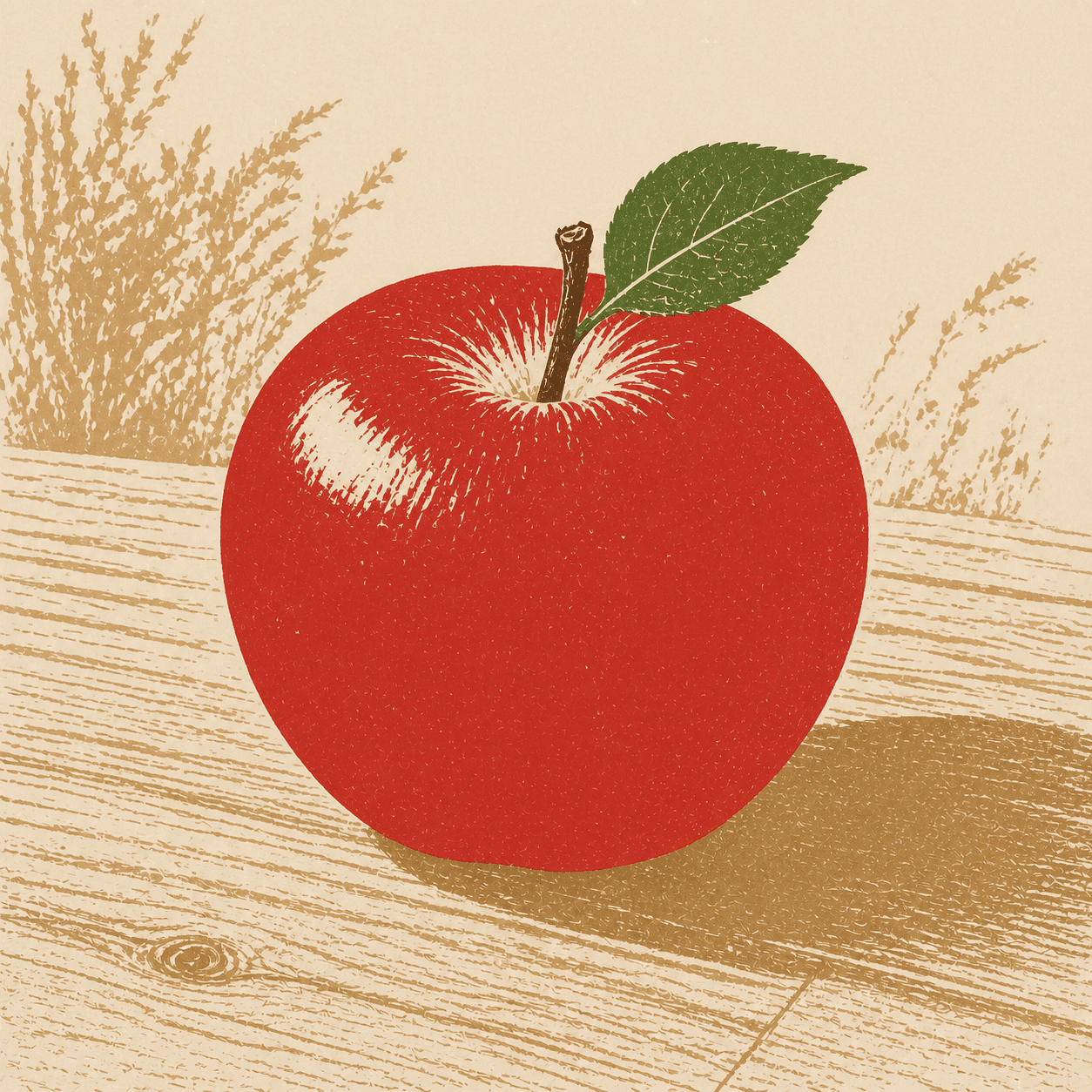
READ THE IMAGE
The red apple reads as one block, while highlight and leaf reveal the order of layers
Red, green, brown, and ochre appear pressed from separate screens. Paper or masking creates the highlight; small gaps remain at an edge. Few colours build the full image through placement and overlap.
- 01
Read one colour per pass
Apple red is a discrete plane; leaf and stem arrive separately rather than mixing wet.
- 02
Let reserve make the highlight
Blocked mesh stops ink so the support itself supplies light.
- 03
Create a third colour by overlap
Transparent or semi-transparent layers mix optically, and sequence changes the result.
- 04
Keep small errors as evidence
Shift, mesh texture, and uneven pull make an edition consistent but never perfectly identical.
In one sentence
Block the mesh that must not print—
use a squeegee to drive colour through everything left open
Screenprint is stencil printing. Silk or synthetic mesh is stretched on a frame, and cut stencil, film, or photo-emulsion blocks non-image areas. A squeegee presses ink through open mesh directly onto paper, cloth, wood, glass, or another surface. Multiple colours require separate screens and registration.
VISUAL LANGUAGE
Mesh DNA
Colour
Flat, covering
Stencil
Image equals open mesh
Blocked areas resist ink; openings define each colour.Pull
Pressure and angle show
Speed, blade, and ink load change edge and deposit.Layer
Registered by colour
Order, transparency, and overlap enlarge a limited palette.Surface
Pressless, adaptable
A screen reaches many scales and materials across poster, textile, and fine art.Where it came from
From stencil textile traditions and commercial signs to art about repetition, consumption, and public address
Stencil and woven-screen printing have long cross-cultural histories. Modern screen and squeegee systems entered commercial use in the early twentieth century. American artists adopted the term serigraph in the 1930s; Pop artists later made photo-stencil repetition and registration error into subjects.
Stencil and textile precedents
Blocking and passage serve pattern, cloth, and signage before the modern framed screen.
Commercial screenprinting
Durable stencils and squeegees support signs, wallpaper, packaging, and textile production.
The artistic serigraph
US artists distinguish creative editions through a new name and WPA-linked practice.
Pop and political poster
Warhol repeats photographic media while workshops and artists extend registered colour as public language.
ARTISTS & WORKS
Meet it through four makers
Corita Kent
Turns advertising type, spiritual language, and brilliant layers into distributable public speech.Andy Warhol
Uses photo-stencil, repetition, and slippage to turn commercial reproduction into a mechanism for celebrity, goods, and death.Jasper Johns
Builds transparent and opaque marks from thirty-one screens, proving screenprint can be slow and complex.Eduardo Muñoz Bachs
Within Cuban film-poster production, transforms limited means and hand printing into witty graphic images.How to recognise it
Read stencil edge, colour layer, and registration—not bright colour alone
- ✓Are fields flat and stencil-edged, with traces of mesh or squeegee deposit?
- ✓Can colours be separated into passes, with new mixtures at overlaps?
- ✓Does light come from reserve or another flat screen rather than continuous shade?
- ✓Do repetitions show slight shift, dropout, or ink variation?
STYLE RELATIONS
Three printing surfaces
REFERENCES
Sources & image note
The apple is a teaching interpretation emphasising limited spot colour, hard-edged reserve, and slight dropout. Actual screenprint ranges from one hand-cut stencil to complex photo screens and is not inherently distressed or retro.