
Classical Art
Symbolism
Symbolism treats the visible world not as a copy of reality but as an entrance into desire, fear, myth, and spiritual experience.
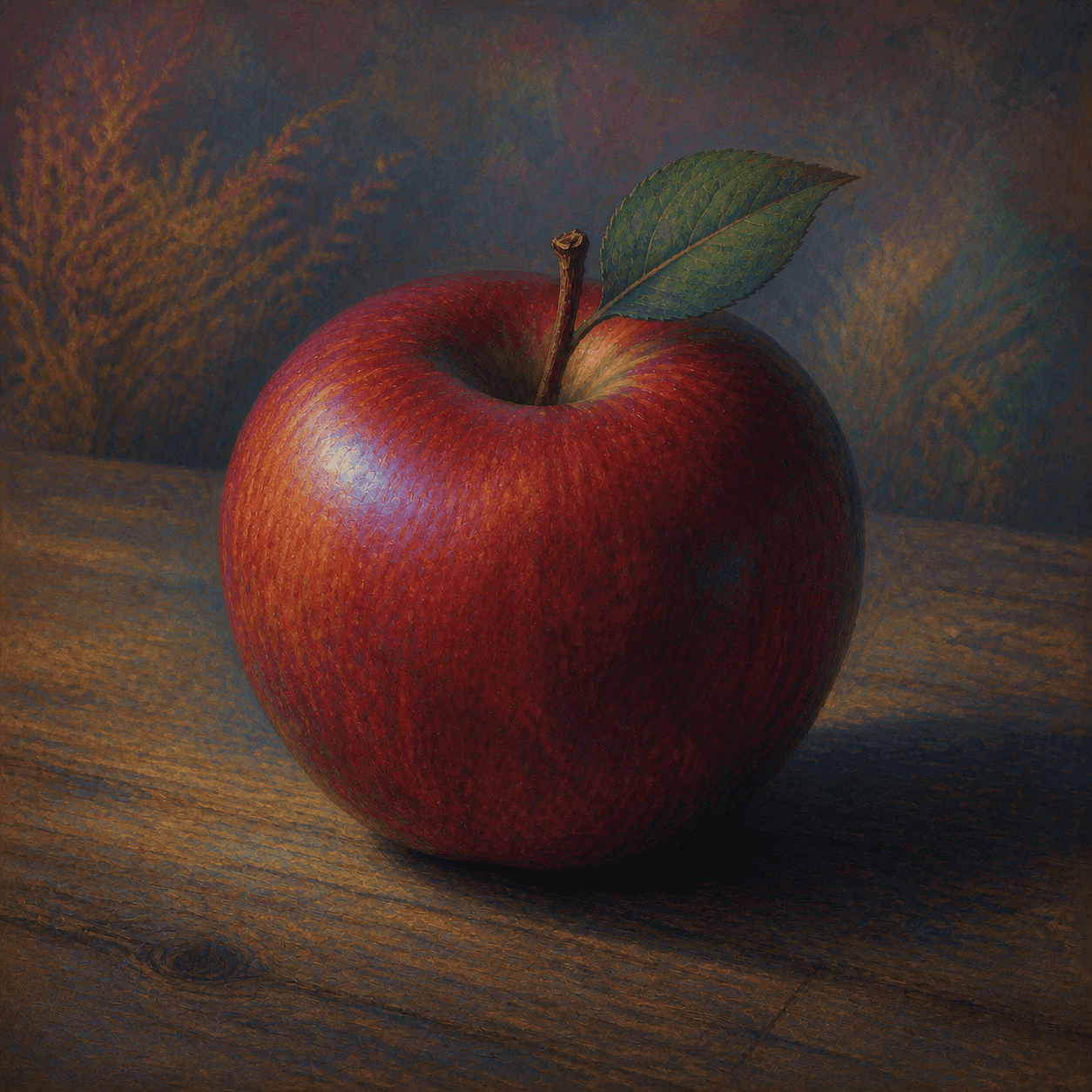
READ THE IMAGE
This apple is no longer only an apple: uncanny light makes it suggest
Violet-blue highlight, deep red skin, and dark space create a psychic atmosphere. This teaching image evokes Symbolism without assigning a fixed code.
- 01
See impossible colour
A cold violet highlight crosses warm red; colour stops obeying natural light and appears as inward emotion.
- 02
See the object isolated
Centred and enlarged as its setting retreats, the fruit can evoke temptation, knowledge, life, or taboo.
- 03
Let the background remain uncertain
Plants and shadow name no place; the space hovers between room, dusk, and dream, resisting closure.
- 04
Let atmosphere precede story
No complete event occurs, yet darkness, halo, and stillness create expectation for the viewer to complete.
In one sentence
Not fixed meanings attached to objects—
but form awakening ideas that cannot be pictured directly
Named first in French literature of the 1880s, Symbolism soon described artists who rejected Naturalist and Impressionist objectivity. They sought ideas, emotions, and inward experience through myth, scripture, dream, monster, musicality, and unnatural colour. No single style united them: Moreau is jewel-like and dense, Redon's noirs strange and weightless, Puvis simplified and mural-like, while Gauguin used flat colour and contour to construct spiritual space.
VISUAL LANGUAGE
Visual DNA
Meaning
Suggestion rather than explanation
Colour
Subjective, psychic, unnatural
Colour can carry mystery, desire, or anxiety without describing observed light.Subject
Dream, myth, religion, death
Ancient stories and private fantasy reach experiences modern society struggles to name.Form
Flattened or excessively intricate
Simplified fields and dense ornament both detach images from daily reality.Media
Poetry, music, and image correspond
Verse, stage, print, and decoration share rhythm, analogy, and synaesthetic ambition.Where it came from
In an age of science, city, and material progress, art sought the invisible again
Symbolism answered fin-de-siècle industrialisation, secularisation, and anxiety while inheriting Romantic subjectivity. Its escapes were not apolitical: distant places, women, and so-called primitive cultures often became screens for European male desire and colonial power.
Precursors build languages of myth and dream
Moreau, Puvis, Burne-Jones, Böcklin, and Redon depart from Naturalism along different routes.
Moréas publishes the Symbolist Manifesto
The literary movement gains a name around idea, suggestion, and anti-naturalism, soon linked to visual art.
International networks emerge
Gauguin and the Nabis, Les XX, Rose+Croix, and secessions expand Symbolist practice.
Symbolist languages enter modernism
Flat colour, psychic image, and dream method shape Art Nouveau, Expressionism, abstraction, and later Surrealism.
ARTISTS & WORKS
Meet it through four works
Moreau, Oedipus and the Sphinx
A mythic stare becomes psychic conflict among knowledge, desire, and death; precise detail rejects ordinary reality.Böcklin, Isle of the Dead
A white figure approaches cypress and rock tomb; enclosed silence turns death into sustained mood.Gauguin, Vision after the Sermon
Red ground, heavy contour, and flat figures place religious vision beside everyday believers, cancelling natural space.Redon, The Cyclops
A giant eye peers over a hill at a sleeping figure; soft colour joins monster, desire, and dream.How to recognise it
Do not reach for a symbol dictionary; see how the work generates association
- ✓Do colour, proportion, or space depart from observation to express a psychic state?
- ✓Are myth, religion, dream, or monster recombined rather than merely illustrated?
- ✓Does imagery remain polysemous, layering desire, fear, death, and spirit?
- ✓Do images of women, distance, or the ‘primitive’ carry fin-de-siècle gender and colonial fantasy?
STYLE RELATIONS
From the external world toward the inward image
REFERENCES
Sources & image note
The apple interprets Symbolist suggestion through uncanny highlight, isolated form, and uncertain space. It is not a fixed icon and cannot represent every international Symbolism.