
Japanese Art
Wabi-sabi
Wabi-sabi is not a beige interior style, nor does distressing or cracking an object automatically grant Japanese aesthetic depth. Wabi shifted in medieval tea from deprivation toward self-sufficient simplicity; sabi evokes time, solitude, and mellow age. Their force comes from use, selection, season, and relations among people and things.
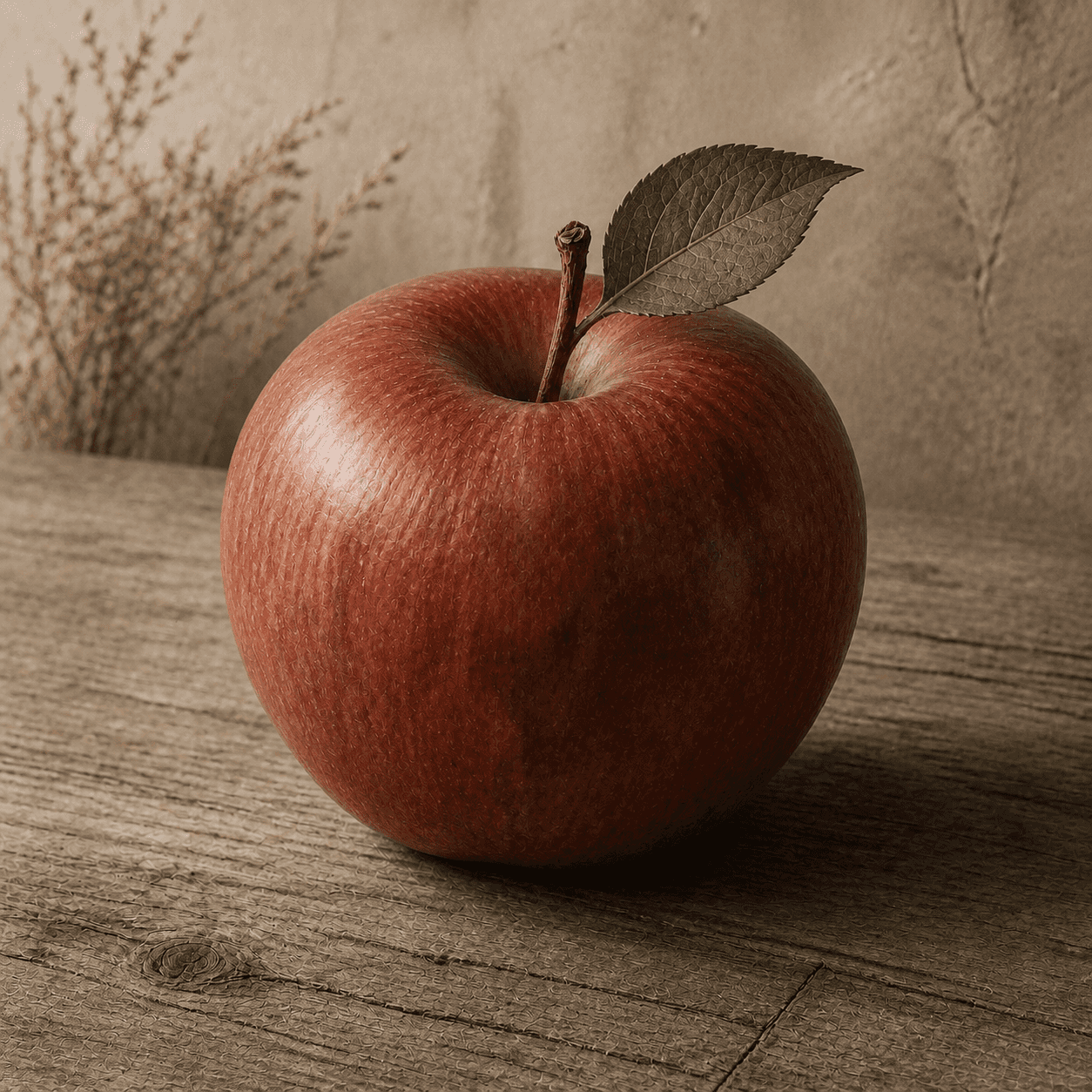
READ THE IMAGE
First ask whether these marks arise from time and use, not whether the palette looks tastefully grey
Worn wood, plaster, muted red-brown, and side light produce quietude. The apple remains unusually complete, symmetrical, and flawless, so it is only an entry into material and time.
- 01
See colour recede behind material
Fruit red turns earthen brown while wall, wood, and leaf share low saturation. Colour remains, but skin, fibre, and dusty absorption arrive first.
- 02
See side light expose rather than beautify texture
A narrow highlight grazes the apple, enlarging pits and abrasion; plaster and boards reveal different ways of swallowing the same oblique light.
- 03
See old wood record processes
Seams, knots, checks, and worn zones distribute unevenly like drying, load, and repeated touch, not one uniform distressed overlay.
- 04
See restraint in an incomplete scene
Branches barely register at back left while right side holds shadow and bare wall. Few elements relate through distance, season, and light without a catalogue of ‘Zen objects.’
In one sentence
Not a repeatable look—
but judgments trained through tea setting, object, use, and time
Wabi once carried senses of distress and frustrated poverty before medieval tea culture revalued it as inward sufficiency amid lack. Sabi relates to aging, solitude, and the mellow surface of years. Today they are commonly fused as wabi-sabi, though historical practice more often worked through wabi tea, connoisseurship, and poetic vocabularies. Murata Jukō, Takeno Jōō, and Sen no Rikyū did not simply reject luxury; they made learned choices among Chinese, Japanese, and Korean wares, using small rooms, natural materials, and exact etiquette to redefine value. Apparently rustic utensils could be deliberately produced, named, transmitted, and collected at great cost.
VISUAL LANGUAGE
Visual DNA
Material
Let earth, wood, bamboo, and ash remain themselves
Irregularity
Deviation must still serve use
Hand forming, kiln change, and natural ash leave differences, yet a bowl must meet lip and hand and cooperate with gesture.Time
Patina accumulates relationship
Wear, repair, smoke, and provenance record use; uniformly manufactured cracks cannot substitute automatically for duration.Assembly
Value occurs between things
A host selects scroll, flower, vessel, and incense for season, guest, and theme; a detached ‘wabi-sabi object’ loses much of the event.Restraint
Simplicity is highly controlled
Small rooms, dim light, and few objects reduce stimulus while route, gesture, cleaning, and sequence become exceptionally exact.Where it came from
From Chinese-treasure connoisseurship to thatched-hut tea, ceramic production, and the global modern idea of ‘wabi-sabi’
Wabi is not poverty itself. Powerful connoisseurs selected particular humble things into elaborate etiquette, while warriors, merchants, Korean potters, regional kilns, and collecting pedigrees all helped construct value.
Chinese treasure rooms meet Jukō's balance
Ashikaga shoguns collect Chinese painting and utensils; Murata Jukō seeks tension between Chinese and Japanese, polished and withered as thatched-hut tea develops.
Jōō and Rikyū deepen wabi tea
Kyoto merchants and warriors use small rooms, gardens, and humble materials amid war; Rikyū pushes four-and-a-half-mat and smaller spaces, low entry, and disciplined action.
Raku, Shigaraki, Bizen, Iga, and Oribe are reinvented
Tea people discover value in utilitarian ware while kilns learn to anticipate fire marks, distortion, and glaze flow; ‘natural’ surfaces and market taste shape each other.
Wabi and sabi merge into a global lifestyle category
Tea institutions, mingei discourse, English-language writing, and design condense wabi-sabi into beauty of imperfection, broadening influence while flattening conflict and ritual specificity.
ARTISTS & WORKS
Meet it through four objects and spaces
National Treasure tea room Tai-an
Roughly two mats of plaster, bamboo, timber, low entrance, and irregular posts recalibrate the body; a humble look rests on exact proportion and choreography.Chōjirō, black Raku bowl named Muichimotsu
Hand-built rather than wheel-thrown, black glaze suppresses ornament while the slightly irregular lip directs attention to palm, mouth, and matcha warmth.Kizaemon Ido tea bowl
Originally a Korean everyday bowl, its profile, glaze, and foot acquired supreme status through Japanese naming and transmission, exposing a value not intended at production.Iga water jar named Hotei
Coarse body, natural ash, fire marks, and deformation emerge from severe firing, then gain individuality through naming, boxes, provenance, and tea assembly.How to recognise it
Do not judge by swatch; ask about material, function, selector, and use history
- ✓Does irregularity arise from hand, fire, shrinkage, repair, and use or from a mass-produced surface effect, and does the thing still support holding, drinking, or movement?
- ✓Within which season, room, scroll, flower, and guest arrangement does it appear; is a standalone commodity borrowing the label?
- ✓Was the humble thing once Chinese treasure, Korean daily ware, Japanese farm vessel, or production tailored to tea taste?
- ✓Do cracks and losses have an explainable history and ethic of care, rather than romanticising damage itself?
STYLE RELATIONS
Tea judgment, monastic ink, and a modern minimalist look must remain distinct
Wabi-sabi
Builds relational value from time, material, use, and a particular assembly amid lack and impermanence.CURRENTZen Ink Painting
Organises image through ink, void, inscription, and monastic transmission; it is not the visual source of every wabi-sabi object.↗Minimalism
Modern art and design may reduce form through industrial material or conceptual systems without valuing patina or tea etiquette.↗REFERENCES
Sources & image note
Worn wood, plaster, side light, and earth colour suggest time and material, but the apple is intact, staged, and has no use history. It is a modern visual interpretation, not proof that an object possesses wabi-sabi value.