
Japanese Art
Zen Ink Painting
Zen ink painting is not a black-and-white minimalist filter, nor proof of an unpremeditated flash of enlightenment. It grew through Sino-Japanese monastic travel, temple collecting, poetic inscription, and shogunal patronage; abbreviated and splashed ink often rests on long training and exact construction.
READ THE IMAGE
Begin with how bare paper becomes light, air, and space left deliberately unsaid
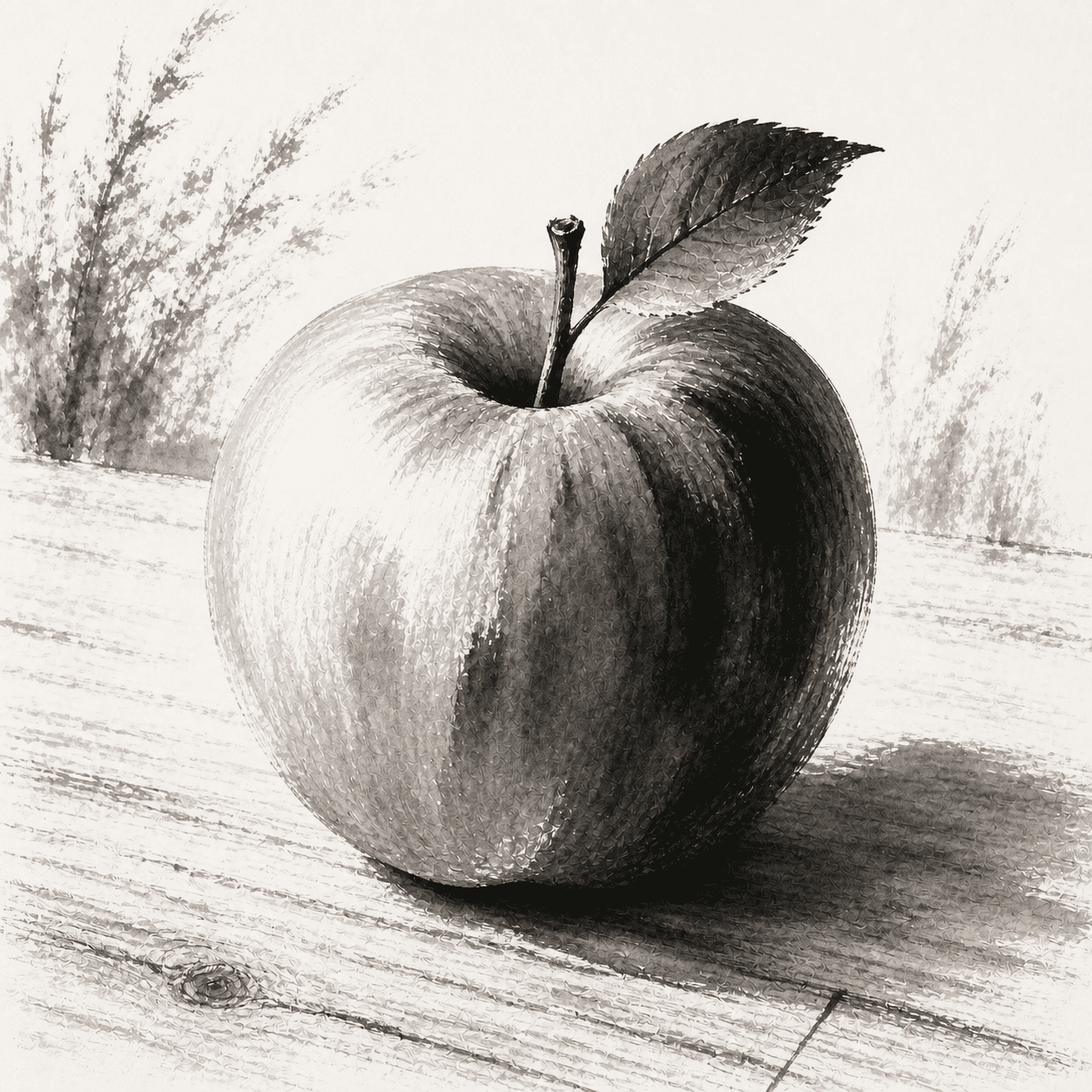
Graded ink, short modelling strokes, a wet background, and an off-centre black weight evoke Zen ink. The apple remains more fully modelled than many historical works and is not a replica.
- 01
See paper white, not white paint
The apple's left side is barely touched; the sheet itself supplies highlight, allowing fruit and surrounding air to emerge together.
- 02
See one ink divide into many values
Leaf, stem, and right edge approach dense black while the belly turns grey. Water load, repetition, and absorption widen one pigment into a scale.
- 03
See dry and wet brushes hold different times
Shorter, drier marks accumulate weight on the fruit; damp grasses dissolve behind it as if made in one breath, separating near and far speeds.
- 04
See asymmetry stabilise the void
The deepest dark gathers on right edge, leaf, and cast shadow while the left remains open. Unequal weight is pulled back by empty space rather than static centring.
In one sentence
Not every monochrome ink work—
but a way of seeing shaped by Zen institutions, poetic learning, and professional painting
After Chan Buddhism reached Japan, Zen became rooted in warrior and temple networks from the thirteenth century. Chinese prelates brought calligraphy, poetry, and Song–Yuan ink painting; Japanese monks who travelled abroad returned with images and habits of viewing. Zen painting includes Bodhidharma, Hanshan and Shide, Guanyin, and monk portraits as well as landscape and flora. Some works abbreviate or splash ink to appear swift; others are meticulously structured and slow to make. Close association does not mean every monochrome painting was made by a Zen monk or records sudden awakening.
VISUAL LANGUAGE
Visual DNA
Ink scale
One ink carries many colours
Void
The unpainted field composes
Bare paper can become mist, water, sky, light, or mental interval, directing limited marks beyond the frame.Abbreviation
Painting less requires seeing more
Contours contract to decisive turns and viewers complete a form from fragments; omission depends on trained command of models and brush.Writing
Brushwork retains bodily speed
Pause, drag, flying white, dryness, and bloom register the act of making; poem and seal may also enter the composition.Transmission
Improvisation rests on lineage
Chinese models, temple collections, master-pupil studios, and later schools give apparently accidental marks a teachable grammar.Where it came from
From Sino-Japanese Zen exchange to Muromachi landscape systems and their reinvention by later schools
Calling Zen ink simply ‘Eastern minimalism’ erases its institutions. Five Mountains monasteries were religious centres and hubs of diplomacy, Chinese poetry, collecting, and painter training; shoguns and warriors shaped taste through commission and connoisseurship.
Zen and Song–Yuan visual culture enter Japan
Chinese prelates and Japanese pilgrims carry icons, monk portraits, calligraphy, and landscape while Kamakura warriors support new monastic networks.
Monk-painters develop figures and ink play
Kao, Mokuan, Ryōzen, and others abbreviate Hanshan, Shide, Budai, and Guanyin as inscriptions join poetry, religious status, and image.
Muromachi ink becomes a professional system
Josetsu, Shūbun, and Shōkokuji painters serve the Ashikaga; Sesshū returns from Ming China to combine Southern Song design, observed place, and studio discipline.
Schools inherit and redefine Zen ink
Sesson, Kanō, Unkoku, and Hasegawa artists transform the Muromachi legacy; Hakuin and Sengai later renew Zen image through forceful brush and humour.
ARTISTS & WORKS
Meet it through four works
Kao Ninga, The Hermit Xianzi
The shrimp-eating eccentric turns through very few lines; abrupt robe folds make rough physical presence and spiritual wit coexist.Josetsu, Catching a Catfish with a Gourd
The paradox of trapping a slippery fish with a gourd joins more than thirty monk inscriptions, making one image a collective poetic-Zen inquiry.Tenshō Shūbun, Reading in a Bamboo Grove
Landscape organised around an ideal study, poetic inscriptions, and Southern Song recession shows that Zen institutions made more than spontaneous ink play.Sesshū Tōyō, Splashed-Ink Landscape
Up close, wet clusters seem abstract; at distance they gather into mountain, trees, hut, and figures. Its inscription records lineage and farewell.How to recognise it
Test brush, format, inscription, and monastic context together
- ✓Do bare paper, bloom, dry stroke, and graded ink actually organise space rather than merely desaturate a coloured picture?
- ✓Is the subject a patriarch, arhat, Guanyin, eccentric monk, or a landscape and flora made within temple collecting and poetry?
- ✓Do inscription, artist identity, temple provenance, or shogunal collection support the term Zen painting?
- ✓Is the work abbreviated figure, haboku landscape, monk portrait, or later Zen calligraphy, and are those distinct categories being flattened into one minimal style?
STYLE RELATIONS
Distinguish monastic ink, court narrative, and a later aesthetic concept
Zen Ink Painting
Uses ink, reserve, and calligraphic motion within monastic, poetic, and Sino-Japanese transmission networks.CURRENTYamato-e
Builds court and historical narrative through Japanese tales, seasons, famous places, and the time of an unfolding scroll.↗Wabi-sabi
A later aesthetic frame for imperfection, impermanence, and material trace—not a painting genre synonymous with Zen ink.↗REFERENCES
Sources & image note
The apple interprets Zen ink through bare paper, graded wash, dry-wet contrast, and off-centre dark. Its complete still-life modelling and modern teaching composition have no historical inscription or temple lineage.